
Basses are like wine: The can be red or white and the cause of many a headache!

TalkBass has been independent since 1998. Add your voice.
Create a free account to reply to discussions, view embedded media, and browse with fewer display ads.
Join free Log in
Want zero display ads or expanded classifieds tools? Compare plans.
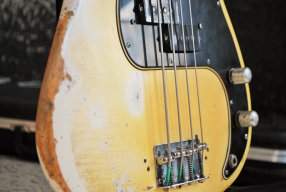



The bass department manager at my local shop also swears that an old instrument that has been played regularly develops a character to the wood on a cellular level from years of vibration at specific frequencies.




Holy crap you're right. I was so sure but somehow melded the bios of Leo Fender and Les Paul in my head. *** brain, ***...

If basses were like wine, I'd be at the store every other day getting another one.
I mean, no, there's nothing to that, nevermind what I said. I'll trade you those nasty old basses for new ones, just PM me.
I've thought about this too but not with regards to vintage. For me, a Precision bass is a Cabernet whereas a Jazz bass is a Pinot Noir. The former is thick, full, reliable, always gets the job done. The latter is temperamental, requires very specific context, can either fail miserably or soar to magical heights.
*I realize this is beyond bougie. I'm indulging my vices from a distance since I no longer drink. Humor me.
You're right about that. But it's not just collectibility. The reason people want them is not because they're expensive. They're expensive because people want them. And we want them because they're awesome. But yeah, try to convince others if you can. We'll take those old basses made of wood that just sat around before it was used, and pickups wound all irregular. And you can have the 2016 one with the same name on the headstock, but precision machined so you don't get any unsightly neck pocket gap. Everyone wins right?The price of something is what someone is willing to pay for it-----no measure of quality.
Right on-- supply and demandYou're right about that. But it's not just collectibility. The reason people want them is not because they're expensive. They're expensive because people want them. And we want them because they're awesome. But yeah, try to convince others if you can. We'll take those old basses made of wood that just sat around before it was used, and pickups wound all irregular. And you can have the 2016 one with the same name on the headstock, but precision machined so you don't get any unsightly neck pocket gap. Everyone wins right?




I had this in mind when I wrote my earlier post, above.
I knew a violin maker in 1995-96-97 who'd make violins & violas by hand from premium woods. Once the finish was dry and the strings on & tuned, he'd attach stereo earbuds to the (wooden) bridge and play music constantly into each instrument for weeks. This 'conditioned' the wood to musical-frequency vibrations and made his instruments more responsive, more resonant, and more full-sounding. A/B testing proved it: His instruments were more musical after this sonic conditioning.
The concept already intuitive to me, his violins sounded so richer that I could only follow through. After 19 years of ongoing exposure of my bass (a '97 G&L L-1500) to musical vibrations (playing daily, keeping it close to the speakers of my stereo) I believe that it is a better sounding instrument now than ever for the same reason.
Could you be more detailed about A/B testing?


