• TalkBass has been independent since 1998. Add your voice.
    Create a free account to reply to discussions, view embedded media, and browse with fewer display ads.
    Join freeLog in
    Want zero display ads or expanded classifieds tools? Compare plans.

Are class D amps tone affected by master volume level?

hi Johnau :)

Tone wise, would I be better off with a lower powered class D amp that would allow me to crank up the master volume some? Does the master volume level affect tone in a class D amp, such that the more its cranked possibly giving a fuller tone? Or does that not matter with class D amps?

The Fletcher - Munson crew has already spoken.

If you want both sounds,
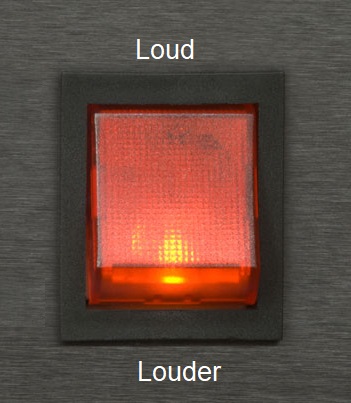
louder-Switch.jpg


(amp output) volume is a must! :D

That said: The tone is also in the fingers!

You can raise your volume using the knobs on your amp but also by playing with a harder touch.

The resulting tone will be very different! (attack and decay changing)

Playing harder => more attack and faster decay = the opposite of "full and round"!

the more its cranked possibly giving a fuller tone?

Playing with a lighter touch will result in a more even (fuller) tone coming from your instrument

=> enough added volume from your amp is crucial! Especially if you want a full and round sound.


But even if you are looking for a sound with a lot of attack (harder hit strings)

It never hurts to have more "master" than needed!

Your fingers only get as loud as they can,

but volume controls work in two directions! :D

Headroom is your friend!


greetings

Wise(b)ass
 
Thanks everyone for the insight. It does seem to me like there is some difference when I turn the amp up during a show. Which after reading to all your replies, I now believe is probably the speakers themselves coming alive and getting fuller, maybe some additional room reinforcement added in.
The music I'm playing is Americana, so other than compressor (which I have and will start using), I'm not sure what in the way of other pedals might be genre appropriate.
No it is literally that we perceive louder as better. Fletcher–Munson curve of our ear makes that.


I definitely hear more low end at higher volume.
Yes, because our ears are built that way.
 
  • Like
Reactions: agedhorse
I definitely hear more low end at higher volume.

Sure but that's what we mean when we talk about sound right? It's like color is a reflection of light in a particular way but no one says "that thing isn't really the color blue - it's just the way you perceive it." Of course but that's what we mean by "that thing is blue." Who's the intended listener to these amps/speakers? Humans I assume.

But that is a function of the actual volume, the sound pressure; not of the amp's power cappabilities or the position of the master. Imagine you like how your amp sounds when you have your master dimed and it's producing 120 dB more than when it's making 110 dB whith the master half way up; another amp that is exactly the same but smaller that makes 110 dB when you dime it, won't sound like big amp dimed. And a bigger amp will get there with the master at a lower setting.
 
  • Like
Reactions: agedhorse
Yeah you need more bass and treble at lower volumes, thus the loudness control on home stereo amps (see Fletcher-Munson curves)
This is what originally drew me to the Eden Time Traveler head which features boosts designed for lower volume situations. It’s a wonderful feature - surprising that other manufacturers don’t incorporate it.
 
Last edited:
This is what originally drew me to the Eden Time Traveler head, that features boosts designed for lower volume situations. It’s a wonderful feature - surprising that other manufacturers don’t incorporate it.
Mesa Boogie's line of Subway amps have Deep and/or Bright switches, some also have voicing knobs. Various Ampeg amps have Lo and Hi switches. Some of the Markbass amps have high and low band boosts... these are all in addition to the usual multiband tone controls.

I'm sure some are more effective than others, depending on how they're designed and where they're used, but boosts at frequency extremes are not unusual.
 
How could one eliminate the preamp section from the equation?
Assuming you have to set your overall level to mix with the rest of the band, it's not like you can dime your master volume for sonic effect, without turning down elsewhere.
I remember with the Quilter they encourage you to experiment with more gain, less master, then vice versa to alter the response. Probably no harm in trying that with other amps.
But, when a clip light is provided for setting input gain, I go ahead and use it. That usually gets me a lively (but not too lively) response with a sensible master volume sweep. Just like the manufacturers intended.
 
Thanks everyone for the insight. It does seem to me like there is some difference when I turn the amp up during a show. Which after reading to all your replies, I now believe is probably the speakers themselves coming alive and getting fuller, maybe some additional room reinforcement added in.
The music I'm playing is Americana, so other than compressor (which I have and will start using), I'm not sure what in the way of other pedals might be genre appropriate.
It's more likely your hearing, Fletcher Munson curves.
 
  • Like
Reactions: agedhorse
The preceding post that mentions Fletcher Munson curves is spot on, and super important to this discussion. Without getting too far down in the weeds we hear different frequencies, more or less well at different volume levels. Another fact of critical importance is the acoustical space within which we are playing. if you were playing live through any kind of speaker the room you are playing in will affect your tone. Generally speaking, the louder you are playing the more of an effect there will be. Google “standing waves acoustics” to learn more about why this is true. Like most of us on TB, I geek out over things like tone woods and. string choices in pursuit of the perfect tone. If I’m being honest with myself, the room I’m playing in and where my cabinet is in that room is more important to my tone than any of that stuff. Thats especially true in smaller rooms at higher volume levels.
 
Last edited:
Mesa Boogie's line of Subway amps have Deep and/or Bright switches, some also have voicing knobs. Various Ampeg amps have Lo and Hi switches. Some of the Markbass amps have high and low band boosts... these are all in addition to the usual multiband tone controls.

I'm sure some are more effective than others, depending on how they're designed and where they're used, but boosts at frequency extremes are not unusual.
I guess I never consider Bright and Deep and Ultra switches on Mesa, Ampeg, etc. were designed for F/M curves when playing at low volume. Cool.
 

Latest posts