BTW: You can take the springs off - they are completely useless. As soon as you make any adjustment to the saddle when there’s even a tiny bit of string tension, the spring is doing absolutely nothing (except maybe rattling).

Enjoy the benefits of a premium membership!
Upgrade Account
-
TalkBass has been independent since 1998. Add your voice.
Create a free account to reply to discussions, view embedded media, and browse with fewer display ads.
Join free Log in
Want zero display ads or expanded classifieds tools? Compare plans.
You are using an out of date browser. It may not display this or other websites correctly.
You should upgrade or use an alternative browser.
You should upgrade or use an alternative browser.
Are high mass bridges actually... Bad ?
- Thread starter Romain909
- Start date
More options
Who Replied?
Check if the neck screws are holding the neck. My guitar player gave me an Epiphone branded bass that MGR said had a twisted neck. Well one of the screws is just turning endlessly., So it was being held by 3 crews and the subtle lift made it look like a twist. Toothpick woodglue and redrill and now It is already 3 times better. I may still have to shim it. I have started to use copper or aluminum foil tape as shims. This bass once setup with new strings will go to a young bass player.
Unless it is a thick uneven material and you have gaps, I haven't heard or seen shims be detrimental to sound.
Unless it is a thick uneven material and you have gaps, I haven't heard or seen shims be detrimental to sound.

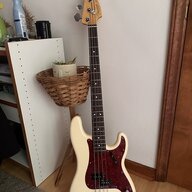
I took this bridge off of one of my precisions for the same reason. The fender 58 posted above did the trick.My experience with this bridge has been good, but obviously there is an issue you need to deal with. If you do decide to swap, try to find a bridge with a similar footprint, as this one will have left a mark, like @DrBnz points out.

It will certainly fit, but the problem with replacing a Fender hi-mass bridge with a bent-plate bridge is that it has a smaller footprint, and the hi-mass often leaves a visible mark on the body which the new bridge will not cover.I took this bridge off of one of my precisions for the same reason. The fender 58 posted above did the trick.
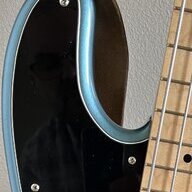
I had a similar rattle when playing the open A string on my 2010 CIC Squier with the stock high-ish-mass bridge. One day, I stuck my pick between the string and the spring as a temporary fix, and the rattle didn’t come back when I took the pick out.
My wild guess is that I bent the spring just enough to add a little tension and/or kill the sympathetic vibration. If it comes back, I’ll just stick the pick in there again - cheaper and easier than a new bridge!
My wild guess is that I bent the spring just enough to add a little tension and/or kill the sympathetic vibration. If it comes back, I’ll just stick the pick in there again - cheaper and easier than a new bridge!

Hello guys.
I own this amazing Fender Ultra Jazz bass (with an OUTSTANDING vintage correct Avant Guard pickguard).
But I have 2 issues with my bridge.
1st : the E strings saddle rattles. If I push the saddle against the base of the bridge, behind the string, the rattle stops.
Sometimes, when I push the saddle backwards against the spring, the rattle can stop. But it is not an exact science, sometimes it is just there.
Before you mention it : the strings are changed every 3 - 6 months (DR), the string is not swirled or twisted but perfectly straight, and the adjustment screws are perfectly leveled on the bridge. Also, it is not amazingly noticeable in my amp, but it 100% sucks the vibration of the string and dampers the sustain. I can feel it more than I can hear it.
2nd issue : The E and G saddles are almost maxed out, and yet the bass still has a 2.4mm / 2.5mm action on the E string at the 17th fret (with a perfect 0.3mm relief at the 7th fret). So, with this bridge, I would need to shim the neck to lower the action further. So this bridge, by design, does not allow to go too low - which is unfortunate given how often JB necks go forward..
Question :
Would you guys swap the bridge ?
I like vintage bridges. Would you go for it ? I am super tempted to try one on the Ultra.
I would say that I prefer modern standard bridges (like those on the American pro II but they use 3 screws, not 5).
View attachment 7349747
View attachment 7349746
I had the same issue on a Squier Dimension V string bass which had this high mass bridge. I ended up routing the neck pocket down from its 14mm to 17mm where it should've been to start with. The bass set up properly afterwards, though i sold it on later on because it wasn't getting much play time vs my 4 string bass.
Are high mass bridges actually bad: i don't think they are, just depends on if the instrument is properly built to accept it to its full potential.

This is certainly a consideration. When replacing a Fender Hi Mass w/ a much smaller 2 saddle bent plate the original bridge did leave small circular indentations exposed.It will certainly fit, but the problem with replacing a Fender hi-mass bridge with a bent-plate bridge is that it has a smaller footprint, and the hi-mass often leaves a visible mark on the body which the new bridge will not cover.
But they were very slight and can only be seen at certain angles. After everything was complete, thankfully it turned out to be a non issue.

I disliked the original bridge on my 60's Vintera Jazz. Replaced it with a HiMass bridge. HiMass is much better than original, IMO.
It all depends on how deep the indentations are (this will vary with the tightness of the screws and the softness of the body wood), and how much such things bother you in the first place.This is certainly a consideration. When replacing a Fender Hi Mass w/ a much smaller 2 saddle bent plate the original bridge did leave small circular indentations exposed.
View attachment 7350792
But they were very slight and can only be seen at certain angles. After everything was complete, thankfully it turned out to be a non issue.
View attachment 7350793
View attachment 7350798
I hate marks on the body, and will go to considerable lengths to avoid them, others may have a more relaxed view.


Next time I change my strings, I ll take the bridge off, out of curiosity. I ll see if the marks are slight or deep. The bass has a very very thick layer of coating. If it is just a shallow trace, it can be buffed off with some car polish and could allow to install a vintage bridge.
Again, I have 2 issues. The saddle rattling and eating some of my string’s vibration (which might be fixable, I agree with you on this), AND the bridge being too thick, not allowing to get enough control over the action. It is not bad as it is right now, but I have played basses with a lighter action
Again, I have 2 issues. The saddle rattling and eating some of my string’s vibration (which might be fixable, I agree with you on this), AND the bridge being too thick, not allowing to get enough control over the action. It is not bad as it is right now, but I have played basses with a lighter action
It might marginally improve stiffness of the whole system. Otherwise, not much difference. I like the feel of something that is more advanced than something even I could knock up in the garage with some metal and a vice and some bad language.Useless IMO. Bail for something lighter and more adjustable. I don't get how a heavier chunk of metal between string and body would have a positive impact on tone.
No, it won't take away anything based on the physics of the system.They certainly matter and have an impact on sound. I put one on my P bass and immediately went back to the old bent metal stock one. The high mass one took the air out of the sound. It took away the bark and the hair around the notes. It gave the bass a weird EQ and felt mainly subtractive in its effect. If you think about it for even a few seconds it makes no sense that a thick block of metal could add anything to the sound. It's going to take away. How could it not?
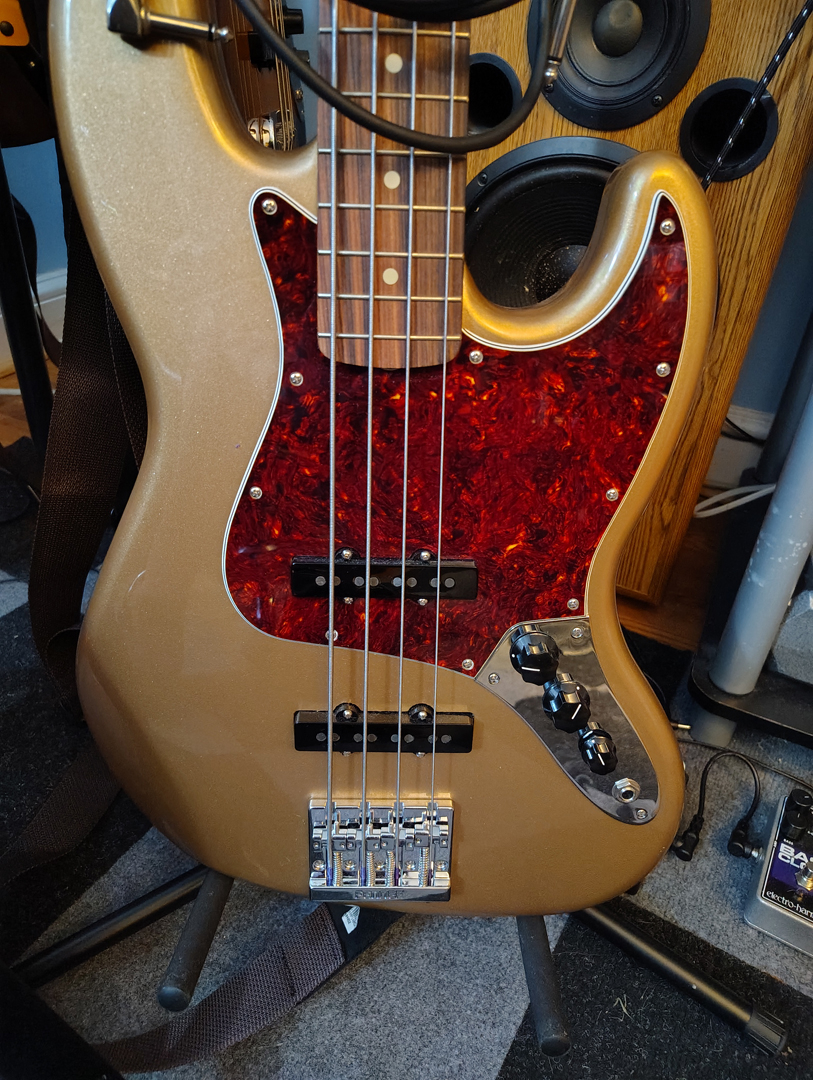
Here's the HiMass on my 60's Vintera Jazz... easiest upgrade I've ever done on a bass.

Old thread but was wondering why this issue only affect a few basses and players. Is it more likely that people love to play with high action, or that their basses neck somehow do not need to adjust for the elevated height? Since Squier/Fender neck pockets seem to be standardized, I do not know the answer.hi mass bridges add height too so the strings will sit higher even if the saddles are bottomed out. a vintage bridge will fix that.
I am dealing with this, looks and weight are fine, but the bridge is too tall. Forget vintage, even Babicz bridges do not have this issue, so I deem it a flawed design if you have to either file the saddles or shim the neck (only acceptable, IMO, if the bridge is designed to be filed, like some Badass were.) There should be enough adjustment available to make them too high and too low on purpose.
Not a hater myself-I love vintage bridges when they make sense, but sometimes a more modern bridge also makes sense for basses either for style or weight issues; however, the modern bridge should always be at least equal in functionality to the original, rather than worse.
Do MiM Player II Modified basses have any filing done in factory to their bridges? Those use the same bridge I am attempting to use, and I doubt they are trouble as otherwise many would be returned. I am also using the same neck. Will update if I find a solution today.
I am in no camp, prefer Babicz only because they work great in the functionality department over vintage and modern bridges, but do not want to buy one for the particular bass. Both old and "new" bridges should work without messing with the bass, otherwise you are making the bridge the main point of your instrument, which does not make sense to me.
"High Mass" bridges are also tall on the Gotoh model, not just Badass or Fender models. It seems like an inherent flaw, unless it is duly noted on all packaging that the saddles are guides and must be filed further. My opinion-no need to be offended.
Last edited:

Saddles bottomed out causing rattle plagues many different types of bridge. Sounds like addressing that issue is the first step. Maybe a neck shim to raise the neck at the pocket and therefore allow the bridge saddles to be set to a normal height.
I installed the Fender HiMass bridge on 3 of my basses and IMHO... it is a superior bridge to the original in every case. I despised the vintage stock bridge on my Vintera 60's Jazz. Some people like those.... to each, his/her own, but not my thing. Basses that I've upgraded with HiMass........
Fender Player Precision Limited Edition
Fender Vintera 60's Jazz
Squire Precision Antigua
Fender Player Precision Limited Edition
Fender Vintera 60's Jazz
Squire Precision Antigua
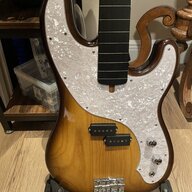
I put a Hi Mass on my Squier VMJB mostly for the fun of it. I think swapping the borderline non-functioning electronics had a bigger impact and I don’t feel like A/B-ing the bridges after the fact. Nowadays, I don’t really think about tonal impacts and care more about the functionality of the bridge itself, ie. base plate slots or ridges to prevent lateral movement, quick change slots, grooved saddles, and most importantly: aesthetics. I’m looking at this Gotoh bridge mostly because I’m not the biggest fan of ridged sides:


In the world of classical string instruments and double basses, "high mass" usually = mute (dampening of vibrations), be it on the bridge, fingerboard or (mainly) soundboard. That's why you add a tourte-style rubber or wooden mute to the bridge to deafen the tone and volume of your instrument.
OTOH, electric instruments, solid bodies and pickups work quite differently, so I don't really know if that could partially translate here.
OTOH, electric instruments, solid bodies and pickups work quite differently, so I don't really know if that could partially translate here.

Latest posts
-

-
-
 The Bartolini BH2: Why Does It Sound So Dark? My EHB1265MS Experiments
- Latest: groovaholic
-

