• TalkBass has been independent since 1998. Add your voice.
    Create a free account to reply to discussions, view embedded media, and browse with fewer display ads.
    Join freeLog in
    Want zero display ads or expanded classifieds tools? Compare plans.

Double Bass Are Kay basses really worth it?

If you’re going to go the Kay route, I would definitely just play what you have and wait for a deal to come up on Craigslist or such. The Kays I’ve seen for $3K-$5 are immaculately cared for, upgraded, or minty original with no noticeable issues. I’ve seen more recently great deals where I’m at (So. TX) where you can find one cheap that needs a proper setup and some luthier work (neck resets, new fingerboard, etc.). That being said you will probably have to have it worked on to get it sounding good, but once properly repaired and setup, they can be wonderful, road-worthy instruments. I’ve played a ‘51 Kay M-1B for 28 years but I’ve sunk about $2K into mine over the years and it was well worth it. It has had a neck reset, new ebony fingerboard, ebony tailpiece and a Deuce bridge. Mine is also custom painted and it sounds surprisingly good acoustically for a painted instrument and it is thunderous amplified. The thin neck can cause your left hand to cramp up if you’re not properly warmed up, but so can any double bass IMO; so this takes some getting used to.

As others have said, I didn’t specifically seek out a Kay though—it was literally the only DB I could find at the time I started playing upright and the price was right ($75 and a trade of an early 80’s Rickenbacker 4001 that needed some truss rod love) and it was sturdy enough to allow my 19 year-old (much lighter version) of myself to stand on and do stage antics with. I look back now and I can’t imagine why I would have even attempted such things on my lovely old Kay; except for the fact that our guarantee went up by $100 a show just because I played a double bass.
 
I don't think anyone's mentioned here how well Kays tend to amplify, though. That's a thing.

I had all but forsaken my old vintage ply bass in favor of my new(er) boutique hybrid. When I amplify the two side by side at very high volumes, though, the plywood bass says 'hold my beer' and shows the hybrid how it's done.

The things that make the Kays less than awesome acoustically and under a bow (like the low overstand) I suspect are the very same things that give them their edge in feedback prevention.
 
They are like mid 1950s Chevys: A well known commodity that are easy to find, easy to work on, and they have been the gateway bass for almost every top player we know of. Like Zoot says, they can handle a TON of power amplified and just shrug it off where my fancy carved basses crumble and feedback the entire night.

If we got rid of every old Kay on the planet, what would the kaybashing haters complain about???????
 
Last edited:
uh, I imagine a ply Christopher is just as unresonant and good to amplify as a kay is. Perhaps the neck angle is more modern but it's hard to find a Kay that hasn't had a neck reset anyways. (I seem to be the only person who likes the original Kay neck angle. I dig the lower tension but that is neither here nor there...)
 
Last edited:
uh, I imagine a ply Christopher is just as unresonance and good to amplify as a kay is. Perhaps the neck angle is more modern but it's hard to find a Kay that hasn't had a neck reset anyways. (I seem to be the only person who likes the original Kay neck angle. I dig the lower tension but that is neither here nor there...)
+1 Yeah, I always attributed the amplification thing to laminate basses in general. Who knows, maybe Kays are particularly good in that regard, but I doubt it.
 
  • Like
Reactions: Joe Olson
They are like mid 1950s Chevys: A well known commodity that are easy to find, easy to work on, and they have been the gateway bass for almost every top player we know of. Like Zoot says, they can handle a TON of power amplified and just shrug it off where my fancy carved basses crumble and feedback the entire night.

If we got ride of every old Kay on the planet, what would the kaybashing haters complain about???????

Oh, don't worry ... there are plenty of things to hate!:D

I don't hate Kays; I just don't get the allure. I think there are better choices in the plywood realm for the same or less money, even brand new.

In 1975 (when I drove a '56 Chevy with 80k miles on it I bought for $75 that burned a lot of oil and was infected by rust), my Kay was smashed in an accident. (I guess that makes me a Kaysmasher). I went to my local luthier, who advised me that "I could do better than another Kay." The German plywood shop bass I bought sounded good and didn't need work for the next 30 years.

Even nowadays, I've played several Kays in shops, as well as some brand-new plywood basses; the Kays haven't compared well acoustically. And if you want a bass to use amplified exclusively, some of those rockabilly models might serve better ... you can stand on them!
 
Last edited:
They are like mid 1950s Chevys: A well known commodity that are easy to find, easy to work on, and they have been the gateway bass for almost every top player we know of. Like Zoot says, they can handle a TON of power amplified and just shrug it off where my fancy carved basses crumble and feedback the entire night.

If we got rid of every old Kay on the planet, what would the kaybashing haters complain about???????
We’d just move on to Engelharts!
 
Last edited:
Another 51 here. Mine is a C1 that I bought from Steve Azola 23 years ago, doesn't even have a Kay brand on it, probably was an OEM for Sears. Since then I've had a new bridge made for it and the fingerboard planed and painted, yes painted, once. It makes a big boom and rattles windows with my current 6 year old set of gut strings on it. I've oiled those once and lightly sanded some hair off of the G string maybe twice. They stay in tune almost as well as the Evahs on my carved bass.

Not saying that people don't have problems with gut strings, just that I never have.

But if I were in the market for a ply bass now for BG, i would be looking around for an Engel. They are basically the same, and I see those with what looks like a good setup for under $1K. Get an Engelhardt, put a Kay emblem on the tailpiece, and everyone will be satisfied.

This guy, Kyle Perkins, fixes and sells american plywood basses and has a house full of them at any time. He has American Standards, Kays (many Swingmasters, etc...), King Moretones, Engels, Gibsons, everything. But guess what he plays?


 
Find a luthier to work with you on getting your Christopher set up with gut or synthetic strings for the music you want to play.

I've played a few good Kay basses, one of which was owned by a luthier's wife. They can be good, but they're not magic..you have two good basses now. I don't think chasing a mythical Kay is going to be a game changer for you.
 
Sometimes I get suggestions from other bass players and non-bass players about what equipment I should use. I say, "OK, I'll keep that in mind" and keep on going.

For bluegrass I have been well satisfied with my carved Romanian with Bel Canto strings.

I'd be willing to bet that it's not the actual tone/sound of the bass these unwanted comments are responding to, but rather something about the notes and time feel you're playing.
 
I often think it curious when someone posts an OP, gets several replies and questions in response, and doesn't come back to the thread they started. Yeah, it is a good thing that not everyone is tied to these forums as some of us, but generally if I care about something enough to start a thread, I care enough to check back in on what I started.

Oh well - at least we are able to entertain ourselves endlessly repeating our couple of opinions! ;)
 
I play both a Kay and 16 year old Christopher regularly and when I went to steel core strings on the Christopher I found that I can get just about as much of a booming tone out of the Christopher. Not quite a 100% matchup, but it's surprisingly loud. I went with Helicore Pizz lights and love them.

One advantage of the newer bass is that it's less fragile and will hopefully require less repairs in the near future.
 
  • Like
Reactions: Joe Olson
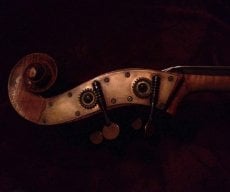
Each Kay bass is unique. I currently have three (front to back): 1950 C1, 1950 M1B, 1941 S-9. I’ve owned and played modern factory basses, too, but for the bluegrass and country music I play Kay basses make a lot of sense and never need apology. Plus, if I ever want another Eastman, or a nice Shen Hybrid or a Thomann, I can order one.


FE3C605C-96E6-4CA0-BA86-8541B14FEE7F.jpeg
F15F41E8-601F-4034-AEB2-F5FD7E93F5DD.jpeg