
Enjoy the benefits of a premium membership!
Upgrade Account
-
TalkBass has been independent since 1998. Add your voice.
Create a free account to reply to discussions, view embedded media, and browse with fewer display ads.
Join free Log in
Want zero display ads or expanded classifieds tools? Compare plans.
You are using an out of date browser. It may not display this or other websites correctly.
You should upgrade or use an alternative browser.
You should upgrade or use an alternative browser.
Are some basses built to have higher action?
- Thread starter TheIndieKid
- Start date
More options
Who Replied?


It's a great little bass. Don't get me wrong, I'm a perfectionist, and you can see that in my questions on Talkbass about the bass. But the build is great.
I hear you. I got the Huntington-I because I was intrigued by what I had heard about the piezo - which is something I've wanted to like but usually found lacking in any bass I know of but one.
In the case of the H1 the implementation is …um…rather unique. And I'll confess I'm not particularly wild about it nor do I use it very much. As a straight mag pup shortie however it's a very nice bass. Really like the neck. And loaded with a set of Pressurewounds, its sonic pallet really opens up compared to the flats it came with. So yeah, I'm slightly disappointed about the piezo. But I do like everything else about mine.

Last edited:

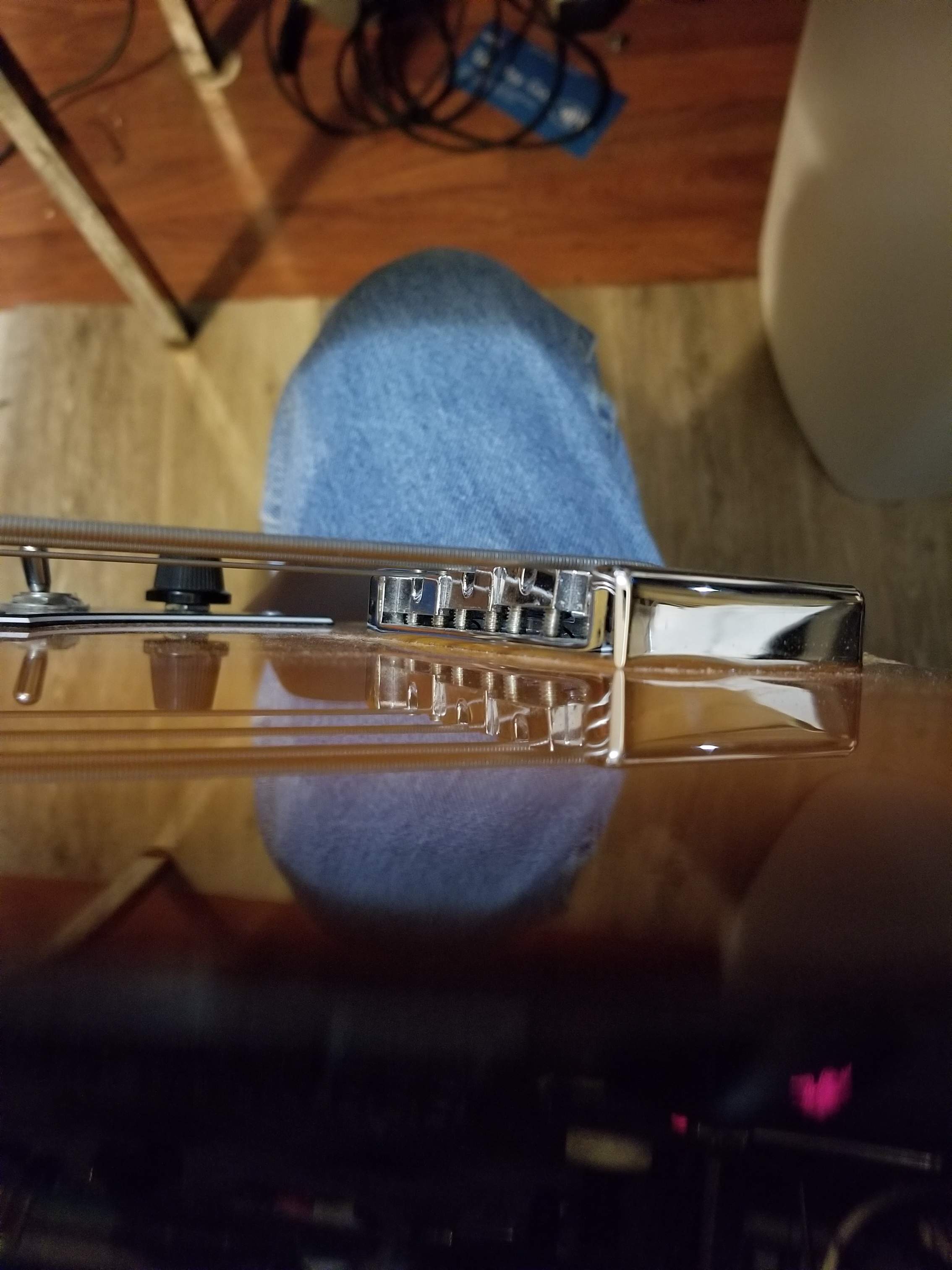
Here's a look at the screws / saddles on mine. The action of the G at 12th fret is about 1.6mm, which is pretty low.
I want to, but it's become a stiff. I'm worried I'll break it if I go further.
You could remove the string tension, then tighten the neck a bit so it's not fighting the string pull while straightening it.

It's tight when I've loosened the strings ):You could remove the string tension, then tighten the neck a bit so it's not fighting the string pull while straightening it.
Good advice. Counteracting the string pull during truss rod adjustment. Besides ... 3/64" is just 1.2mm - that IS low action, isn't it? Just make sure that the individual bridge saddles are supported through the adjustment screws.You could remove the string tension, then tighten the neck a bit so it's not fighting the string pull while straightening it.
If You don't trust yourself in this or if you think something is wrong with the instrument, consider taking it to an experienced technician or - if the bass is under warranty - take it to where you bought it and have them fix it for you.
Last edited:
Three or four years ago I bought a new American vintage Hot Rod Precision with a high mass bridge and could never get the action low enough, I finally bought a vintage bent plate bridge and have plenty of adjustment now, the base plate of the high mass bridge was too thick, don't know what they were thinking. The bent plate bridge looks a lot better too.
Even that might be normal. Tight is OK, very tight is not OK and stuck is unacceptable.It's tight when I've loosened the strings ):

Going a little flatter on the neck relief will get your action lower. That plus lower tension strings will get it even lower. I know your relief is already minimal but it makes a difference to go even flatter.
I would think higher tension strings would get you lower.

I've seen basses where the travel of one of the components did not suffice to adjust for a perfect setup.
I myself do own at least one bass where some of the screws are all the way in or all the way out, maxing out one setting in order to assure a clean intonation. I don't mind that as long as it's working. When the whole thing shifts a bit with age, I do hope it'll be towards the direction I can adjust, though. Otherwise I'll have to take it to some professional. But I'll cross that bridge when I get there.
Here's two cents to the literal question in the title:
I'd say yes. Every bass has a sweetspot where the sound and playability and ergonomics and whatnot just meet up. I have a bass that is intentionally set up with the action way higher than it could be, because the whole thing feels and sounds better that way. It's hard to describe, but it feels like it was meant to be set up this way.
My 6 string feels best when it's as low as possible.
I myself do own at least one bass where some of the screws are all the way in or all the way out, maxing out one setting in order to assure a clean intonation. I don't mind that as long as it's working. When the whole thing shifts a bit with age, I do hope it'll be towards the direction I can adjust, though. Otherwise I'll have to take it to some professional. But I'll cross that bridge when I get there.
Here's two cents to the literal question in the title:
I'd say yes. Every bass has a sweetspot where the sound and playability and ergonomics and whatnot just meet up. I have a bass that is intentionally set up with the action way higher than it could be, because the whole thing feels and sounds better that way. It's hard to describe, but it feels like it was meant to be set up this way.
My 6 string feels best when it's as low as possible.

<snip> Currently, I'm looking at 3/64 on the G and 4/64 on the E.
Is that string height measured at the highest fret? In my book, that's pretty low action!
If what's bothering you is that it feels hard to play in the middle of the neck, most likely the neck has too much relief. For me, about .010" relief measured at the 6th/7th fret feels good.

JeezyMcNuggles
Inactive
- Feb 23, 2018
- 14,723
- 20,970
- Disclosures
- I suck, but nobody really notices
Even with specs, fret work, and all the bells and whistles, how you play is what really determines how low your strings can go.I wouldn't go so far as to say a bass was specifically built to have high action. I think it'd be more accurate to say some basses are capable of being set up for lower action than others.
Many makers specify a recommended action height in their setup guides. How far you can deviate from that depends on the individual bass. And on a set neck instrument, where you don't have the option of shimming if needed, you're going to be more limited in your range of adjustments.
There's nothing unusual about that. It's just the way it is.

Ric5
Inactive
- Jan 29, 2008
- 29,772
- 30,452
- Disclosures
- I like 5, 8, 10, and 12 string basses
I've attempted to set my Supro Huntington up with low action. Currently, I'm looking at 3/64 on the G and 4/64 on the E. However, the G saddle is touching the base of the bridge and just doesn't look right. It feels like the screws should be visible under the saddle. Therefore, are some basses built for higher action?
no 2 pieces of wood are exactly the same so each bass neck will be a little different

Unless it's (piezo) in the bridge saddles the only harm you'd do is shortening the saddle height adjustment screw holes. Can't tell for sure if there's any kind of detail on the bottom of your bridge saddles so if they are flat on the bottomget some different grits of sand paper and a window pane. Tape the paper on the glass and work the underside of your bridge saddles down some. The only real danger is going far enough to cut into the hole where your intonation screw threads in. Get a set of cheap digital calipers and keep your saddlee close to the same thickness. Whatever you take off the bottom will be how much lower you can drop your saddles.I wish. There's a piezo below the saddles. I think the odds are stacked against me.

I can get it down to about 3/64" on the G string with about 0.08" relief. ...
Are you sure? That relief (2.03mm) sounds like verging on unplayable to me, and with an action of only 1.2mm, I'm struggling to see how that's even possible without buzzing and choking all over the place. Did you not mean 0.008" (0.2mm), which would be just about perfect?
Sorry, yes that's right. I always get these measurements wrong.Are you sure? That relief (2.03mm) sounds like verging on unplayable to me, and with an action of only 1.2mm, I'm struggling to see how that's even possible without buzzing and choking all over the place. Did you not mean 0.008" (0.2mm), which would be just about perfect?
At the 17th!Is that string height measured at the highest fret? In my book, that's pretty low action!
If what's bothering you is that it feels hard to play in the middle of the neck, most likely the neck has too much relief. For me, about .010" relief measured at the 6th/7th fret feels good.
I love high action.
...but I digress. I hope you find a solution.
...but I digress. I hope you find a solution.
I haven't heard of anyone using 3/64" on the G, especially with only .008" of relief. I'm not sure why you think those specs are doable or even desirable. Maybe if you use that bass for tapping and nothing else, or if it's a fretless. Even for a fretless I wouldn't expect those numbers to work.At the 17th!
I tend to play with a really light touch. I don't play technically, but I like comfort. Furthermore, I move my hand further from or to the neck/bridge if I want dynamics, without turning up.I haven't heard of anyone using 3/64" on the G, especially with only .008" of relief. I'm not sure why you think those specs are doable or even desirable. Maybe if you use that bass for tapping and nothing else, or if it's a fretless. Even for a fretless I wouldn't expect those numbers to work.
Latest posts
-

-

-

-
 What I am finding out with regards to playing as I grow older
- Latest: fishdude101101
-
