• TalkBass has been independent since 1998. Add your voice.
    Create a free account to reply to discussions, view embedded media, and browse with fewer display ads.
    Join freeLog in
    Want zero display ads or expanded classifieds tools? Compare plans.

Double Bass Arm Weight

So I've recently come to realize that I do not understand the concept of using arm weight to produce a big sound.

I play French and have been having some pain in my right hand because of this. Also, the skin under my thumb nail has a tendency to rip back because I squeeze really hard in order to play loud. Because I've been doing this for so long, I do not know how to play any other way.

Can anyone describe in laymen's terms (if possible) the concept of using arm weight? How does one apply it properly and what should it feel like if it's being done right? Thanks.
 
I recently learned this myself as a student, and so I do not know I do exactly, just that by now most of the time, it clicks. A relaxed shoulder and a grip on the bow with your index finger rather far up the bow, with the thumb and second finger acting as the center of a pivot, and the two last fingers helping to stabilize and affect the bows rotational movement as well as slight support in lifting the back end to help push the front end.

Important points:
*don't grip the bow with your fingertips, use all of your hand.
*No fingers should be completely straight. Especiall the thumb needs to be sligtly curved.
*you should be able to freely adjust the bow angle.

Also, try holding your bow upside down, by rotating the arm 180 degrees clockwise. This is the way the forces involved will act when the bow is on the string.

However, I'm not a teacher. These are my personal interpretations of instructions by my teacher(s).
 
Imagine your arm is a piece of meat -- a dead fish, or a long cut of beef tenderloin. If someone were to pick your arm up and let it go, it would fall helplessly to your side. It helps to actually have someone do this with you.

Next, take your bass and put yourself into a natural playing position. Have somebody hold your still-dead arm over the fingerboard and let it drop. There should be a healthy crack as your relaxed arm falls onto and sticks into the board. If the landing is gentle, you're probably holding some weight. If the arm falls off the board, you may want to reassess your playing position.

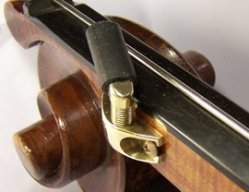
Now that you understand the sensation of having a fully relaxed arm with the weight directed into the strings, the trick is to keep that sensation while holding a bow. Your fingers should be doing very minimal work: never squeezing or clenching. In fact, most of the bow weight itself should be supported by the string. The pads and flesh of your fingers and thumb should provide enough surface friction to gently hold the bow without letting it drop. You may find this approach easier with a rubber tube on the stick and frog.

This is something most people have a hard time with, adults in particular. You've spent most of your daily life actively using your muscles. Letting your muscles relax and work passively may not come naturally, but it will almost certainly result in less pain/fatigue and a better core sound if you learn to apply it.
 
Good advice above. As always, this stuff is easier to teach in person. Seasoned orchestral players are good at conveying this type of playing; nobody wants to crank away with hand tension in a section for 30 years.

How is your setup? When was your last rehair? Are you playing on a good quality bow? Is your soundpost attended to correctly? Can you draw a sound in a relaxed fashion without applying downward pressure? Have you played with bow placement and speed rather than pressure for increased volume? Are you playing in the center of the pitch with your left hand?

These are some of the usual suspects. Fixing these sort of problems can take time. Are you studying with a good teacher currently?

Also, "big" sound isn't necessarily "good" sound. Strive for warmth, focus, and control. Be patient and relax. If you're forcing it, you ain't doin' it right.
 
I've never liked the term "arm weight". I find it kind of a cliche, and not really helpful. I agree with all the advice above however. The goal is to be relaxed as possible, to spread the work around from fingers to shoulder and back, and avoid stressing one particular point in the chain. Also, like Chicagodoubler said, make sure your equipment is optimized and compatible. This doesn't necessarily mean you have to go out and spend gazillions on a better bass or bow. An example: I was develping shoulder problems playing on a big modern five string in orchestra. I switched from playing my "liebes" bow to a cheap Chinese snakewood, and the problems went away. My very excellent bow was simply a bad match for this bass.
 
I always like to say- you can fight gravity short term, but gravity will always win." :)

Call it what you will; a relaxed approach to the bow is the only way to sustain a career. I've seen far too many young men in arm braces, careers cut short by tension and foolishness.