So, I've had a chance to use the XLR to Cat cable converters and just wanted to post a follow-up.
Skipping to the conclusion, I have to say I think they're absolutely awesome (even an exciting development) for my applications. Although they've been picking up use and commentary for a few years now, I was unaware of them. From the previous thread, I saw that some, but a seemingly small number of people here on the forum, have been using them. Having tried them out now for some different situations, I think these deserve a lot of attention and would be of great benefit to people who have circumstances similar to mine. Basically, if you're not a sound tech, are reading the live sound forum, looking to streamline setups, looking for time savings, you should consider these.
There are several good youtube video going over them
Again, this is the most basic use of cat cable for audio; i.e., simply as a 1:4 physical replacement for XLR cables, and in that, functionally, it's not offering anything that hasn't been available for ages in fantail snake cables and sub snake/drop boxes. They are however, generally smaller, lighter and less expensive that tradition snake options. The criticism that each unit is limited to 4 channels is fair and is what it is. Intuitive (gut level) skepticism of various aspects like fragility and susceptibility to noise/interference is somewhat understandable but unfounded. If you already have an investment in snake cables and sub snakes, then you'd have little interest. If, on the other hand, the whole of your cabling involves running a number of 20'-35' XLRs, they offer an improvement.
My circumstances (which don't think are uncommon) are that I have a small range of recurring scenarios where some amount of cable runs for setup are on us as non-sound tech band members. The way things have gone for me, sub snakes and snake cables have been parts of sound guy or venue kit or maybe a band member who goes deeper into the system (virtually becoming a sound guy), not something that "the band" or individual members have been equipped with. So far, I've geared up with a pair of the fantail boxes, a 26' flat cat6 cable (added Neutrik ethercon carriers), a 20' ethercon cable, and a few sets of gender changers.
3 scenarios so far...
1) One usual full-band scenario is where we are using our IEM rig with house/hired sound and are responsible only for wired IEM runs (In may experience, in there cases, techs don''t consider it helpful for band members to do any cable runs, I presume because it messes with their process and directly knowing how everything is connected).
This past Friday was a small-stage full-band gig with house sound, and the dummer and I are on wired IEMs. On the stage, I put the male box near my pedal board, plugged two fantail ends directly into my headphone amp, and plugged a 10' XLR cable into a fantail end and handed that to the drummer. I plugged in the tail ends for the other box at the mixer and then ran the flat cable between the boxes. Technically, this was instead of running 3 25' XLRs (I could have used a two-channel snake cable for my ears or just run mono).
I understand that "on paper" and intuitively, that just doesn't seem like a big difference (The trade is running three longer XLR cables for one cat cable and still using a short XLR, but to me, this is one of those situations where the benefit feels so much greater than the sum of the differences. Setup and tear-down both seem markedly neater and easier.
2) Another full-band scenario is where FOH is run off of our IEM rig and/or hired sound is only responsible from the split or to run our mixer.
Here, with the boxes, I've run my ears on 1 and 2 and had gender changers on 3 and 4 for my mic and DI. I can plug in may ears and DI at the pedal board and only need a short XLR for the mic, so, this is a 4 to 1 replacement of cable runs.
This was may setup yesterday
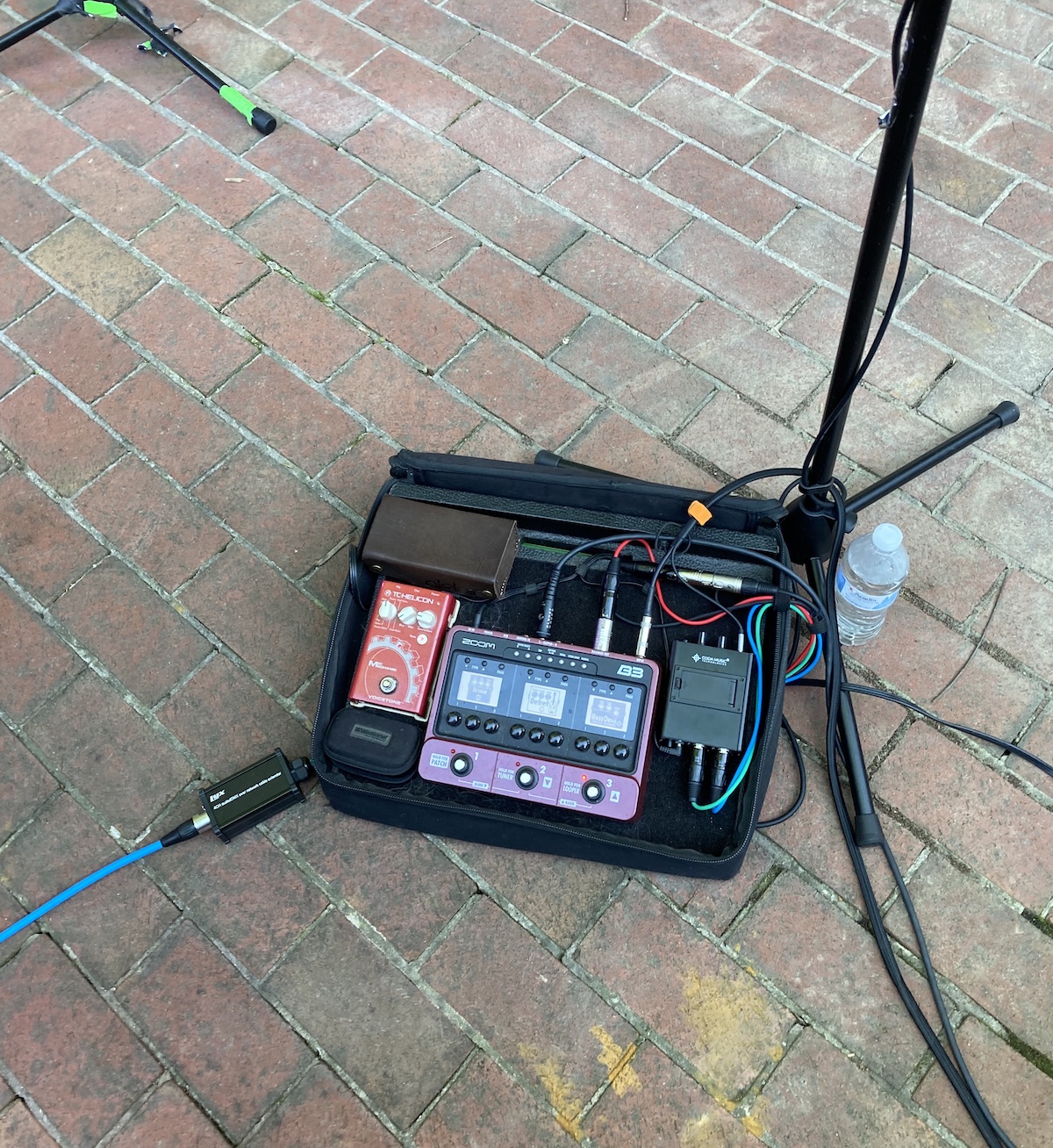
3) A third usual scenario is acoustic duo/trio gigs where we use an analog mixer, tops on stands and may or may not use wedges (generally no IEMs or anything wireless) and run a bunch of XLRs.
Last Saturday was a trio gig (no amps, no IEMs), and I put a box on the front line and connected the three mics and my DI and ran the ethercon around to to mixer where I had plugged the fantail ends in, so again, a 4 to 1 replacement of 20 and 25' XLRs. Again, just neater and quicker seeming.
I'm completely sold on the utility of the fantail version of the boxes. At the mixer end, in the case of an IEM rack, they plug directly in and can be left setup and in the rack. On the other end, I'm finding that at least some can be plugged directly in, and any 6' and 10' cables that need to be used just feel so much easier to to carry, handle, setup, and roll than 20-30' XLR cables.
On the cat cables, I'm absolutely not convinced of any significant benefit or need to use ethercon cables or connector carriers for for my use...more demanding use like touring, part of venue kit, part of hired production kit, or other frequent/heavier-duty use, sure, they make sense.
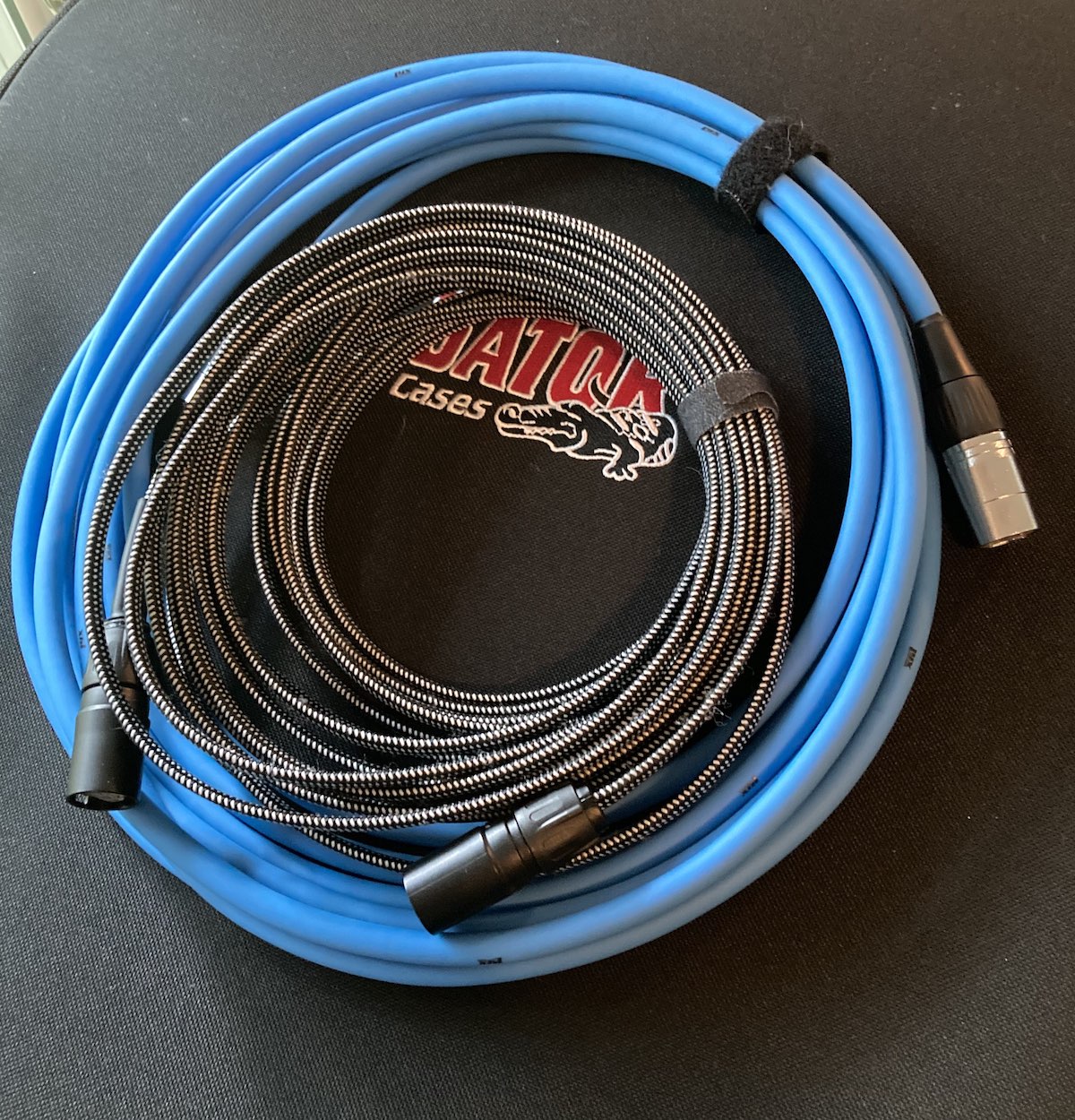
A couple of brands of ethercon cables are ~$1.50/ft. They are thicker than most XLR cables and weigh fully twice as much as some available cat cable for generic use. The shielded Cat6 cable I got has nylon braid and seems at least as robust as any other cable I have, maybe more so.
The bigger cable is 20' and the smaller 26'
What I can see doing from here is kind of building up a collection of these and finding the best uses for them over time. Things will get faster, lighter and easier. The rehearsal room where there are spaghetti piles of XLRs might be a project.
Skipping to the conclusion, I have to say I think they're absolutely awesome (even an exciting development) for my applications. Although they've been picking up use and commentary for a few years now, I was unaware of them. From the previous thread, I saw that some, but a seemingly small number of people here on the forum, have been using them. Having tried them out now for some different situations, I think these deserve a lot of attention and would be of great benefit to people who have circumstances similar to mine. Basically, if you're not a sound tech, are reading the live sound forum, looking to streamline setups, looking for time savings, you should consider these.
There are several good youtube video going over them
Again, this is the most basic use of cat cable for audio; i.e., simply as a 1:4 physical replacement for XLR cables, and in that, functionally, it's not offering anything that hasn't been available for ages in fantail snake cables and sub snake/drop boxes. They are however, generally smaller, lighter and less expensive that tradition snake options. The criticism that each unit is limited to 4 channels is fair and is what it is. Intuitive (gut level) skepticism of various aspects like fragility and susceptibility to noise/interference is somewhat understandable but unfounded. If you already have an investment in snake cables and sub snakes, then you'd have little interest. If, on the other hand, the whole of your cabling involves running a number of 20'-35' XLRs, they offer an improvement.
My circumstances (which don't think are uncommon) are that I have a small range of recurring scenarios where some amount of cable runs for setup are on us as non-sound tech band members. The way things have gone for me, sub snakes and snake cables have been parts of sound guy or venue kit or maybe a band member who goes deeper into the system (virtually becoming a sound guy), not something that "the band" or individual members have been equipped with. So far, I've geared up with a pair of the fantail boxes, a 26' flat cat6 cable (added Neutrik ethercon carriers), a 20' ethercon cable, and a few sets of gender changers.
3 scenarios so far...
1) One usual full-band scenario is where we are using our IEM rig with house/hired sound and are responsible only for wired IEM runs (In may experience, in there cases, techs don''t consider it helpful for band members to do any cable runs, I presume because it messes with their process and directly knowing how everything is connected).
This past Friday was a small-stage full-band gig with house sound, and the dummer and I are on wired IEMs. On the stage, I put the male box near my pedal board, plugged two fantail ends directly into my headphone amp, and plugged a 10' XLR cable into a fantail end and handed that to the drummer. I plugged in the tail ends for the other box at the mixer and then ran the flat cable between the boxes. Technically, this was instead of running 3 25' XLRs (I could have used a two-channel snake cable for my ears or just run mono).
I understand that "on paper" and intuitively, that just doesn't seem like a big difference (The trade is running three longer XLR cables for one cat cable and still using a short XLR, but to me, this is one of those situations where the benefit feels so much greater than the sum of the differences. Setup and tear-down both seem markedly neater and easier.
2) Another full-band scenario is where FOH is run off of our IEM rig and/or hired sound is only responsible from the split or to run our mixer.
Here, with the boxes, I've run my ears on 1 and 2 and had gender changers on 3 and 4 for my mic and DI. I can plug in may ears and DI at the pedal board and only need a short XLR for the mic, so, this is a 4 to 1 replacement of cable runs.
This was may setup yesterday
3) A third usual scenario is acoustic duo/trio gigs where we use an analog mixer, tops on stands and may or may not use wedges (generally no IEMs or anything wireless) and run a bunch of XLRs.
Last Saturday was a trio gig (no amps, no IEMs), and I put a box on the front line and connected the three mics and my DI and ran the ethercon around to to mixer where I had plugged the fantail ends in, so again, a 4 to 1 replacement of 20 and 25' XLRs. Again, just neater and quicker seeming.
I'm completely sold on the utility of the fantail version of the boxes. At the mixer end, in the case of an IEM rack, they plug directly in and can be left setup and in the rack. On the other end, I'm finding that at least some can be plugged directly in, and any 6' and 10' cables that need to be used just feel so much easier to to carry, handle, setup, and roll than 20-30' XLR cables.
On the cat cables, I'm absolutely not convinced of any significant benefit or need to use ethercon cables or connector carriers for for my use...more demanding use like touring, part of venue kit, part of hired production kit, or other frequent/heavier-duty use, sure, they make sense.
A couple of brands of ethercon cables are ~$1.50/ft. They are thicker than most XLR cables and weigh fully twice as much as some available cat cable for generic use. The shielded Cat6 cable I got has nylon braid and seems at least as robust as any other cable I have, maybe more so.
The bigger cable is 20' and the smaller 26'
What I can see doing from here is kind of building up a collection of these and finding the best uses for them over time. Things will get faster, lighter and easier. The rehearsal room where there are spaghetti piles of XLRs might be a project.


 ) and someone else takes care of them.