• TalkBass has been independent since 1998. Add your voice.
    Create a free account to reply to discussions, view embedded media, and browse with fewer display ads.
    Join freeLog in
    Want zero display ads or expanded classifieds tools? Compare plans.

B string gauge: I'm confused

SoVeryTired

Endorsing nothing, recommending much
Jul 2, 2011
4,933
358
Milton Keynes, UK
I'm trying to work out what sort of gauge would give the best B string (on a 35" bass). With the idea of balanced tension in mind I got a .135 - the B turned out to be a bad string but it felt huge. I then got a set with a .125 - not bad, but noticeably 'floppier' in feel and sound compared to the other strings. Part of my brain says that thick string = higher tensions = clearer sound. The other part says thick string = thick sound.

I'm looking for clarity and brightness above thump and fatness.

Is there a simple answer to this?

 
I find a .135 B string just right. Most folks will tell you that indeed thicker strings = thicker sound, thinner strings = brighter, snappier sound but I've seen many exceptions to that rule. It may apply as long as you're talking about the same exact string (like a GHS Boomer .135 vs a GHS Boomer .125) but strings vary my manufacturer.
 
I'm trying to work out what sort of gauge would give the best B string (on a 35" bass). With the idea of balanced tension in mind I got a .135 - the B turned out to be a bad string but it felt huge. I then got a set with a .125 - not bad, but noticeably 'floppier' in feel and sound compared to the other strings. Part of my brain says that thick string = higher tensions = clearer sound. The other part says thick string = thick sound.

I'm looking for clarity and brightness above thump and fatness.

Is there a simple answer to this?

Simple answer? Thicker string = higher tension. Lots of five string players prefer taperwound; it offers a much cleaner witness point at the saddle.

On the 34" 5's I used to own, I used an untapered .145. Higher tension, but it didn't sound quite right. I think tapered would've been perfect for my need. My 35" fives wore taperwound .130 and sounded good.
 
Simple answer? Thicker string = higher tension. Lots of five string players prefer taperwound; it offers a much cleaner witness point at the saddle.

On the 34" 5's I used to own, I used an untapered .145. Higher tension, but it didn't sound quite right. I think tapered would've been perfect for my need. My 35" fives wore taperwound .130 and sounded good.

Interesting. I've heard conflicting things about taperwounds, some saying they're more likely to intonate badly or produce strange sounds higher up the neck. But if they offer more clarity in the lower register, I could probably live with that.

Edit: I should add that my only experience with taperwound was the bad .135, so I can't really speak from experience.
 
I just put my first set of taper wound strings on my 5 and I like 'em a bunch, punchy and clear as a bell. I did have to make some major intonation changes (the B, E, and A saddles had to come waaay forward), and raise the saddle height on the taper wound strings; but it wasn't any more difficult that setting up any of my other basses or guitars.
 
I just put my first set of taper wound strings on my 5 and I like 'em a bunch, punchy and clear as a bell. I did have to make some major intonation changes (the B, E, and A saddles had to come waaay forward), and raise the saddle height on the taper wound strings; but it wasn't any more difficult that setting up any of my other basses or guitars.

And what gauge B are you using?
 
I was always a .105" E player on 4-string. I like the higher tension feel of the .136 B on a 35" scale. .102 on 35" is about equal to .105" on 34".

.142" on 35" was amazing, but really a bit more than I needed.

[edit] The 34" 5-string I'm referring to is a Carvin LB75 that was just amazing for sustain anyway. Putting the .142" set on it makes it a freakin' cannon.
 
I'm using flatwounds in a BEAD tuning. I like the idea of equal tension, so I composed a set of Ernie Balls, which I can get as singles here. I use 0.060, 0.080, 0.105 and 0.130. The first three produce 48 pounds of tension each. The 0.130 B produces 43 pounds. This holds for a 34" bass. On a 35-er it would be 51.5 and 47.5 lbf respectively. A 0.135 B-string would match the tension of the other three strings, but is notably more massive than a 0.130. I prefer a 0.130 over a 0.135. A 0.125" B-string, on the other hand, is a bit too skinny for me. I tend to make it rattle and clank.
 
For people who've tried different gauges, regardless of feel, how have you found the tone of thicker versus thinner Bs? I'm most interested in getting the clearest, cleanest B sound, whatever that may feel like.

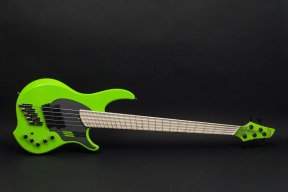
(Dingwall owners need not comment!)
 
How about the owner of Dingwall? ;)

+1 for CircleK

Now you're just showing off! :p

One day... (drifts off into GAS dreamland)... Next time I pop into Bass Direct I'm not leaving without trying a few of your basses. I was too scared last time, as a complete noob. Now I want to experience the multi-scale goodness. :)

I'm very interested in your views on the perfect non-Dingwall B in the meantime! I've looked at CircleK before and totally get the balanced tension idea but I wonder whether it leads to balanced tone, or whether I end up with a fat B that sounds... well... fat.

My other recent strings thread was about rescuing my 5er from gathering dust. I need a really bright, clear, not too mid-heavy sound, i.e. what my new cheap Squier with stainless rounds is delivering. How do CircleKs actually sound compared to something like D'Addario Pro Steels?

Thanks to all for the help so far and the help yet to come!
 
Circle Ks are not going to be as bright as a good stainless string. I say that as a former DR Hi-Beam and Dean Markley SR2000 user. So there's your references.

I had used Carvin's stainless strings with a .128 B on the Level 6 and found the B kind of flabby. I got some GHS .135 Bs from another TB user (I think they were super steels) and put them on the LB75 and it opened my ears to what a proper B should sound like.

Bottom line for me: I will never go back to a .130" or smaller B string on 34" scale. And I still lust after a Knuckle Quake with its 39" scale. :D