I'm fairly new to the bass world, & currently own a Squier Affinity, nothing to brag about. I'm considering a 5 string, & I read a lot on the forums that Brand X has an awsome "B" string, Brand Y has a terrible one, Brand A is the best, & Brand B the worst. If all the instruments are 34" scale, & strung with the same brand of strings, say D'Addario, then the tension should be the same on all instruments. What makes some "supposedly" better than others?

Enjoy the benefits of a premium membership!
Upgrade Account
-
TalkBass has been independent since 1998. Add your voice.
Create a free account to reply to discussions, view embedded media, and browse with fewer display ads.
Join free Log in
Want zero display ads or expanded classifieds tools? Compare plans.
You are using an out of date browser. It may not display this or other websites correctly.
You should upgrade or use an alternative browser.
You should upgrade or use an alternative browser.
"B" Strings
- Thread starter Cobalt Blue
- Start date
More options
Who Replied?
rockstarbassist
Inactive
The strings on the bass are the arguably least important factor on how "good" a B string is.
It's about construction mostly. I have yet to play a 34" bass w/ a low B that impresses me. Apparently Pedulla does, but I've only played their 4's. My Quantums are 35" scale and rival the almighty Dingwall in a B string showdown.
Why in my tastes the Fender-style instrument doesn't have a good B, is anyone's guess. Feels too floppy and loose for me. The Moduli and Dingwall's have nice, taught tension that bring the sonic thunder.
It's about construction mostly. I have yet to play a 34" bass w/ a low B that impresses me. Apparently Pedulla does, but I've only played their 4's. My Quantums are 35" scale and rival the almighty Dingwall in a B string showdown.
Why in my tastes the Fender-style instrument doesn't have a good B, is anyone's guess. Feels too floppy and loose for me. The Moduli and Dingwall's have nice, taught tension that bring the sonic thunder.

This is a difficult question to answer, which is why all this stuff comes up so much (e.g., does 'wood' matter, 'what's the difference between maple and RW boards', is 35" scale better for B string, etc.).
The simplest way to think about this is that a bass is a complex machine, and the tone, playability, etc. is a result of the interaction of many things... the wood type, the resonance of a particular piece of wood, the construction method, the density of the body, the mass of the headstock, the pickups, the impedance of the output of the instrument, the scale length, the fret material, the finish, etc., etc.
No one thing really seems to drive the way different basses sound, or the way a B string feels... it's the combination of all the above.
I've played ash/maple active basses that were muddy and dark, and alder/RW passive basses that sizzled and growled. I've played bolt-on basses that sustained forever, and neck throughs that have had the quickest, punchiest attack ever. I've played a 36" inch scale bass that had a lame sounding B string, and many 34" inch scale basses where the B string was huge, taught, and articulate.
The 'brand' thing is more a reflection of consistent, high quality construction versus not. So, in general, the Fodera brand of basses will have 'better' B strings than off the shelf Mexican Fender 5's, (as an example). However, I've played Fender 5's that were magnificent, and I've played a Fodera or two that had problems.
It's also why two basses that seem identical (same preamps, strings, pickups, body woods, etc., etc.) can have VERY different B string tones and feels.
How's that for a long response that doesn't really answer the question
The simplest way to think about this is that a bass is a complex machine, and the tone, playability, etc. is a result of the interaction of many things... the wood type, the resonance of a particular piece of wood, the construction method, the density of the body, the mass of the headstock, the pickups, the impedance of the output of the instrument, the scale length, the fret material, the finish, etc., etc.
No one thing really seems to drive the way different basses sound, or the way a B string feels... it's the combination of all the above.
I've played ash/maple active basses that were muddy and dark, and alder/RW passive basses that sizzled and growled. I've played bolt-on basses that sustained forever, and neck throughs that have had the quickest, punchiest attack ever. I've played a 36" inch scale bass that had a lame sounding B string, and many 34" inch scale basses where the B string was huge, taught, and articulate.
The 'brand' thing is more a reflection of consistent, high quality construction versus not. So, in general, the Fodera brand of basses will have 'better' B strings than off the shelf Mexican Fender 5's, (as an example). However, I've played Fender 5's that were magnificent, and I've played a Fodera or two that had problems.
It's also why two basses that seem identical (same preamps, strings, pickups, body woods, etc., etc.) can have VERY different B string tones and feels.
How's that for a long response that doesn't really answer the question
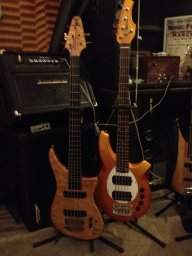
The strings on the bass are the arguably least important factor on how "good" a B string is.
It's about construction mostly. I have yet to play a 34" bass w/ a low B that impresses me. Apparently Pedulla does, but I've only played their 4's. My Quantums are 35" scale and rival the almighty Dingwall in a B string showdown.
Why in my tastes the Fender-style instrument doesn't have a good B, is anyone's guess. Feels too floppy and loose for me. The Moduli and Dingwall's have nice, taught tension that bring the sonic thunder.
OK, but what about the construction makes the diff? For a given scale and string gauge, the tension in the string is dictated by the pitch. A Dingwall is a special case, since every string has a different scale.
And don't go on about through strung basses or those that have the strings come out by the rear strap button; the scale is the nut to bridge distance and how much extra string there is outside that gap has nothing to do with the tension.
OK, but what about the construction makes the diff? For a given scale and string gauge, the tension in the string is dictated by the pitch. A Dingwall is a special case, since every string has a different scale.
And don't go on about through strung basses or those that have the strings come out by the rear strap button; the scale is the nut to bridge distance and how much extra string there is outside that gap has nothing to do with the tension.
There is much more to the sound of a good B string than tension. I've now played two Dingwalls. Yes, the tension was quite high on the B string. Was it the 'best' B string sound I've heard.. IMO, not at all.
rockstarbassist
Inactive
OK, but what about the construction makes the diff? For a given scale and string gauge, the tension in the string is dictated by the pitch. A Dingwall is a special case, since every string has a different scale.
And don't go on about through strung basses or those that have the strings come out by the rear strap button; the scale is the nut to bridge distance and how much extra string there is outside that gap has nothing to do with the tension.
Take a pill and remove the corn cob from your rear man. You act like you work for the 34" scale alliance or something...
When did I even attempt or remotely "go on about strung through basses"? I don't even own one. My Moduli sound great largely because the graphite gives it so much oomph. There are no dead spots, and the line from bridge to tuner is 100% dead on. Plus it angles against the nut instead of under a string tree or something, which IME doesn't produce very favorable B results at all.
If it were "so easy", maybe you and Fender could create a halfway decent playing 5'er.

Take a pill and remove the corn cob from your rear man. You act like you work for the 34" scale alliance or something...
When did I even attempt or remotely "go on about strung through basses"? I don't even own one. My Moduli sound great largely because the graphite gives it so much oomph. There are no dead spots, and the line from bridge to tuner is 100% dead on. Plus it angles against the nut instead of under a string tree or something, which IME doesn't produce very favorable B results at all.
If it were "so easy", maybe you and Fender could create a halfway decent playing 5'er.
Sorry, many do just that WRT string-throughs and such. I was reacting to this: "Why in my tastes the Fender-style instrument doesn't have a good B, is anyone's guess. Feels too floppy and loose for me. The Moduli and Dingwall's have nice, taught tension that bring the sonic thunder."
That "nice, taught tension" is due to the string gauge, scale, and pitch, and nothing else. The sound of it is something else altogether.
FWIW, I play an Alembic, not a Fender.

I dunno. My Lakland is 35" scale, and it's got a great B string. Works for me, and I follow the 'whatever works' school of thought, rather than the 'my scale length is better than yourn.' one.
To the OT, don't follow what we say here to the letter: we're all zealots. Try out a bunch of 5vers and pick the one with the best sound across all strings. My opinion is that 35 inches is king, but I know that not everyone here believes that, and I wouldn't be willing to go to the mats over it.
Hell, Sadowsky can pull of 5 strings very well, and they're 34" scale axes...
To the OT, don't follow what we say here to the letter: we're all zealots. Try out a bunch of 5vers and pick the one with the best sound across all strings. My opinion is that 35 inches is king, but I know that not everyone here believes that, and I wouldn't be willing to go to the mats over it.
Hell, Sadowsky can pull of 5 strings very well, and they're 34" scale axes...
Because the formula for a string's tension/frequency of oscillation assumes the string is fixed at the endpoints. It's not. Depending on the materials used and how they are used, the string can transfer some vibration to other parts of the bass.
Harder endpoint materials (nut, bridge) will give you a tighter string. Imagine if your nut and bridge were made of play dough. They'd flop around. If the nut "hugs" the string, it will transfer less motion. But if you hug it too much, you won't be able to tune it, since it will be stuck. It's things like that.
Harder endpoint materials (nut, bridge) will give you a tighter string. Imagine if your nut and bridge were made of play dough. They'd flop around. If the nut "hugs" the string, it will transfer less motion. But if you hug it too much, you won't be able to tune it, since it will be stuck. It's things like that.


