What is it that makes some basses have tight B strings and some have floppy ones? Is it the placement of the tuning peg on the headstock? Bridge design? I can't come up with a satisfactory answer.

Enjoy the benefits of a premium membership!
Upgrade Account
-
TalkBass has been independent since 1998. Add your voice.
Create a free account to reply to discussions, view embedded media, and browse with fewer display ads.
Join free Log in
Want zero display ads or expanded classifieds tools? Compare plans.
You are using an out of date browser. It may not display this or other websites correctly.
You should upgrade or use an alternative browser.
You should upgrade or use an alternative browser.
B strings
- Thread starter EBBassMan
- Start date
More options
Who Replied?
BurningSkies
CRAZY BALDHEAD
- Feb 20, 2005
- 27,956
- 20,348
- Disclosures
- Endorsing artist: Dingwall Guitars
Usually, the gauge of the string. Take your E, and tune it down to B. It is now very floppy because it is too thin to be a good B string.

No. Its scale length combined with neck construction, string angle at the bridge, etc.
I agree with BS but would also add that string design and construction can have an impact on the "strength" of a B-string. Round vs Hex core, handmade vs automated, fully wound at the bridge contact point vs a taperwound or "exposed core" string... all these plus the above equal a number of factors that ultimately can't single out one or two factors into why some basses have tight Bs and some don't.

LOL, what makes a good B? Everything. Above all, it's in the ears of the beholder. There are many people saying that _______ has the best B out there and I don't always agree.

I've often pondered this and I've come up with the conclusion that it's in the design of the bass, the design of the string, and proper set up. A bass that has a 35" scale length doesn't necessarily mean that the B string will be tight. If the neck isn't reinforced and the wood is soft then it will bend and move much easier and the B string won't be as tight. If the bass is at 34" scale length but has a strong reinforced neck it will more than likely have a tighter B string.
Also, a larger string gauge will be tighter than a lighter one. String construction also plays a part. A string with a hexagonal shaped core will have more tension than one with a round core.
Set up will also make a difference. I used to like really low action for slapping and popping but when I needed to use my B string a lot in a different band I found that I was getting a lot of clacking and fret noise from the B string. I took it to a luthier here in town and he had my bass set up with the strings just a little bit higher and the B string played so much better even though my action was still plenty low enough to do what I needed to do. I used .130 stainless steel strings and that little tweak made all the difference. I'm no longer babying my B string when I play.
Also, a larger string gauge will be tighter than a lighter one. String construction also plays a part. A string with a hexagonal shaped core will have more tension than one with a round core.
Set up will also make a difference. I used to like really low action for slapping and popping but when I needed to use my B string a lot in a different band I found that I was getting a lot of clacking and fret noise from the B string. I took it to a luthier here in town and he had my bass set up with the strings just a little bit higher and the B string played so much better even though my action was still plenty low enough to do what I needed to do. I used .130 stainless steel strings and that little tweak made all the difference. I'm no longer babying my B string when I play.

The low B string is a string that doesn't have a lot of tightness to it, so being "floppy" is a matter of several factors that come in to play. The length (scale of the bass), gauge of low B, neck, angle of headstock, bridge. The thing that also gets overlooked is the way it is plucked. I find that if I pluck it a little softer than my other strings, it somewhat gets rid of the so called floppiness of the string.
None of my 5'ers have floppy B's IMO, but if I had to say what was the floppiest low B on a bass that I have, it would be my 2001 Ibanez BTB405QM, but then it's all in the attack.
None of my 5'ers have floppy B's IMO, but if I had to say what was the floppiest low B on a bass that I have, it would be my 2001 Ibanez BTB405QM, but then it's all in the attack.
Sorry, I should have said assuming the strings and scale length are the same. I've had 34" scale basses (my Stingray 5 and Bongo 5) that had what felt like a "tight" B and some 35" scale basses (Spector Legend) that had a "floppy" B. I guess my question was more along the lines of what is it in the design of a bass that makes a B string feel "tight"? I hadn't considered neck construction/stiffness. Capnsandwich, I think you hit that one right on the head.

It's got little to do with scale length, as many people with scale lengths varying from as little as 32" to as much as a Knuckle (whose scale length on the B is far longer than 35", IIRC) can attest.
Skilled luthiers have good knowledge as to how to get a great low B string at any reasonable scale length by using whatever tricks-of-the-trade they've learned over the years.
As such, since scale length is such a small ingredient in the overall recipe, there are clearly several factors at play, and since each skilled luthier has his own recipe, there's no simple answer.
Skilled luthiers have good knowledge as to how to get a great low B string at any reasonable scale length by using whatever tricks-of-the-trade they've learned over the years.
As such, since scale length is such a small ingredient in the overall recipe, there are clearly several factors at play, and since each skilled luthier has his own recipe, there's no simple answer.

I think the bass construction (combo of scale length, neck reinforcement, bridge etc) has the most to do with it....I do agree that some B strings sound better than others but the bass construction (IMHO) has more to do with it......that and a good set up!!!
I also feel that a Player's approach to playing can make or hinder B-string performance.
Far to many refuse to understand or acknowledge the physics of strings vibrating and insist on attacking a B-string the same as they would a much tigher and higher string.
Far to many refuse to understand or acknowledge the physics of strings vibrating and insist on attacking a B-string the same as they would a much tigher and higher string.
What is it that makes some basses have tight B strings and some have floppy ones? Is it the placement of the tuning peg on the headstock? Bridge design? I can't come up with a satisfactory answer.
Usually not the bass - most of the time it's the player's technique on the B, they pluck too far up towards the neck and whack on it with all their strength which severely weakens the sound.
Pluck closer to the bridge and lighten up, and it'll tighten right up.
LS

I'm no luthier but I think string construction and play style would have more impact on the determination of a B string being floppy or tight. Bass construction varies from builder to builder but many things concerning the neck especially stay quite consistent. My Spector actually had floppy B until I slapped some new string on it. And even when it was floppy it still sounded great. So floppy and tight don't actually tell you whether a B string is good or not just whether it's floppy or tight, lol  .
.
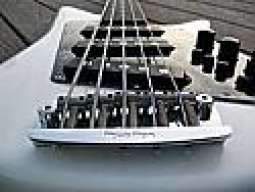
.Personally i would never buy a 5 string that didn't have a string through bridge - i think that's the single most important thing to make a B string tight
Personally i would never buy a 5 string that didn't have a string through bridge - i think that's the single most important thing to make a B string tight
...but the interesting thing is that extra space your string has on a string-through bridge doesn't do a thing towards actual string tension: that only has to do with the mass (gauge) of the string, the scale length between the two witness points on the bass (the nut/zero fret and bridge saddle, and the pitch of the note played. No "Extended B-string Headstocks" (Didn't Pass Physics 101) at the top or String-through-body construction at the bottom of the bass actually makes that B-string "tight".
However, what can happen with STB bodies is that the strings are breaking at a sharper angle over the bridge saddle from inside the body, which can put more downward force on the string and increase the nefarious and never-well-described term "Perceived Tension". You may indeed feel that the string is "tighter" due to this method of stringing (it's actually the opposite direction of making sure you have enough wraps of string around a tuning post causing enough downward force to make sure the string doesn't pop out of the nut or cause rattling inside the tuner) and it may help in other ways, but in strict terms of string tension it's not causing a thing.


