• TalkBass has been independent since 1998. Add your voice.
    Create a free account to reply to discussions, view embedded media, and browse with fewer display ads.
    Join freeLog in
    Want zero display ads or expanded classifieds tools? Compare plans.

Balancing Ebony Fretboards for warmth

solarfly

Supporting Member
Jul 30, 2016
206
328
I'm working on a design for a custom bass. I really love the look of Macassar Ebony and I'm hoping to get a very creamy/dark streaked piece for the fretboard. I also enjoy playing maple necks and love that feel. Yet, a lot of music that I play tends towards more jazz, R&B, motown, classic rock. My current working bass is my Fender Jazz Elite with a maple neck and fretboard and an aldar body.

What the builder and I have been discussing is possibly a maple neck, Macassar Ebony fretboard, aldar body with ash tonewood. I'm wondering what opinions you would have on punchiness and warmth vs. the ability to also get some of that Palladino/Curtis Mayfield/James Jameson sort of muted thumpiness when needed? Thoughts?

Edit: I tend to also play my Fender Jazz with brighter strings, D'Addario NYXLs, which have a bit more of an aggressive feel, yet they are very responsive and sound good with various muting techniques. I play the bass mostly in active mode, and flipping it to passive gets me those dynamics. I'm not looking to recreate my Fender Jazz, though I want a bass versatile enough to complement when I choose.
 
Punchiness, warmth, Pino, Mayfield, and Jamerson tones all from a fretted ebony fingerboard?

AND bright strings to boot?

I think you're chasing something you won't manage without changing strings, pickups, etc, etc. Fingerboards have a significantly stronger influence on the sound than body timbers. If you wanted to dull it down, a mahogany neck and a really soft/light body might get a little softer, but maybe not noticably. If you wanna sound like Pino and Jamerson, build their kind of bass, fit their strings, learn to play like those guys.
 
Thanks for the comments Reverendrally!

The pickups we're going with are dual-coil switchable between single/dual and passive/active with an EQ. I listened to about 20 videos last night showcasing the various tones and the range is impressive. I'll ask about mahogany on the neck, that's a wood I hadn't considered. We discussed red oak, but thought that might be too subdued.

I was actually planning on using nickel roundwound on the new bass. I mentioned the brighter strings on my jazz just to try to illustrate where I like my tone a little better. I don't expect the new bass to sound like the Jazz, and the Jazz does its job well for those particular sounds. When I finally settled on NYXL for my Jazz, I had already gone through 5 different packs of strings from different manufacturers until I found something I liked, so I imagine I'll probably go through the same experiment with any new bass (on my old Ibanez ATK I went with D'Addario Pro steel, which are SUPER bright, but suit that bass well).
 
I have a Warmoth ebony on maple slim taper jazz neck that has been on 2 different bodies.

First it was on a Warmoth dinky P body (mahogany with Gonçalo Alves top), large pole piece P pickup (probably Fender Japan). With LaBella flats it nailed the Motown sound.

Looks didn't match the sound, so I swapped everything to a Squier P body. It sounded identical to me.

My daughter liked that bass and we put DR rounds on it. It's now a nice rock bass, but the Motown vibe is gone. I put the strings on a Jag body with a Rosewood on maple neck (SD quarter pounder P) and that's presently my "Motown" bass.

My point - IMO the important ingredients for that sound are a P pickup and flats.
 
  • Like
Reactions: reverendrally
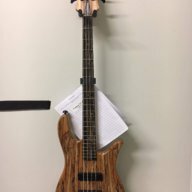
I built an alder bodied, roasted maple neck with ebony fingerboard bass with Delano quad and a dual coil soapbar pickups. Fretted, nickel rounds.

Honestly not as bright as I would have though by using the ebony board. No way near as bright as my ash/maple stuff.

I think you'll be fine.

IMG_6394.JPG
 
I'm working on a design for a custom bass. I really love the look of Macassar Ebony and I'm hoping to get a very creamy/dark streaked piece for the fretboard. I also enjoy playing maple necks and love that feel. Yet, a lot of music that I play tends towards more jazz, R&B, motown, classic rock. My current working bass is my Fender Jazz Elite with a maple neck and fretboard and an aldar body.

What the builder and I have been discussing is possibly a maple neck, Macassar Ebony fretboard, aldar body with ash tonewood. I'm wondering what opinions you would have on punchiness and warmth vs. the ability to also get some of that Palladino/Curtis Mayfield/James Jameson sort of muted thumpiness when needed? Thoughts?

Edit: I tend to also play my Fender Jazz with brighter strings, D'Addario NYXLs, which have a bit more of an aggressive feel, yet they are very responsive and sound good with various muting techniques. I play the bass mostly in active mode, and flipping it to passive gets me those dynamics. I'm not looking to recreate my Fender Jazz, though I want a bass versatile enough to complement when I choose.

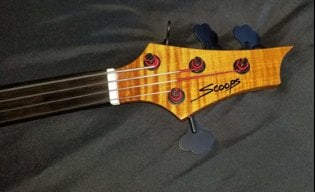
Punchiness, warmth, Pino, Mayfield, and Jamerson tones all from a fretted ebony fingerboard?

AND bright strings to boot?

Maybe try old flatwounds on a passive P bass?
 
  • Like
Reactions: reverendrally
Maybe try old flatwounds on a passive P bass?

That's not a sound or feel I enjoy playing at all! I tend to play my Jazz on the brighter side. I did an experiment last week. I broke out my old (original) Ibanez ATK 305 (looks a lot like this with much nicer wood grain and "Ibanez" on the headstock, MIJ Ibanez ATK 305 1994 woodgrain | Tom's Spare Crap). I believe the body is ash. The neck is maple with a maple fretboard and I'm running D'Addario Pro Steels, which are the brightest they have. It suits this bass and the sound I got from it on stage last week was really growly, bright highs and deep, resonant tone in the lows. I played it on stage at an open mic with a lot of musicians I jam with sitting in the audience and they all commented on the sound.

I think my decision to go with the Ash tone block, Alder body, maple neck and ebony fretboard will work for me and will compliment my Fender Jazz bass in terms of slight variety in sound. It's a Fodera. It will run two dual coil pickups with the Fodera/Pope Custom electronics. Lots and lots and lots of tonal options in that package. In fact I think I can even dial it in the way I want it with dip switches if I recall. Anyway, build time is fast right now, so I'll be getting her around November!
 
That's not a sound or feel I enjoy playing at all! I tend to play my Jazz on the brighter side.

Right on.

But if you're really chasing that Pino of Jamerson vibe, flats on a passive P will get you at least halfway there today. Curtis' guy, Lucky Scott, played a Jazz, but being the early 70's chances are his bass was passive and rocked old flats as well. The next part - which may take years - is learning to play and think like those guys.

Just trying to save you some time.
 
  • Like
Reactions: ctmullins
All too many times I have built a guitar of a bass with the expectation of a certain tone, and never reaching that expectation.

I've since developed a philosophy that says use the sound of the bass as it wants to be, not as I want it to be. I get along with my basses much better now.

Face it, every bass has a sweet spot. It's up to the player to find it and exploit it!
 
Right on.

But if you're really chasing that Pino of Jamerson vibe, flats on a passive P will get you at least halfway there today. Curtis' guy, Lucky Scott, played a Jazz, but being the early 70's chances are his bass was passive and rocked old flats as well. The next part - which may take years - is learning to play and think like those guys.

Just trying to save you some time.

I study their music with a fantastic teacher, Berklee grad, but learning to think like them -- man, that's got to be a life long pursuit. My Fender Jazz lets me switch it into passive mode, and then I cut the treble hard (with these steel strings I have to) and play with a muted technique and a lot of deadnotes. The bass on Curtis Mayfield's Superfly soundtrack is incredible as a study as it really plays with stretching and compressing the feel of the rhythm. Paladino has the ability to extract this muted, conservative sound from the strings, playing somewhat minimally while creating a mood.

Their techniques can be taken and applied to any bass, bright or deep or soft sounding. A lot of the sound really is how the right hand / thumb or fingers are attacking the strings. But like I said, my tastes are really varied. I was playing Megadeath songs with a friend on the weekend. Or when I do George Benson's Just the Two of Us, we do it with a more upbeat bassline, bright strikes and pops to bring out a little more of the Will Smith version in feel and it works. Or Herbie Hancock's Chameleon, that sounds great with hot strings and an autowah to get a really funky sound.

Guess that's why we own multiple basses :)

There will be a place for the Fedora and a place for the Fender Jazz in my music. I can't wait to play it -- will post pictures in November!
 
All too many times I have built a guitar of a bass with the expectation of a certain tone, and never reaching that expectation.

I've since developed a philosophy that says use the sound of the bass as it wants to be, not as I want it to be. I get along with my basses much better now.

Face it, every bass has a sweet spot. It's up to the player to find it and exploit it!

I really like the way you put it. I feel that way about strings on a bass. One type or brand doesn't work across the board - NYXLs weren't aggressive enough for the personality of my Ibanez ATK, while they were far too bright for my Jazz. The Jazz does well with NYXLs but would also sound great with nickel rounds. Flats on my Jazz wouldn't suit me. But I had flats on my P-Bass that I gave away and with the rosewood fretboard that sounded good. At the time, I just didn't think I needed that many basses.