if yes, you got the wrong players.Do the guitar and bass players not know what to do about this and they asked you?
if no, "why you like waste time?"

TalkBass has been independent since 1998. Add your voice.
Create a free account to reply to discussions, view embedded media, and browse with fewer display ads.
Join free Log in
Want zero display ads or expanded classifieds tools? Compare plans.
if yes, you got the wrong players.Do the guitar and bass players not know what to do about this and they asked you?

Drop G? With a pitch shifter? Can humans even hear this?
Bass players who play that low will say yes. I think they're the only ones.
Unfortunately yes..... I know a guitarist who sometimes tunes to drop F...... he tried drop E (as in a full octave below E standard) once but couldn't find a string gauge that would make it playable.....
My advice? Comprise and have him play a 6 string bass.....

Personally I don't like it. It wasn't my decision as the tuning existed before I joined, I was just pointing out that its easily doable.Just because you can go that low, what does it bring to the party? Seriously... I get the feeling I'm missing something somewhere. (Wouldn't be the first time if so.) And even though I do like many metal bands, I'm an "old guy." And I don't get all the ultra-low tailchasing I'm seeing or hearing. Help me out with this one.
This a nice vid, would like to hear a live recording, from the audience (not from the board). I didnt mean to call all droppers idiots, sorry if I came across that way. To slack a string 6 semitones is kinda beyond ... well, beyond. Sure, a low B can be detuned a semitone, but the the question was a guitar playing bass with an octive pedal, was it not- no low B.
Drop Tunings:
What matters for the purposes of fingering is the relative relationship among the strings. For example, a dropped B tuning has all strings tuned to different notes than a standard tuning, but the strings have the same relationship to each other as a drop D tuning (where only the 6th string differs from standard tuning), and as a result the fingerings are nearly the same as for standard tuning.
Drop a# Specifically:
Drop A♯/Drop B♭ - A♯-F-A♯-D♯-G-C / B♭-F-B♭-E♭-G-C
What wer're discussing, is using a guitar, to simulate bass, with way slacked strings. Sounds like a recipe for mud. When I (used to) see bands like the youtube video posted, live, it was always mud and sound pressure. That has been my experience. Maybe non stadium bands in this vein dont sound muddy these days anymore live cos everything is better with gear and strings.
- Two full steps down from Drop D. Utilized by bands such as A Day To Remember (on Mr Highway's Thinking About The End, Welcome To The Family, Violence (Enough is Enough), Life Lessons Learned the Hard Way and Sticks and Bricks), Hostility, Issues, Static-X, Bring Me the Horizon (since Suicide Season), In Flames, Sybreed, Hellyeah, Amaranthe, Breaking Benjamin (since Phobia), Parkway Drive, Otep, Spineshank, RED, Bury Your Dead, Eye Empire, Dirge Within, Remembering Never, and occasionally Chevelle, Darkest Hour, Evanescence, [This invalid link has been removed], For the Fallen Dreams, and Sevendust.
Im not saying cats in that those sub genres are all idiots, Im am saying that what Ive seen live is usally too loud, and overly full in the low end to the point where clarity goes bye bye. Just what Ive seen. You can rock any string tension you wish.
So to start off, I'm the drummer for a heavy metal band... Thanks so much in advance!
Bass players who play that low will say yes. I think they're the only ones.
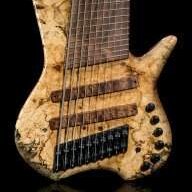

What about the Warwick Dark Lord? People have been playing that through regular rigs and say it's fineIt's more "feel" than "hear", imho, though it still retains musical relevance. Maybe I like low frequencies because of my high frequency hearing loss.
Agreed. What gauge rubber bands make that sound?WHY?.............
The amount of negative comments about the tuning in this thread is surprising; drop G is nothing new nor weird. I don't do drop tunings, I just get more strings, but I play F# B E A D G C F Bb Eb and there are absolutely no issues whatsoever with getting the low end heard (whether or not the fundamental gets cut off doesn't matter much). I'd recommend looking at Link Removed, you can go as low as you'd like. I'm using a .190 for the low F# and you can find up (or down) to .266 in there.
Personally I don't like it. It wasn't my decision as the tuning existed before I joined, I was just pointing out that its easily doable.


I dunno, how low does it go? It's not a matter of brand, it's a matter of what human ears are capable of. Again, folks are probably mostly hearing overtones and inferring the root tone.What about the Warwick Dark Lord? People have been playing that through regular rigs and say it's fine
I dunno, how low does it go? It's not a matter of brand, it's a matter of what human ears are capable of. Again, folks are probably mostly hearing overtones and inferring the root tone.