I use only a single amp + cabinet for practices and gigs and play in big bands and small combos, all jazz, all with an upright bass. Most places that I play had wooden floors and I usually put my amp+cabinet (Clarus SR head and Genzler BA-10 array) directly on the floor. It also sounded pretty good with plenty of volume and a nice full sound. Recently I was at studio and I put the cabinet on a chair. Suddenly the sound was incredibly thin. It sounded like crap. I put the amp back on the floor and eveybody playing with me was so much happier when the sound was full. At one of the big bands I play with they provide me with an amp. Its either a TC electronics BG 250 for GK MB112. While neither are the dream amps for upright they sound good. Well they sound good if they are on the wood floor of the stage but they sound really thin if I put them up on a chair. Lastly I was at a practice in a friends basement using my Genzler+Clarus gear and had the amp on a concrete floor. Again the sound was really thin. I also tried his 50W Ampeg Rocket amp and it sounded thin too, plus a bit distorted. Clearly concrete is far different than wood so the coupling is close to non existent. Has anybody had this experience? Any suggestions for how to use the amp on a concrete floor? I didnt' have time to try and turn tone knobs enough to see what might fix it. I guess I was really surprised at how drastic the sound changed. I know wood floors can couple and sometimes create a boomy sound so a HPF can help address that to some extent but my limited experience was that it created nice warm, full sound. Anyone have suggestions?

Enjoy the benefits of a premium membership!
Upgrade Account
-
TalkBass has been independent since 1998. Add your voice.
Create a free account to reply to discussions, view embedded media, and browse with fewer display ads.
Join free Log in
Want zero display ads or expanded classifieds tools? Compare plans.
You are using an out of date browser. It may not display this or other websites correctly.
You should upgrade or use an alternative browser.
You should upgrade or use an alternative browser.
Double Bass bass cabinet placement
- Thread starter bassEng
- Start date
More options
Who Replied?

In my experience concrete/stone floors reflect much more treble. So what you are hearing is perhaps not less coupling of bass, but more treble information. I often like the more "present" sound from hard floors, if the room is reasonably damped otherwise.
Another difference in the situations you describe, could be how close you are to the walls, which give extra bass coupling. Just my thoughts.
Another difference in the situations you describe, could be how close you are to the walls, which give extra bass coupling. Just my thoughts.

The spaces we play in, whether stages, sides of rooms, or corners, are always part of our sound. I think of them like meta cabinets. Learning to deal with them is part of learning how to to optimize any amplified sound. Decoupling acts as a sort of high pass filter.
In certain situations, like on stages with enclosed sides and a back where you are close enough to the back, it can be useful to decouple by various amounts. It really all depends on the space.
In certain situations, like on stages with enclosed sides and a back where you are close enough to the back, it can be useful to decouple by various amounts. It really all depends on the space.

There's no right answer, just experience in various rooms and what you learn to mitigate disaster on occasion. I always place my cabs on the floor, more out of necessity than anything else. It's rare to have more than a postage stamp size foot print to set up in my world.
Two things come to mind regarding your experience with the concrete floor in the basement:
The size of the room may have affected the bass frequencies.
Wooden floors are built on joists. The wooden floor has more ability to vibrate, and the hollow spaces between the joists can amplify the bass frequencies; while a concrete floor is solid and does not vibrate,
The size of the room may have affected the bass frequencies.
Wooden floors are built on joists. The wooden floor has more ability to vibrate, and the hollow spaces between the joists can amplify the bass frequencies; while a concrete floor is solid and does not vibrate,

All good advice above. The Floor, Wall and Celling of any particular space create the acoustics within that space. If the surface of the floor is unforgiving (l.e. concrete, ceramic tile, stone. then the treble gets a big boost. That’s why playing on a concrete platform outdoor stage is so un rewarding for bassist. Could be that the speaker cabinets you’re using simply cannot counter that effect because they are more room dependent. The Genzler BA 110 Cabinet’s design and response is light years ahead of the the GK MB 112 and the Ampeg Rocket. Just my take.

I use only a single amp + cabinet for practices and gigs and play in big bands and small combos, all jazz, all with an upright bass. Most places that I play had wooden floors and I usually put my amp+cabinet (Clarus SR head and Genzler BA-10 array) directly on the floor. It also sounded pretty good with plenty of volume and a nice full sound. Recently I was at studio and I put the cabinet on a chair. Suddenly the sound was incredibly thin. It sounded like crap. I put the amp back on the floor and eveybody playing with me was so much happier when the sound was full. At one of the big bands I play with they provide me with an amp. Its either a TC electronics BG 250 for GK MB112. While neither are the dream amps for upright they sound good. Well they sound good if they are on the wood floor of the stage but they sound really thin if I put them up on a chair. Lastly I was at a practice in a friends basement using my Genzler+Clarus gear and had the amp on a concrete floor. Again the sound was really thin. I also tried his 50W Ampeg Rocket amp and it sounded thin too, plus a bit distorted. Clearly concrete is far different than wood so the coupling is close to non existent. Has anybody had this experience? Any suggestions for how to use the amp on a concrete floor? I didnt' have time to try and turn tone knobs enough to see what might fix it. I guess I was really surprised at how drastic the sound changed. I know wood floors can couple and sometimes create a boomy sound so a HPF can help address that to some extent but my limited experience was that it created nice warm, full sound. Anyone have suggestions?
This is all normal. The nature and quality of gear and the way you adjust it do matter, but there is no silver bullet that allows you to totally overcome poor room acoustics. It sounds like you are already doing everything you can. Choose the amp position that works best for you in a given situation, fiddle with the controls to get the sound as good as you can, and then accept reality and deal with it.
I actually prefer elevating my cab and tilting it to aim at my head. For me this is basically trading away fullness down low for more clarity and focus. For upright specifically (IME) it also tends to reduce the interaction between the bass's body and the amp. So it increases gain before feedback and allows me to hear as well as possible without blowing out the room.
I also feel that elevating the cab and tilting it to aim at your head produces a bit more consistent results. It gets the cab a bit close to your ears, which increases the volume you hear. FYI SPL drops off by 6dB per doubling of distance. If the cab is 4' from your head and you elevate it so it is 3' from you head the SPL change is 20Log(4/3)= 2.5dB. In other words the sound becomes 2.5dB louder at your ears, without turning up the amp.
As you mentioned, elevating the cab also changes the low end a bit. You get a notch at the frequency were the distance from the acoustic center to the floor = 1/4 wavelength. Basically the sound travels down 1/4 wavelength to the floor and bounces back up 1/4 wavelength to the original position. This puts the reflected sound 1/2 wavelength or 180 degree out of phase with the direct sound, which results in a bit of cancellation. Let's say you elevate the acoustic center by about 2', this puts a notch at around 141hz. (141hz has a wavelength of ~8' and 1/4 wavelength is ~2')
The final factor I will mention is the dispersion of speakers varies by frequency. At the lowest frequencies the sound is pretty much omni-directional. This is because the area of the speakers is too small in relation to the wavelength to have any control. As the frequency goes higher, the wavelength gets shorter. So as the frequency increases, a bass cab will start to develop pattern control in the low mids. By the high mids the cab will have considerable control over dispersion, and at some point the sound tends to get beamy. If that cab is flat on the floor, the mids and higher frequencies tend to shoot by you well below ear level unless you are standing a significant distance in front of the cab. This means you won't hear the higher frequencies till they have bounced around a bit. The resulting sound tends to be darker and more diffuse, but tonal balance can vary quite a bit with the reflective quality of the acoustic space.
In regards to taste:
I started elevating my cabs very early in my musical development. My choice is based on what I like to hear on stage as well as in the audience. That doesn't mean it's the right answer for you.
In the early 2000s I used to frequent a cigar bar that featured live jazz on Tue night. A flute professor was running one of the jazz combos and playing upright. I sat in frequently and had lots of conversations with him. He was really struggling with feedback and clarity. I suggested elevating his cab, which he tried on the next gig. I thought his bass sounded better both on stage and in the audience. Only one problem, he hated the way it sounded. So during the first set break, he put his amp on the floor and it sounded like it had previously.

If you are playing on wooden stages and not having problems with feedback and/or an overly boomy sound, count yourself lucky!
As others have said, the room is the a big part of the instrument and learning how to adjust settings to work with different rooms is necessary. I suggest always having a HPF on hand.
Keep in mind while you may perceive your sound as a bit thin, it could be working well in the context of the whole ensemble - from the audience's perspective.
As others have said, the room is the a big part of the instrument and learning how to adjust settings to work with different rooms is necessary. I suggest always having a HPF on hand.
Keep in mind while you may perceive your sound as a bit thin, it could be working well in the context of the whole ensemble - from the audience's perspective.
Jazzdogg
Less barking, more wagging!
My solution has been to use two small cabs with 8" drivers. I pole mount a 1x8 above a 2x8; with the1x8 near ear level, I can hear my intonation clearly, while the floor-coupled 2x8 provides the beef. A variable high--pass filter, and thoughtful placement of my cabs relative to stage walls, enables me to tweak my sound to suit the venue. Best of all, the two cabs have a combined weight of only 30 pounds. Too bad Mike Arnopol is no longer making the Crazy8 and Crazy88 composite cabs; these are the best cabs in my arsenal.
Good luck!
Good luck!
Last edited:

. . . might be worth a try to see if it helps: the next time you're on the concrete basement floor, bring or borrow a piece of plywood to put down between the cab and the concrete (perhaps the homeowner has something available) . . . doesn't have to be a large piece maybe something 3' x3'?
Back when I was still using cabs (I'm now 100% IEM's) my preference was to put it on a chair or amp stand to get the sound closer to my ears - often the EQ on the amp would be adjusted as necessary for the space.
Back when I was still using cabs (I'm now 100% IEM's) my preference was to put it on a chair or amp stand to get the sound closer to my ears - often the EQ on the amp would be adjusted as necessary for the space.
Lots of useful feedback (the good type of feed back). I mentioned my discovery about using a chair to elevate the Ampeg and Tc electronic combos because I really found it it interesting to hear how drastically different things sounded. The consensus from the band was that they liked the amps on the floor better. I had no problem hearing myself either way.In my experience concrete/stone floors reflect much more treble. So what you are hearing is perhaps not less coupling of bass, but more treble information. I often like the more "present" sound from hard floors, if the room is reasonably damped otherwise.
Another difference in the situations you describe, could be how close you are to the walls, which give extra bass coupling. Just my thoughts.
The home owner did give me a 4x4 foot piece of plywood to put on the concrete floor underneath the amp. It was different but I can't say it was better.
When I go back to play in the basement with the concrete floor I'm going to do a few experiments with my amp/cab (genz benz BA110). I didn't try turning down treble before and turning up the bass EQ. On wood floors I had grown accustom to needing to dial the bass back a bit and turn the higher frequencies up so it never occurred to me to tweak things in the opposite way. I didn't have much time to setup and dial things in since they were aleady playing when I arrived. This time I will try playing more with the EQ on the amp. Also I will bring my Radial Pre Pz preamp to give me a few more things to tweak. I don't mind more high frequencies but I was truly amazed at how much bottom end went away. It was a pretty bag basement room but the walls had insulation in them so that provides some damping. The other people definitely wanted a more full sound so this will take some tweaking to see what can be done.
As far as raising the amp higher to hear it better goes...I've never really played in a situation where I couldn't hear myself. Even in a big band with all the horns playing at the same time it really hasn't been a problem. Maybe I've just been lucky. I did see Ron Carter at the Regattabar in Massachusetts a few months ago. He played through a rather small amp that was placed up some boxes behind him. I was in the 2nd row and I actually thought his sound was a bit thin through that amp (I don't remember the middle). If you are up really close at the Regattabar you don't really get to hear much from anything that is mic'd and comes from the overhead, house speakers. His amp wasn't mic'd but perhaps they also ran a direct input to the board that I didn't see. Of course his playing was incredible, as was the whole Striker group.
The guitar player had his amp on a stand and that worked great but he is not concerned with creating a low end cushion.

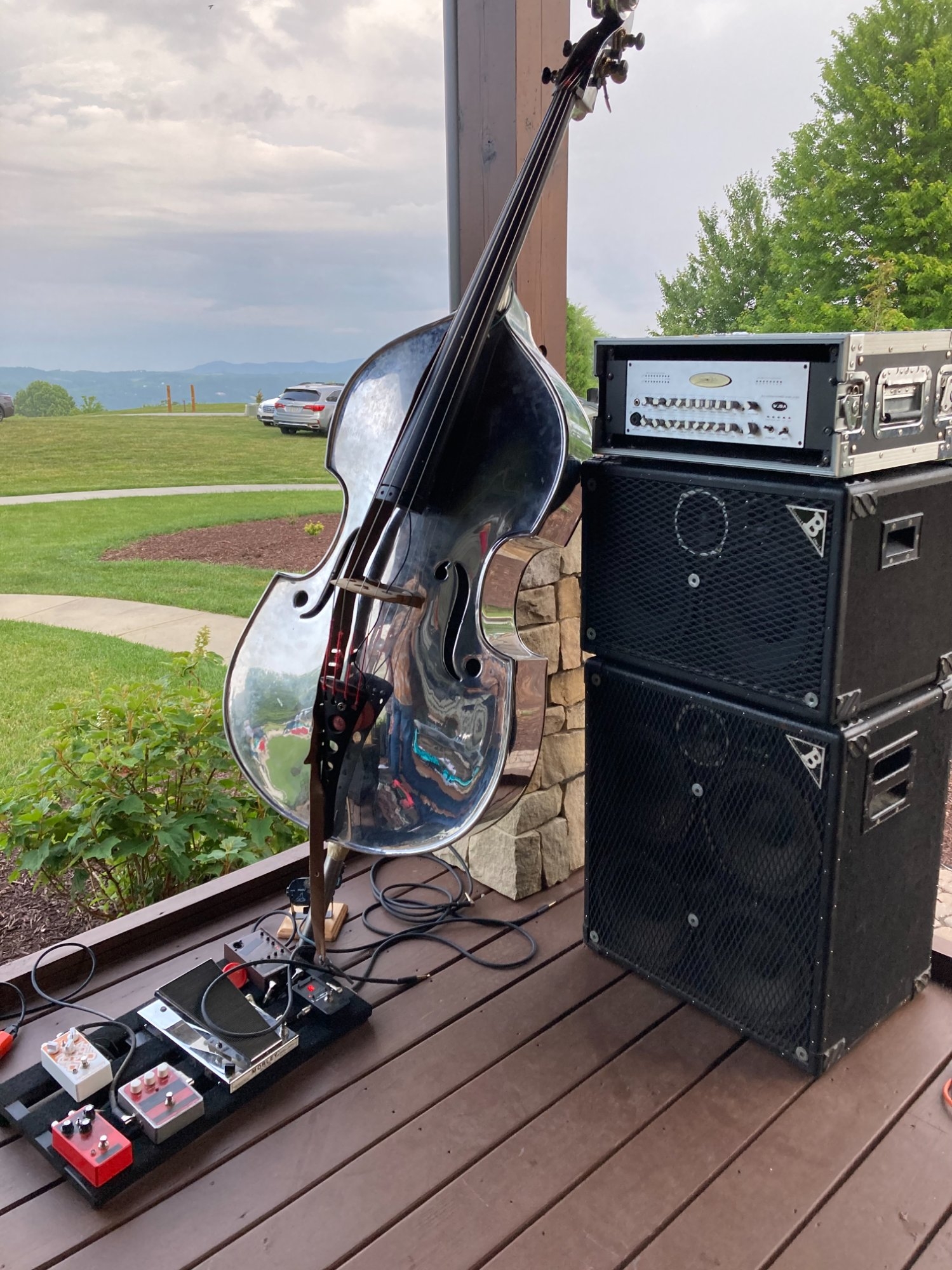
You need another bass...maybee two more....and a bigger amp...and more pedals. Push through the room like a '67 Chevy camaro with a big block. There. Problem solved.
Me and Pop with one of his 1969s. One of many I remember as a little grommet. This one had a small block and he got rid of it. 'Seems like I'm still using the same dress code....

Me and Pop with one of his 1969s. One of many I remember as a little grommet. This one had a small block and he got rid of it. 'Seems like I'm still using the same dress code....
Last edited:

As @Povl Carstensen alluded to above, the wood floor is not amplifying bass frequencies. It is absorbing higher frequencies. Moreover, high frequencies are more directional; if our ears were attached to our knees, we would hear more of those higher frequencies from a speaker on the floor.Two things come to mind regarding your experience with the concrete floor in the basement:
The size of the room may have affected the bass frequencies.
Wooden floors are built on joists. The wooden floor has more ability to vibrate, and the hollow spaces between the joists can amplify the bass frequencies; while a concrete floor is solid and does not vibrate,

When I walk into a venue with a concrete floor I know it’s likely going to be wonky. But since I either play acoustically or through a PA I don’t stress too much. Most of the time it’s workable. Only occasionally do I feel like it’s a lost cause. As everyone states above I look for other acoustical opportunities or advantages I can eke out of a room or stage. I know it’s an unpopular opinion but getting rid of an amp is, for me, the best way to get some control and consistency to my sound and the more I get closer to making the sounds Iwant, the more this holds true. I just can’t get close to the sounds I want when I go through an amp. Not so for a mic to a PA which I generally feel fine with. I don’t even really like monitors. I’m not sure how I got to this place as a player. Recently here in Japan I’ve been playing with choirs performing anime composers music (of all things)! Sometimes I’m the only instrument on stage, maybe twelve singers or so. I love blending with all the voices. I’m basically playing what the bass singers would sing or some harmony part therein. It’s making me a better player to blend with these voices. The dynamic range of these singers is wild. To match them, to “sing” with them, is an acoustic dream. I don’t feel I could do this with an amp, in fact I’m sure I couldn’t. It just wouldn’t blend.

I'd humbly suggest it is probably your bluegrass jamming background...... I’m not sure how I got to this place as a player. ...
The absence of amplification in that environment nurtures a desire to hear the actual tone of the instrument.
Yes, but I also have a rock background long before that! Ha! I had an SVT before I ever had an upright bass. In New Orleans I used to gig with a Baby Blue on a GK 15” cab, plywood bass, La Bella guts, underwood pick up. I thought it sounded great! But yeah, it’s been a slow process away from amps. With Rhiannon I used to have a Aguilar rig. But we started really paring down. Plus my arco finally started to be a main part of my voice on the instrument. I think that was the death knell to amps for me. Of course I have one, a Tone Hammer 350 and a few Aguilar 112. Never say never but I don’t see the need in the near or distant future!I'd humbly suggest it is probably your bluegrass jamming background...
The absence of amplification in that environment nurtures a desire to hear the actual tone of the instrument.

Independent of genre tendencies, though, once you're playing in a room with a lot of echo, an amp does more harm than good.
IEMs are pretty much a silver bullet when it comes to feedback prevention, and having the best and most consistent bass tone in your ears. That's the most logical cabinet placement.
The FOH sound still needs to be managed for different rooms, but it's a much easier job with fewer amps and cabinets on stage bleeding into the other mics.
IEMs are pretty much a silver bullet when it comes to feedback prevention, and having the best and most consistent bass tone in your ears. That's the most logical cabinet placement.
The FOH sound still needs to be managed for different rooms, but it's a much easier job with fewer amps and cabinets on stage bleeding into the other mics.
I’ve certainly done it. I had mixed results. Sometimes it was actually glorious. I’ll never forget playing live on the BBC with my IEMS and I was floored. Other nights they sounded poopy so I’d take one out and that worked pretty good. Unfortunately live sound is just a crapshoot. We all find our ways to deal with it. Back to the OP I was always a cab on a stand or chair if possible the theory being that the engineers designed its frequency response decoupled. If I do use an amp it is at a bare minimum level. I learned the hard way that throwing my phat bass tone around almost never made anything better.Independent of genre tendencies, though, once you're playing in a room with a lot of echo, an amp does more harm than good.
IEMs are pretty much a silver bullet when it comes to feedback prevention, and having the best and most consistent bass tone in your ears. That's the most logical cabinet placement.
The FOH sound still needs to be managed for different rooms, but it's a much easier job with fewer amps and cabinets on stage bleeding into the other mics.
I use a QSC CP8 powered speaker, placed as a wedged monitor behind me. It has a "floor monitor" option in its DSP presets, which compensates for the floor coupling.
My trio uses 2 QSC CP8s right behind us at head height on small speaker stands for monitoring. It's worked very well. I've quit using a bass amp in the trio because it just doesn't sound as natural as the CP8s. Just for the record, Allen & Heath's newer CQ series mixers coupled with the QSCs is a really hi-fi combo.


