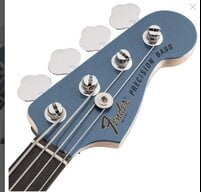
1) No lefty version, or poor symmetry for flipping.
I play lefty, so this disqualifies huge swaths of the bass market.
2) Less than 5 strings.
Don't see the point of it. The B doesn't get in the way, and with its extra pitches and voicings is an immensely useful tool. I suppose I could tune BEAD instead, since I don't often use the top few frets of my G, but I do a fair amount of chording with the EADG strings. The same chord with BEAD strings may have a totally different, often unacceptably thick and muddy timbre, and can complicate attempts to follow up with low-register notes on the B.
2.5) Useless (floppy, muddy) B strings.
Essentially implied by #2. Also implies that scale lengths under 34" are problematic.
3) Irredeemably dark tone.
It's been said several times already: you can beef up a bright bass, but its hard to make a dark one shine (or breathe electronic life into one that's acoustically dead). I'm willing to play around with all sorts of tones, but I'll always need me some shine from time to time.
4) Inability to hold tune for the duration of a play session with broken-in strings.
I don't mind having to tune up every day, but I can't be going noticeably out of tune during a set unless I just slapped on new strings. This peeve also covers any bass that simply cannot ever be tuned properly due to bad fretwork or intonation.
5) Neck-diving.
For the obvious reasons. I have some tolerance for it, but not too much.
6) Failure to include obvious technical improvements of bass evolution and simple optional features.
Easy-access truss rods and batteries, fully adjustable quick-load bridges with string-thru-body option, straplocks (or at least fairly substantial strap buttons), straight string-pull from tuner to tailpiece, active/passive switches, series/parallel/coil-selectors when clearly applicable to the pups, at least one neck stability feature (quartersawn, laminated, or dense-exotic wood and/or graphite/metal strips/bars)... COME ON GUYS, it's the frickin' 21st century already! All this stuff should be par for the course by now. (Tho I don't include angled headstocks because those can complicate construction to an extent that may be worth skipping via string trees; I'd include drop-tuners too but those have a potential tuning stability tradeoff in my experience).
7) Nothing but bridge pups.
Normally I like to blend pups. When I favor one or the other, 90+% of the time it's the neck. Single-pup MusicMen are a bit too bridgey for me. Those Warwick Thumbs with the double bridge J's are right out.
8) Lotsa coatings and glue.
Finishes and laminates cost money and dampen vibration. I can understand a (thick) top lam and/or a 3-5 piece neck (or a hard finish for 1-piece maple) for reasons of tonal balance and stability respectively, but beyond that it's just cosmetics. Veneer-thickness lams on anything other than the headstock, where cosmetic effect is great and costs in tone and money are low, are offensive to me. Personally I'd much rather achieve standout cosmetic effects via design choices that also accomplish something functionally (e.g. a solid walnut body and purpleheart neck, which will look interesting, require no neck finish for stability, sound unusual but still good, etc., all while not actually costing too much more in the end because you save money by skipping the hard finishes).
8.5) Figured maple tops.
Essentially implied by #8, but worth mentioning again because holy CRAP they've been done to death! Admittedly, yeah, they can look real pretty, but geez, even cheapo China-made stuff is starting to feature real maple lam tops. And even when they fake it, who's gonna know the difference, or care? It will still look fancy. And it'll still be functionally irrelevant. So what are you really paying for?
9) Horny bodies.
Purely a matter of taste to me, but I really don't like horns, even though due to lack of lefty selection most of my basses have them. I've always thought Stratty shapes were stupid-looking. So long as the bass can stay balanced, then as far as I'm concerned, the fewer, the shorter, the thinner, the blunter, and the, well, less horny the horns, the better. For this reason more than any other I'm rather attracted to some metallic body shapes, but I realize that in the eyes of the audience they'll often be inappropriate. Other stuff that manages not to offend my sensibilities includes the Ampeg F-hole (barely horny at all), Alembic Epic (nonexistent lower horn), certain well-proportioned singlecuts, and acoustics or things that strongly suggest acoustic shapes (e.g. Hofner Beatle, Les Paul, Tele, even Pedulla MVP).
10) More than 21 frets.
If I needed to use 'em, I'd rather have another string on top. If I already have too many strings, I'd rather play another instrument or just do without those notes. Also, I like slap space and/or the potential to mount an extreme-neck-position pup.




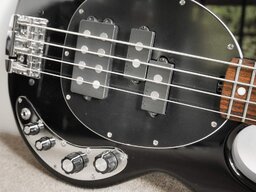
 The words "Peoples Republic of .." contained in the wording of the "Made in .." sticker
  .
.