I think most of us tend to assemble a "short list" of instruments that fit our basic criteria of how a bass ought to be configured, both functionally and aesthetically.
What are the top ten design attributes that cause you to reject an instrument as unsuitable for inclusion onto your personal short list?
I'm not talking about intrinsically good or bad here. I'm referring to personal preferences in style and ergonomics that make you either stop and take a closer look, or move on.
Here's my list, in no particular order:
1) Poor truss rod access. I like my action set low, so I need precise control over neck relief. If it's a PITA to adjust, I'm not interested.
2) Opaque paint. If the wood is good enough to be made into a fine instrument, it outta be good enough to look at. I don't trust the quality of wood I can't see, and vastly prefer the appearance of natural wood grain; even plain ol' alder or mahogany.
3) Less than 24 frets or stops. Preferably more. My two fretless basses have 36 and 28 stops, respectively, and occasionally they come in handy.
4) Non-quick-release bridges. What a pain in the butt. I need the ability to quickly and easily remove and replace the strings for cleaning and swapping different sets.
5) "Classic" (Fender/Gibson/etc.) slab body and headstock designs. Nothing wrong with em, though, in my experience, they tend to run heavy and they're a little rough in the ergonomics department - particularly those big blocky heels - but they just don't inspire me.
6) Excessive weight. Nothing over 9 1/2 pounds (and preferably under 9) will do. I once owned a fretless MM Stingray V and that sucker was one miserable 10 1/2+ pound boat anchor on long jobs.
7) Less than five strings. Preferably six. I haven't owned a 4-string in almost thirty years, and I doubt that I ever will again.
8) String trees. They just bug me. I prefer tilt-back headstocks, both aesthetically and to achieve a good breaking angle over the nut. String trees look like an afterthought or design shortcut to me (but I'm sure they work just fine).
9) Pickguards. I never use a pick, and I don't care for the the appearance of a big slab of plastic covering up the wood.
10) Short upper horns. They throw off the balance, and, to my eye at least, they usually lack the graceful flowing appearance of a long upper horn.
What are the top ten design attributes that cause you to reject an instrument as unsuitable for inclusion onto your personal short list?
I'm not talking about intrinsically good or bad here. I'm referring to personal preferences in style and ergonomics that make you either stop and take a closer look, or move on.
Here's my list, in no particular order:
1) Poor truss rod access. I like my action set low, so I need precise control over neck relief. If it's a PITA to adjust, I'm not interested.
2) Opaque paint. If the wood is good enough to be made into a fine instrument, it outta be good enough to look at. I don't trust the quality of wood I can't see, and vastly prefer the appearance of natural wood grain; even plain ol' alder or mahogany.
3) Less than 24 frets or stops. Preferably more. My two fretless basses have 36 and 28 stops, respectively, and occasionally they come in handy.
4) Non-quick-release bridges. What a pain in the butt. I need the ability to quickly and easily remove and replace the strings for cleaning and swapping different sets.
5) "Classic" (Fender/Gibson/etc.) slab body and headstock designs. Nothing wrong with em, though, in my experience, they tend to run heavy and they're a little rough in the ergonomics department - particularly those big blocky heels - but they just don't inspire me.
6) Excessive weight. Nothing over 9 1/2 pounds (and preferably under 9) will do. I once owned a fretless MM Stingray V and that sucker was one miserable 10 1/2+ pound boat anchor on long jobs.
7) Less than five strings. Preferably six. I haven't owned a 4-string in almost thirty years, and I doubt that I ever will again.
8) String trees. They just bug me. I prefer tilt-back headstocks, both aesthetically and to achieve a good breaking angle over the nut. String trees look like an afterthought or design shortcut to me (but I'm sure they work just fine).
9) Pickguards. I never use a pick, and I don't care for the the appearance of a big slab of plastic covering up the wood.
10) Short upper horns. They throw off the balance, and, to my eye at least, they usually lack the graceful flowing appearance of a long upper horn.








 )
)
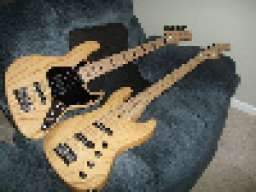
 (except of course, the shape of the instrument itself)