
Enjoy the benefits of a premium membership!
Upgrade Account
-
TalkBass has been independent since 1998. Add your voice.
Create a free account to reply to discussions, view embedded media, and browse with fewer display ads.
Join free Log in
Want zero display ads or expanded classifieds tools? Compare plans.
You are using an out of date browser. It may not display this or other websites correctly.
You should upgrade or use an alternative browser.
You should upgrade or use an alternative browser.
Bass Features: Top Ten Personal Turn-Offs
- Thread starter Debased
- Start date
More options
Who Replied?
24 frets (I like the extra frets and they do get some use from me.)
Accessability (I like to be able to play those extra frets with ease.)
Cheap hardware (The bass should stay in tune and stay intonated.)
EQ's (It needs to have bass, treble, mid and mid freq.)
String Spacing (I like a bass to be around 16-17mm.)
Design (I'd like the bass to look appealing/unique, not just some generic looking bass.)
Hum (I can't stand it when a bass hums when I move my hand away from it.)
Natural or Burst (I prefer the look of a naturally finished bass, or a sunburst or greenburst, blueburst, whatever.)
Weight (I like a light/average bass.)
Accessability (I like to be able to play those extra frets with ease.)
Cheap hardware (The bass should stay in tune and stay intonated.)
EQ's (It needs to have bass, treble, mid and mid freq.)
String Spacing (I like a bass to be around 16-17mm.)
Design (I'd like the bass to look appealing/unique, not just some generic looking bass.)
Hum (I can't stand it when a bass hums when I move my hand away from it.)
Natural or Burst (I prefer the look of a naturally finished bass, or a sunburst or greenburst, blueburst, whatever.)
Weight (I like a light/average bass.)

HI
Cool, Scott. My setup couldnt be simpler. 4 string basses with 2 band pre's, no effects, etc
Rob
Cool, Scott. My setup couldnt be simpler. 4 string basses with 2 band pre's, no effects, etc
Rob

Definitely pickguards. I never use a pick and don't see a need for them. Besides, they never add anything to the bass looks-wise.

Hmmm...
9. Fingerboard level too close to top-of-body level: it can make slapping kind of hard if you can't get your finger in between the body and string easily.
Thanks - interesting observation. Would you say that Ken Smith basses qualify?
Dot inlays - They look like training wheels to me. Soooo "beginner". Side dots are fine, but the ones on the front are just stupid.
Clover tuners - I'm not a Leprechaun. Get those away from me. =/
Really round necks - for some reason I like flatter necks like on my fiver Dean vs. the really round one on my 4 string SX. I can just play easier and it doesn't seem to strain me as much.
Pickguards - Please. I payed good money for an instrument, and I got a Phantom of the Opera reject?
Neck dive - I don't want to hold up my bass. I want my shoulder to do it for me.
The next ones are hypocritical, since I just bought a guitar with ALL of them and still love the guitar despite all of the "turn offs":
Hard finish - Too sticky.
Slab body - not as comfortable as a contoured one.
Inaccessible truss rodd - I have to unscrew the neck to get to it. Sucks.
Non-angled headstock - I don't like string trees. Much rather have an angled headstock.
Clover tuners - I'm not a Leprechaun. Get those away from me. =/
Really round necks - for some reason I like flatter necks like on my fiver Dean vs. the really round one on my 4 string SX. I can just play easier and it doesn't seem to strain me as much.
Pickguards - Please. I payed good money for an instrument, and I got a Phantom of the Opera reject?
Neck dive - I don't want to hold up my bass. I want my shoulder to do it for me.
The next ones are hypocritical, since I just bought a guitar with ALL of them and still love the guitar despite all of the "turn offs":
Hard finish - Too sticky.
Slab body - not as comfortable as a contoured one.
Inaccessible truss rodd - I have to unscrew the neck to get to it. Sucks.
Non-angled headstock - I don't like string trees. Much rather have an angled headstock.
weight: If i want to play standing up i don't want to have to put it down after 10 minutes
too flashy: I don't want my bass to stick out like a pimp
single cuts: I just can't stand that bulge that goes further up the neck
thick neck: I want to be able to reach all the notes easily
4 string player: I wouldn't be apposed to play five or six but i prefer four a lot more
cheap knobs: I hate it when knobs fall off.
less than 4 bolt on neck: Not good enough quality.
Only one bridge pickup: Awkward place to rest my finger
g or e string too close to edge of neck: Exactly why i didn't buy
a peavey grind
way too bright and only bright sounding: I tried an Aria with a single bridge humbucker and it had a great bright sounding slap tone but that's about it.
too flashy: I don't want my bass to stick out like a pimp
single cuts: I just can't stand that bulge that goes further up the neck
thick neck: I want to be able to reach all the notes easily
4 string player: I wouldn't be apposed to play five or six but i prefer four a lot more
cheap knobs: I hate it when knobs fall off.
less than 4 bolt on neck: Not good enough quality.
Only one bridge pickup: Awkward place to rest my finger
g or e string too close to edge of neck: Exactly why i didn't buy
a peavey grind
way too bright and only bright sounding: I tried an Aria with a single bridge humbucker and it had a great bright sounding slap tone but that's about it.

I don't know if I have 10, but
1. Bad trussrod access
2. Muddy tone
3. Elaborate inlays
4. Too heavy
5. No straplocks
6. Stiff action
7. Pick ups in the way
8. Fender style pickup/bridge covers
1. Bad trussrod access
2. Muddy tone
3. Elaborate inlays
4. Too heavy
5. No straplocks
6. Stiff action
7. Pick ups in the way
8. Fender style pickup/bridge covers

3. Active preamps with passive pickups: In my experience you get much more noise than passive/passive or active/active.
I don't get this one. Tons of very good, very quiet basses have passive pickups and active preamps. Active pickups not made by EMG are actually not that common. Yeah, MEC makes them (noisiest pickups around!!!) and Duncan and Bart make a few models, but most aftermarket pickups are passive.
I can live with most things.
I have three deal breakers.
1. A neck heavy bass. One of these almost ruined my left hand. No thanks, I'll take a bass with decent ergonomics.
2. A clublike neck.
3. Basses over 12 pounds.
I don't particularly care for any dark fingerboard woods other than ebony, but I can live with them if the rest of the bass rocks.

Here are my bass turn-offs. I have many other preferences, but these are the features that would prevent me from even considering a bass:
-volume/volume rather than volume/blend (I can't stand this on guitars either) - I don't like to fool around with knobs to lower my volume
-35" scale (I can barely handle 34" and both my basses are 33")
-less than five strings, unless it's a cool vintage short scale bass
-lined fretless - it's distracting and I don't need it.
-wooden pickup covers - it's an electric instrument, get over it, stop trying to hide the pole pieces.
-volume/volume rather than volume/blend (I can't stand this on guitars either) - I don't like to fool around with knobs to lower my volume
-35" scale (I can barely handle 34" and both my basses are 33")
-less than five strings, unless it's a cool vintage short scale bass
-lined fretless - it's distracting and I don't need it.
-wooden pickup covers - it's an electric instrument, get over it, stop trying to hide the pole pieces.
1: Thick necks. I don't want to feel like I have to struggle to get my fingers to the E or B string
2: Wooden pickup covers. I've come around to natural finishes, but there's a difference between letting wood look like wood and making the rest of it look like wood. It's tacky and ugly.
3: Wide string spacing. I don't slap much, so I don't care if it's hard to fit your fingers between the D and G strings, I like my spacing that way so I can move more quickly.
4: More than 5 strings. Extending range downwards is great, if not necessary for what I do, but I never have thought "Man, I wish I could get a higher note". Never.
5: Maple fretboards on most basses. As far as I'm concerned, maple only looks good with natural finished bodies.
6: Jazzes, P-Basses, and Stingrays without pickgaurds. The shape is important, but the pickgaurd is really what's distinctive. Without that, the design just doesn't have the right look.
7: Gloss black finishes. Boring to look at, way too common, and they attract fingerprints like crazy.
8: Non-Black Block Inlays. Don't know why, but it looks terrible. Block inlays only look good in black on maple boards, which in turn, as I said earlier, only look good with natural finishes.
9: Jazz Pickups without a thumbrest. There's simply no way to balance your thumb on those tiny things.
10: "Warwick" on the headstock
2: Wooden pickup covers. I've come around to natural finishes, but there's a difference between letting wood look like wood and making the rest of it look like wood. It's tacky and ugly.
3: Wide string spacing. I don't slap much, so I don't care if it's hard to fit your fingers between the D and G strings, I like my spacing that way so I can move more quickly.
4: More than 5 strings. Extending range downwards is great, if not necessary for what I do, but I never have thought "Man, I wish I could get a higher note". Never.
5: Maple fretboards on most basses. As far as I'm concerned, maple only looks good with natural finished bodies.
6: Jazzes, P-Basses, and Stingrays without pickgaurds. The shape is important, but the pickgaurd is really what's distinctive. Without that, the design just doesn't have the right look.
7: Gloss black finishes. Boring to look at, way too common, and they attract fingerprints like crazy.
8: Non-Black Block Inlays. Don't know why, but it looks terrible. Block inlays only look good in black on maple boards, which in turn, as I said earlier, only look good with natural finishes.
9: Jazz Pickups without a thumbrest. There's simply no way to balance your thumb on those tiny things.
10: "Warwick" on the headstock

The fastest thing that will cause me to put a bass down (I'll try anything) is the sound. If it's dead, uninteresting, and unresponsive, that bass goes back on the rack. If it's treble-heavy and sounds like Fieldy's "bass"lines, then it goes back.
I don't think ergonomics or truss rod access or quick release bridges are that big a deal, as long as the bass SOUNDS phenomenal. Take the Geddy Lee for example. Great feel, incredible sound, but you have to take the pickguard off to get to the truss rod which is a HUGE pain, because the neck is so thin that it keeps requiring adjustment. I've owned the bass a month or two and I've had to adjust the neck twice.. I'm considering cutting a little access nook in the PG and just leaving it on so I can adjust on-the-fly. My Cort A5 requires that I take the A string off to adjust the neck, but it has a more substantial neck and requires very little adjustment.
The sound is the absolute more important aspect for me. That's why I don't have any Ibanez or Schecter or Warwick basses.. I think they all sound tinny and have harsh treble responses.
I don't think ergonomics or truss rod access or quick release bridges are that big a deal, as long as the bass SOUNDS phenomenal. Take the Geddy Lee for example. Great feel, incredible sound, but you have to take the pickguard off to get to the truss rod which is a HUGE pain, because the neck is so thin that it keeps requiring adjustment. I've owned the bass a month or two and I've had to adjust the neck twice.. I'm considering cutting a little access nook in the PG and just leaving it on so I can adjust on-the-fly. My Cort A5 requires that I take the A string off to adjust the neck, but it has a more substantial neck and requires very little adjustment.
The sound is the absolute more important aspect for me. That's why I don't have any Ibanez or Schecter or Warwick basses.. I think they all sound tinny and have harsh treble responses.

Scott in Dallas
Commercial User
- Aug 16, 2005
- 2,084
- 27
- 55
- Disclosures
- Builder and Owner: DJ Ash Guitars
-volume/volume rather than volume/blend (I can't stand this on guitars either) - I don't like to fool around with knobs to lower my volume.
I'm loving my Jazz more and more every day but I'm thinking you have a point with this one. I may convert the second volume to blend at some point to see how I like it; only one volume works when I have the pickups switched to series anyway. I'm having trouble thinking of a downside.

Rakie
Let me take you down, 'cause I'm going to...
aight, this list is gonna sound kinda off, but its honest !
1. Pickguards
2. Jazz Basses
3. P-Basses
4. Musicman basses
5. Narrow string spacing
6. Paint
7. Basses over 9.5lbs
8. Neck heavy basses
9. Cutaways that dont allow access to the higher register
10. Knobs that get in the way of my playing. (Most basses )
)
1. Pickguards
2. Jazz Basses
3. P-Basses
4. Musicman basses
5. Narrow string spacing
6. Paint
7. Basses over 9.5lbs
8. Neck heavy basses
9. Cutaways that dont allow access to the higher register
10. Knobs that get in the way of my playing. (Most basses
)
I've never fully understood why so many people dislike gold hardware. IMO, it looks classy.
Is it that it tends to tarnish easily? (because frankly, that's what I like about gold hardware)
Graeme
Frankly I don't like it because I think its ugly and tacky, but thats just my own opinion. I prefer chrome hardware, I find it to be softer on the eyes, while giving a real nice accent. I also don't like the combination of gold and silver, so if I had gold hardware I'd have to have coated strings or my OCD would drive me nuts.

1.Anything pointy or sharp
2.Unbalanced - ie. neck dive
3.Body too small
4.Fiddly electronics layout
5.Neck too thick - front to back
6.Neck too narrow - widthways
7.Any graphics or lettering on the body
8.Maple or any pale fingerboard
9.Headless
10. Narrow string spacing
2.Unbalanced - ie. neck dive
3.Body too small
4.Fiddly electronics layout
5.Neck too thick - front to back
6.Neck too narrow - widthways
7.Any graphics or lettering on the body
8.Maple or any pale fingerboard
9.Headless
10. Narrow string spacing
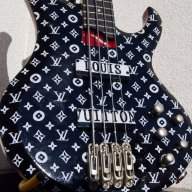
In no particular order...
1. Any number of strings other than four. I mostly play DB and mine has four strings. It's just easier to deal with four. Though basses with fewer strings are a lot of fun they're just less convenient for me.
2. Unsuitable for tuning in fifths - because I tune my DB in fifths. I strongly prefer being able to use the same tuning (CGDA) on BG so it's a big minus if it's difficult to get a good tone out of the low C string.
3. Thin necks. Never liked'em.
4. Narrow string spacing. Even though I have thin bony fingers.
5. Small bodies. I know they're lighter and with the proper design the whole bass can balance well but... I don't know. I just have an unreasonable fondness for overgrown instruments.
6. Too many knobs or switches. I know I wouldn't use'em. Used to own a BC Rich Mockingbird with the old full active electronics. Quickly figured out which setting I liked best (both pickups on and in phase, tone and volume on full, neck pickup in series, bridge in parallel, varitone off, preamp off) and never used any other in the few years I played that bass.
7. Anything too fancy or delicate. In my own way I love excess but I prefer things that I know will still look good with a few scratches and dings. And I have big Texan belt buckles.
8. Light-colored finishes and fingerboards. Dirt doesn't show up as much on darker colors.
9. Poor balance. I play lefty so I've had to put up with some not-so-convenient right-handed basses...
1. Any number of strings other than four. I mostly play DB and mine has four strings. It's just easier to deal with four. Though basses with fewer strings are a lot of fun they're just less convenient for me.
2. Unsuitable for tuning in fifths - because I tune my DB in fifths. I strongly prefer being able to use the same tuning (CGDA) on BG so it's a big minus if it's difficult to get a good tone out of the low C string.
3. Thin necks. Never liked'em.
4. Narrow string spacing. Even though I have thin bony fingers.
5. Small bodies. I know they're lighter and with the proper design the whole bass can balance well but... I don't know. I just have an unreasonable fondness for overgrown instruments.
6. Too many knobs or switches. I know I wouldn't use'em. Used to own a BC Rich Mockingbird with the old full active electronics. Quickly figured out which setting I liked best (both pickups on and in phase, tone and volume on full, neck pickup in series, bridge in parallel, varitone off, preamp off) and never used any other in the few years I played that bass.
7. Anything too fancy or delicate. In my own way I love excess but I prefer things that I know will still look good with a few scratches and dings. And I have big Texan belt buckles.
8. Light-colored finishes and fingerboards. Dirt doesn't show up as much on darker colors.
9. Poor balance. I play lefty so I've had to put up with some not-so-convenient right-handed basses...

I don't understand the "it simply MUST have 21/22/23/24/68 frets" complaint. Does it really that make much of a difference? I've never been playing one of my Fenders and found myself limited by the number of frets.
I've always had this mental image of someone playing a 21 fret bass and going for that high F# on the G string, only to find that the fretboard has ended as their hand goes caroming off and bursting into flames.
I've always had this mental image of someone playing a 21 fret bass and going for that high F# on the G string, only to find that the fretboard has ended as their hand goes caroming off and bursting into flames.
I don't understand the "it simply MUST have 21/22/23/24/68 frets" complaint. Does it really that make much of a difference? I've never been playing one of my Fenders and found myself limited by the number of frets.
I've always had this mental image of someone playing a 21 fret bass and going for that high F# on the G string, only to find that the fretboard has ended as their hand goes caroming off and bursting into flames.
Depends how you're playing..
If you are looking to play high register solos, by using the same patterns that you use in the lower octave, then you will run out of frets...
On the other hand I found that I could get the same effect by using artificial harmonics "a la" Jaco - but this does require a modification of your technique.
In the past in Jazz classes I have always been required to play a solo and it does help to have a bigger range if you are struggling to be inventive - nowdays I feel my technique has improved beyond that stage!!


