• TalkBass has been independent since 1998. Add your voice.
    Create a free account to reply to discussions, view embedded media, and browse with fewer display ads.
    Join freeLog in
    Want zero display ads or expanded classifieds tools? Compare plans.

Bass for each style

I'm from the "one bass to rule them all" school of bass playing.

You see the same basses in all genres. That tells me the instrument doesn't define the music, the player does.

For all of my playing life I've owned one P bass (50 years) and since moving to 5 strings my main basses have been Lakland (14 years), Mike Lull (10 years) and Sadowsky (4 years). I've yet to find a style of music that each of those basses wouldn't comfortably cover.
 
Excuse me if I sound dense, but what is outlaw country?

A marketing term for a sub-genre of country music that emerged in the late 60s/early 70s as a response to what was coming out of Nashville at the time. Top artists associated with outlaw country were Willie Nelson, Waylon Jennings, Merle Haggard, Johnny Cash and Kris Kristofferson and others like Hank Jr, Jerry Jeff Walker, David Allan Coe, Johnny Paycheck....
 
I have 9 basses, but the Rickenbacker 4003, the Reverend Rumblefish with Jazz pickups for harder rock, and the Reverend Fatfish semi hollow with flats or the Normandy hollow body with roundwounds for blues & classic rock cover it all for gigs. The Kala U-Bass is fun from a novelty perspective and offers a big standup like sound when amplified. The Tacoma Thunderchief is great for acoustic jams.
 
I have 4 basses- Jerry Jones Longhorn, Gibson EB0, Rickenbacker, and an old Hagstrom. I can play any style on any one of them by adjusting how I play. Except for slap/tap stuff. I never played in a working band that wanted slapping/tapping anyway.

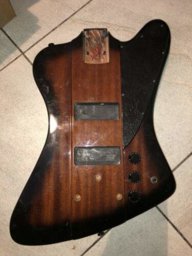
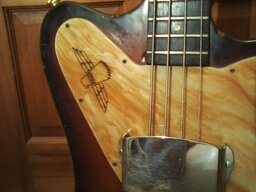
I saw the line of JJs a few years ago...glad to see the Masonite guitars got a real wood motif...
 
  • Like
Reactions: dangevans
Hi guys, just looking to soak up on your expertise: What would you say is the appropriate bass for each music style?
Like P bass for rock (and pretty much anything), J for jazz, funk and reggae, Ibañez or Dean for metal...
Too general...and obvious. Ps ARE good for everything that ails you, but the best rock bass is a Fender Telecaster from '68-'71 while a worthy Jazz bass is a killer funk machine, R&B monster, and way beyond merely adequate at rock!
 
Sure, I use a Ric for everything. Others use a Precision for everything. But what is the stereotypically best bass for each style? Even if it's just a matter of looks.

I'm thinking Precision for country.
Pointy for metal, preferably black.
Old and beat up for blues.
Cheap as possible for punk.
Rickenbacker for prog? Five-string? Six-string?
Jazz-shaped object for jazz?
Star-shaped Precision for funk?
 
  • Like
Reactions: Bexuga
I mean, we all have preferences regardless of style and models, but what I'm asking is what bass is more suited for a style of music, instead of a musician.
It's well established that the musician is more important and that EQ can do wonders to tone, and like someone already said, it will never sound wrong (though it may definitely look wrong), but some basses excel at some styles. There is a reason a Jazz bass is called a Jazz bass.
Actually, the name "Jazz Bass" was used by Leo Fender as a marketing ploy, not because it was intended for any particular style of music. For those who are interested, below is an excerpt from a history of Fender I wrote a few years ago:
"In 1959 Leo and George finally began working on a new model of bass guitar, and in 1960 the Fender Jazz Bass (or simply “J-Bass”) was introduced. Intended as a stablemate for the Jazzmaster guitar that came out in 1958, it was originally introduced as the Deluxe Model (the Jazzmaster guitar had been marketed as a “deluxe" version of the Stratocaster), but then was renamed "Jazz Bass" because Leo thought the redesigned neck, which was narrower and more rounded than the Precision Bass, would appeal more to jazz musicians. Unexpectedly, jazz bassists transitioning from acoustic bass to electric preferred the wider neck of the P-Bass that was more similar to an upright bass, but rock guitarists taking up the bass were immediately very enthusiastic, many preferring the much narrower neck design and wider tonal pallet.

The new thin Jazz Bass neck was only 1 1/2" at the nut and had a slab Brazilian rosewood fingerboard with "clay" dot position markers. For electronics the J-Bass had two single-coil pickups with two pole pieces per string (as opposed to the Precision Bass and its split-humbucking pickup that had been introduced in 1957). This gave the bass a more articulate and much stronger treble response, most likely intended to compete with the Rickenbacker bass that had been introduced in 1957, and was noted for its bright sound. Compared to the Precision Bass, the two single-coil pickups also gave it a totally different sound that offered a good deal more tonal versatility. The original Jazz Bass had two stacked pots that offered individual Tone and Volume controls for each pickup – a novel feature for a bass at the time. By late 1961 Fender had changed the stacked knob controls to a simpler three-knob design where the first two knobs controlled each pickup's volume, and the smaller third knob served as a master tone. The body itself borrowed the new “Offset Waist Contour” from the Jazzmaster, but retained the long “horns” needed to help balance the long neck of a 34” scale instrument. Less symmetrical than the P-Bass, this created a visual sleekness in the Jazz Bass design that, combined with the smaller neck, added improved comfort and ease of play. The bridge was identical to the threaded saddle Precision Bass one, but the mute system was more complicated. Instead of a simple foam strip glued under the bridge cover, the Jazz Bass featured an individual mute for each string. The mute holders were screwed into the body and hidden by the bridge cover, but this set-up was often removed by players. About the same time Fender went to the three-knob design, the individual mute system was also changed to the more basic foam strip that was used on the Precision Bass. It was also sometime in 1962 that Fender would change the slab rosewood fingerboard to a much thinner radiused laminated rosewood board. Final changes came in 1964 when the clay dot markers were replaced with faux pearl dots, and the nitrocellulose pickguard was changed to vinyl. The J-Bass would see other future modifications, but not until after Leo sold Fender to CBS in 1965. Like the Precision, the Jazz Bass became a world standard, and continues to be one of the most influential and copied bass guitar designs."