• TalkBass has been independent since 1998. Add your voice.
    Create a free account to reply to discussions, view embedded media, and browse with fewer display ads.
    Join freeLog in
    Want zero display ads or expanded classifieds tools? Compare plans.

Bass for each style

What would you say is the appropriate bass for each music style?

In the first place, I'm not into each and every music style.

For years, I've been playing fretless exclusively. Worked for styles ranging from blues to funk. Yes, techniques like slapping and touchstyle can be made to work on fretless. And in fifths tuning (CGDA), too.

Said:"Well nobody is slapping on a Rick, so no one should slap on a Rick".

Ricks actually are very nice for slapping (with the right PUs, strings and setup) because of their superior definition. Also the slightly shorter scale (33¼"), the thinner body (1¼"), and the 20-fret board is quite comfortable. The only thing I miss is the more complex sound of hippie sandwiches :bag:
 
  • Like
Reactions: Watchootognbout
Obviously a Fender (or Fender looking) bass is great for classic rock, blues, classic R&B and singer/songwriter stuff. For contemporary R&B, hip hop, modern pop or GB (wedding band) stuff, a five string is almost a necessity. For jazz fusion, an active electronics five string works great. For acoustic gigs without drums, I like either an electric hollowbody or fretless.
 
View attachment 4165962


OP: 'looking the part' is more important in some genres than others. IME: playing/sounding the part is what musicians do --- in any genre. so any competent electric bass + any competent player = any style. no matter what the bass --- or the player --- looks like!


"OK, 'the girl from ipanema', here we go, 1...2...3...4..."
View attachment 4165970

Except for the optical train wreck, there’s no reason this should not work.
 
  • Like
Reactions: JRA
Chris Brubeck plays straight ahead jazz, or anything else he plays, on a Rickenbacker (albeit fretless).

Check out this cool bass solo at 3:19:


"What bass gear have you been playing and trying out?"

"Nothing new for me, I still play my 1969 Rickenbacker 4001 fretless with Rotosound Tru Bass 88 Tapewound strings, through an SWR Electric Blue head and assorted cabinets. Despite not playing upright, I’m a traditionalist in many ways. I still love my connection with this exact piece of wood that I have played for a half century on many recordings with The Dave Brubeck Quartet, The Brubeck Brothers Quartet, Triple Play, and many others. It is an extension of my hands and my brain, and I am grateful we found each other."
 
Last edited:
IMG_20210106_195623012.jpg


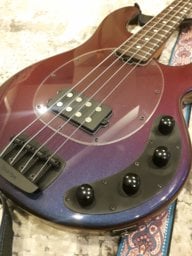
I like to use a Stingray for rock and blues. Then I use a Stingray for metal and funk. A Stingray with flats seems to work fine for jazz, same with the fretless Ray. Then I tend to use a Stingray for anything else. Seems to work for me.
 
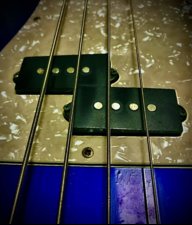
Given the fact that the Jazz bass is one of the most copied basses ever created, my opinion is if you're going to have just one bass for many styles the J is best. But if you can have multiple, a precision bass and a jazz bass would cover any style you would ever need. Maybe throw in a Stingray just incase.
 
  • Like
Reactions: N4860 and Bexuga
I use my P for everything, and my P works for everything I play. But...

If I were in a heavier rock, or funky-nasty band, I might wanna add a P/J or P/MM. If I were doing modern gospel or pit, I might need an active 5. I use my P for bluegrass, but if I wanted to get real I should get a DB. And the right bass for tribute bands, obviously.
 
Well for some people the answer to both of those questions would be the same. Myself included.
I mean, we all have preferences regardless of style and models, but what I'm asking is what bass is more suited for a style of music, instead of a musician.
It's well established that the musician is more important and that EQ can do wonders to tone, and like someone already said, it will never sound wrong (though it may definitely look wrong), but some basses excel at some styles. There is a reason a Jazz bass is called a Jazz bass.
 
Guilty. Didn’t read all the posts. Excuse...tired of online stuff recently, if you know governmentally what I mean.

Something I have learned. If the OP is referring to performing live locally, then the local discrimination dictates choice of bass for whatever. And the way you play it...with pick(s) or fingers and the content of what you contribute.

interestingly, the same applies on a larger scale...semi-pro, pro, recording, choice of bass, how you look...how.you.look.

Welcome discrimination into the fold.

I grew up on sound and content. I evolved into the how.you.look.

And now...due to USA costs of creating and marketing affecting final profits, beats and bass for top tunes are now created with computers. And any live performances are primarily lip-synced, choreographed and have player-synched performers, for “the look”.

Brave new world?

Sorry if I offend. I am still an old dog learning new tricks.
 
There is a reason a Jazz bass is called a Jazz bass.

Nomen est omen :rollno:

Jazz bassists use a wide variety of instruments (and a wide variety of sounds as well).

And, conversely, you can cover a lot of ground with a Jazz Bass.

You really would have to go into extremes like, if you wanted to play both Reggae, Dub, etc., and Phree Phunk. Although you still could use Jazz Basses for both, just with different strings and setup.
 
Hi guys, just looking to soak up on your expertise: What would you say is the appropriate bass for each music style?
Like P bass for rock (and pretty much anything), J for jazz, funk and reggae, Ibañez or Dean for metal...
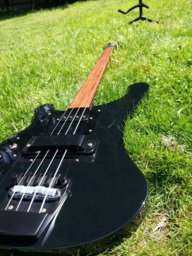
The bass you play the best and like the most is suitable for all music, all styles. You are the bass player; you get to choose the bass.
 
I don't play active basses, but heres my thoughts on passive - To specify i hear Fender or yamaha basses with these details. It also doesn't mean to pickup that bass every time for that genre, it's just what i personally assume to use at first if given the genre of a gig/band and nothing else... Ultimately, i will listen to the recording and try and match the tone exactly, which breaks the below conventions frequently enough.

J for funk, slap, jazz, rock, but can do any style although you might lack lows with some jazz basses- for some styles, requiring adjustment in eq or technique

P with flats- depending on how high your action is which affects thump and sustain- for soul, motown, oldschool, rock, but works with everything - although may lack sustain with high action, and " thump" may not be appropriate in some settings, rare to hear slapped

P with rounds for everything, which will always sound good, but will not be able to emulate a jazz. Might be too naturally "fat" for some situations but can be adjusted with eq, volume or technique.

PJ with rounds for everything, back pickup alone sometimes doesn't cut a jazz usually, but close enough in a pinch and worth the versatility. It's just a P bass with more options.
PJ pickups together is it's own sound, this one is harder for me to classify what genre - since it bassically works for everything as well. Since my PJ is a yamaha, it's a pretty particular sound. It is more smooth, clean, clearer than a p by itself. Maybe more "modern" sounding. Not as hiary as a P. I like it for some 70s/80's/90's, and gospel. I would imagine PJ together sounds most different from brand to brand than p or j alone.

Fretless for when you need fretless.
Active basses of all configurations adds versatility and tonal options. No other comment since i don't use them
Synth basses are another sound, and can be emulated with all the above with different results with pedals/ technique.

Players adjust techinque to compensate on all basses, for all styles when needed.
This is just my version based on the styles i play and personal experience.
Amp is 50% of the equation, the above assumes amp will not lack in any way, or matches the style.
 
  • Like
Reactions: J_Bass and Bexuga