Enjoy the benefits of a premium membership!
Upgrade Account
-
TalkBass has been independent since 1998. Add your voice.
Create a free account to reply to discussions, view embedded media, and browse with fewer display ads.
Join free Log in
Want zero display ads or expanded classifieds tools? Compare plans.
You are using an out of date browser. It may not display this or other websites correctly.
You should upgrade or use an alternative browser.
You should upgrade or use an alternative browser.
bass woods
- Thread starter K Dubbs
- Start date
More options
Who Replied?
Alder. I just like the presence and warmth of Alder in a bass. I have ash basses as well and they are more punchy, buy I prefer the warm tone.
Originally posted by Jugghaid
Alder. I just like the presence and warmth of Alder in a bass. I have ash basses as well and they are more punchy, buy I prefer the warm tone.
*lurking*

I have done some research and it seems that Mahogony and basswood are on in the same...i may be wrong, but as far as i know there is no such thing as a basswood tree. Anyone know anything about this?
This, finally(!), takes this to the point f choice: are we talking objective truth (physics, if you like) or subjective truth (emotional, if you like)?Originally posted by moley
Seriously though, I've been wondering what difference the material (and shape/size I suppose) of the body of bass makes to the sound. Surely to be able to really say what difference it makes you'd have to have a range of basses identical except for the wood they're made of. And you'd have to try different pickups and different strings with the different woods too. Have all you guys who are saying what wood you like actually done this? Or is it just that you like the sound of the bass, so you say you like whatever wood it's made of the best?
I think this thread is about emotional perception of sound. Which is to some extent a function of sound, but also about visual perception, physiological/ergonomical feel, moral perception, etc!
And as that, it is great!
If anybody wants some extra on the physics, use PM (and expect a few days for the answer -looong!). The biological views have been expressed earlier, by JP and perhaps someone else.
Depends on what other materials will be going into the instrument as well. The body material has much less influence on overall tonality than the neck material, and works with the neck material to produce the tone as well.
Most of my basses though, are Alder or Swamp Ash, because they're common as dirt in decent production instruments.
Most of my basses though, are Alder or Swamp Ash, because they're common as dirt in decent production instruments.
I guess my fav for a J-style bass would have to be what i have now..
South American Swamp Ash body, rock mapel neck and ebony finger...great bright attack..but you can that lovely rich warm sound that i dig so0o much....
For more creative shapes......well....Ambonia wood is really rich and deep sounding....but also Walnut give depth and colour...
but still voted for Balsawood
South American Swamp Ash body, rock mapel neck and ebony finger...great bright attack..but you can that lovely rich warm sound that i dig so0o much....
For more creative shapes......well....Ambonia wood is really rich and deep sounding....but also Walnut give depth and colour...
but still voted for Balsawood
I'm very new to the forum here, but thought I'd throw in my 2 cents as I have a few "radical" ideas.
My instruments use Western Red Cedar for the bodies. Very light, highly resonant, a "true" tonewood, ie, commonly used for the best classical guitars, and coming into use over the last 20 years with steel string acoustics.
The main reason for using it is based on my pickup system...a passive "MagPi" design. The cedar really helps to even out and sweeten up the piezo, which is a disc style 'ducer imbedded in a quarter sawn maple bridge. The pickup system itself is based on the interaction between the high capacitance of the piezo, and the high inductance of the magnetic string pickup, which usually is a standard dual coil style humbucker.
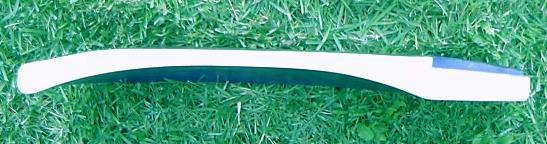
The solid body is then carved very thin, much like the top on a fine jazz guitar, adding resonance and reducing weight.
Here's a photo of a cross sectioned body(this is a guitar body but the bass body is carved the same). Thickness of the body under the bridge is about 5/8".
 .
.
The sound clip below is of a bass I just finished; the neck on this instrument is made from Douglas Fir....again highly resonant and light in weight...and after testing, I found it to be more stiff than mahogany, and WAY more stiff than maple. The FB is pao ferro...(kudos to Mike Powers at Peavey for turning me on to this wonderful lumber...I worked with him for more than 3 years in Mississippi).
Invalid Link Removed
This clip is from Brian Gingrich in Chicago with his jazz quintet. His bass uses a commercial maple/phenolic FB neck.
A real bassist
Thanks for the listen....and this great forum.
My instruments use Western Red Cedar for the bodies. Very light, highly resonant, a "true" tonewood, ie, commonly used for the best classical guitars, and coming into use over the last 20 years with steel string acoustics.
The main reason for using it is based on my pickup system...a passive "MagPi" design. The cedar really helps to even out and sweeten up the piezo, which is a disc style 'ducer imbedded in a quarter sawn maple bridge. The pickup system itself is based on the interaction between the high capacitance of the piezo, and the high inductance of the magnetic string pickup, which usually is a standard dual coil style humbucker.
The solid body is then carved very thin, much like the top on a fine jazz guitar, adding resonance and reducing weight.
Here's a photo of a cross sectioned body(this is a guitar body but the bass body is carved the same). Thickness of the body under the bridge is about 5/8".
The sound clip below is of a bass I just finished; the neck on this instrument is made from Douglas Fir....again highly resonant and light in weight...and after testing, I found it to be more stiff than mahogany, and WAY more stiff than maple. The FB is pao ferro...(kudos to Mike Powers at Peavey for turning me on to this wonderful lumber...I worked with him for more than 3 years in Mississippi).
Invalid Link Removed
This clip is from Brian Gingrich in Chicago with his jazz quintet. His bass uses a commercial maple/phenolic FB neck.
A real bassist
Thanks for the listen....and this great forum.

As long as we're picking nits: The furthest forward and the furthest back fibers of the neck are both under the greatest stress. The fretboard is under the maximum compressive stress; the back of the neck is under the most tensile (stretching) stress.Fuzzbass said:Thanks, geshel, this makes sense. I would nitpick on one thing: seems to me that the convex side of the neck (almost always the side away from the fretboard) undergoes more stress: bend a loaf of bread, and it will break on the convex side, not the concave. I suppose one could argue that the loaf might collapse on the convex side, but I've never known a bass neck to collapse (have I gotten too silly yet?)
As far as wood contributing .0000001% to the tone: ha ha. First of all, the string is vibrating; second, its vibration is altered by interaction with the entire body of the guitar; third, the transducer (pickup) does its best to convert this vibration to an electrical signal; fourth, the electronics alter that signal.
It's kind of like taking a photograph. Yes, the lens, camera, film, processing, printing, print paper, etc all contribute to what the final photo looks like. These elements are like the pickup, electronics, and so forth. But by far the most significant element in how final photo appears is the subject matter that you're photographing. This is equivalent to the moving string! And that motion is intimately influenced by interaction with the guitar, which is mostly wood.
I like maple. I like the brightness it adds and its good weight/density. Silver leaf maple such as my Godin is made of is excellent. Alder would be my second choice, or swamp ash.

Nice explanation. My loaf of bread analogy was lame!pilotjones said:As long as we're picking nits: The furthest forward and the furthest back fibers of the neck are both under the greatest stress. The fretboard is under the maximum compressive stress; the back of the neck is under the most tensile (stretching) stress.
I certainly agree that wood and strings are significant factors, but here's why I disagree that either is the most important: certain basses have very distinctive tones regardless of the wood they're made of. This is due to electronics and pickup placement.pilotjones said:It's kind of like taking a photograph. Yes, the lens, camera, film, processing, printing, print paper, etc all contribute to what the final photo looks like. These elements are like the pickup, electronics, and so forth. But by far the most significant element in how final photo appears is the subject matter that you're photographing. This is equivalent to the moving string! And that motion is intimately influenced by interaction with the guitar, which is mostly wood.
Compare the standard P-bass versus J-bass. This is an extremely effective example because they're pretty much the same instrument (passive, solidbody, bolt-on): the only significant difference between the two is pickups and pickup placement. Point being: even blindfolded, it's easy to tell the difference between a P-bass and a J-bass regardless of strings and woods and playing technique. One could even throw the MM Stingray into this mix: the active preamp would be a giveaway, but a passive Stingray will sound different from both a P-bass and a J-bass due to the large bucker and its placement.
I don't mean to say these basses can never sound similar: it's possible to get P-bass like tones using just the neck pup on the Jazz (because location is nearly the same). But I'd like to hear someone get Jaco tone out of a standard P-bass! On the flip side of that coin, many basses with J-J pups offer Jaco tone when the bridge pup is favored, whether they're bolt-on, neck-thru, multi-lam, ash, alder, bubinga, whatever.
I think we agree here - the influence is probably about equal. To my thinking, the translation of motion to voltage is rather imperfect, plus there's the fact that the pickup can read the motion at different points of the string, which exhibit different motions (sounds). Maybe the metaphor would be more appropriate if it were making a painting rather than a photograph. On the one hand, the choice of media, color palette, and style profoundly influence what you come up with. On the other hand, so does the subject!Fuzzbass said:...
I certainly agree that wood and strings are significant factors, but here's why I disagree that either is the most important: certain basses have very distinctive tones regardless of the wood they're made of. This is due to electronics and pickup placement.
...
no buckeye burl in the choices !!!  thats the best looking wood if ever seen, when the kob is well done its the most beautiful result you can get
thats the best looking wood if ever seen, when the kob is well done its the most beautiful result you can get
There is nothing like ash or maple. They have great attack and plenty of resonance. You can easily tame it or boost the treble and "let the demons out"
Ash and maple just seem to be the most versitile IMO.
Ash and maple just seem to be the most versitile IMO.

for most stuff, I prefer walnut for a fretted and mahogany for a fretless.
if I have a hardcore funk gig, I'm happy with a swamp ash fretted bass.
I'm really intrigued by what Bill Conklin calls dragonwood. I think it might become my favorite all-around tone wood.
from the lows,
Stew
if I have a hardcore funk gig, I'm happy with a swamp ash fretted bass.
I'm really intrigued by what Bill Conklin calls dragonwood. I think it might become my favorite all-around tone wood.
from the lows,
Stew