• TalkBass has been independent since 1998. Add your voice.
    Create a free account to reply to discussions, view embedded media, and browse with fewer display ads.
    Join freeLog in
    Want zero display ads or expanded classifieds tools? Compare plans.

basses for newbies (SX batch build thread)

Status
Not open for further replies.
I have the current MIM Fender Standard Jazz Bass in LPB. It looks great.

Here it is, slightly modded:
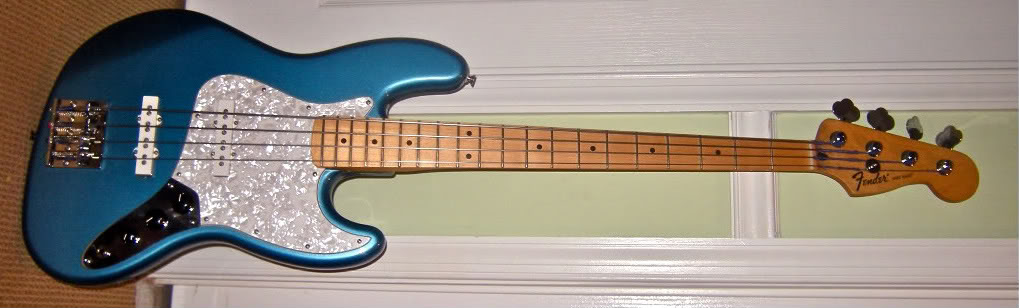
jbass.jpg


Here it is in the catalog:
Invalid Link Removed
Think it would look better with black pups, but maybe I'm just old fashioned.

 
selowitch: love the blue and maple and the pearl pickguard, but I agree with previous poster: black covers on the pickups might look better
A reasonable position; I simply feel that black pickups are just sooooo common. 95% of basses out there have black pickups, so how is that a sign of uniqueness? Note that the white pearloid pickguard matches the white pups better than it appears to in the photo.

Oh, here it is with the white knobs added:
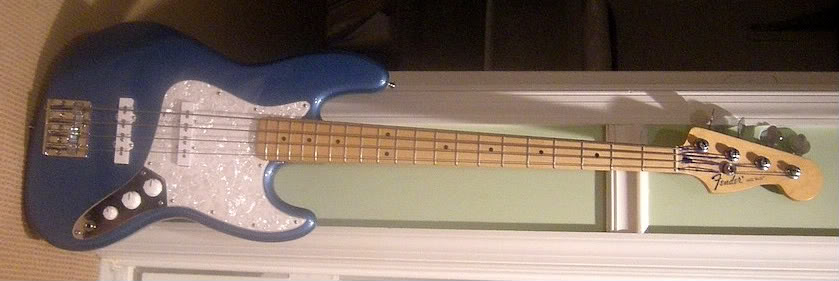
DSCN0375.jpg
 
A reasonable position; I simply feel that black pickups are just sooooo common. 95% of basses out there have black pickups, so how is that a sign of uniqueness? Note that the white pearloid pickguard matches the white pups better than it appears to in the photo.

Oh, here it is with the white knobs added:
DSCN0375.jpg
Neither of us said it was more unique to use black covers. White covers are definitely more unique. But unique doesn't mean better for everyone. Obviously, you prefer them, and that's awesome for you. Some of us just like the good ol' black covers.;)
 
Wow!! What a thread. Takes awhile at one or two pages per day, but I finally caught up with y'all. Quite a lot of good stuff in here Chunger. It will take me some time to digest it. I'm a bit of a tinkerer so tweaking the setup on my new bass wasn't something I was afraid of. You've given me a whole lotta other things to think about, tho'.

I bought an Ibanez GSR200 at my local pawn shop. It's a P/J bass, so I'll have to review your wiring on the P/J's you've done. I know I need to upgrade the shielding because the neck J pickup is buzzy. I also think I'll have to tweak the truss rod and bridge for a better action. At only 4 weeks of learning it's hard to tell if the fret buzz is my fumbling or the setup. Probably a little of both.

Anyway, thanks for sharing all of your trial and error experience. The great photo work helps to see what you are writing about. Maybe you should consider putting this in book form. I'll be glad to ghost write some of it for you ;)

JB
 
Gotta get more momentum on website stuff. . . I think I might just do some google pages work prior to rolling out full blown webstore. I should at least attempt to establish a minimal web presence. NAMM is going to roll right up on me.

Monday will be a critical conversation with factory rep about finalizing specs and speedy builds of a couple production samples.

I am now a Lakland dealer. . . they finally responded to an email sent months ago inquiring about this. This gives me the ability to offer a good step-up option from the SX builds to students at a decent price in the Skyline series. But, in the interim period (prior to hearing back from them), I've been developing a product that interestingly sits in a very similar price bracket if you figure in dealer pricing structure.

It also appears I've been put on the "ignore" list regarding a few inquiries into other amp options for my silly goal of having an end-to-end solution. While I can understand large companies ignoring the squeaky little tire kicker cold calling them about wanting to peddle their products, It does make me kindof mad and eventually that leads to me re-doubling my efforts to provide something to fill the need. So, in collaboration with a few capable/experienced friends, I'm hoping to roll out a simple prototype micro amp concept in time for display at NAMM. It could be a complete flop conceptually. . . or it could be simply too much to bite off for me, but we'll see what if anything comes of it. At least I'll learn something. At the scale I'm looking at though, I don't think I will be able to beat Markbass heads in price, but for raw studio application, I think my amp will be able to beat it in outright tone.
 
Gotta get more momentum on website stuff. . . I think I might just do some google pages work prior to rolling out full blown webstore. I should at least attempt to establish a minimal web presence. NAMM is going to roll right up on me.

Monday will be a critical conversation with factory rep about finalizing specs and speedy builds of a couple production samples.

I am now a Lakland dealer. . . they finally responded to an email sent months ago inquiring about this. This gives me the ability to offer a good step-up option from the SX builds to students at a decent price in the Skyline series. But, in the interim period (prior to hearing back from them), I've been developing a product that interestingly sits in a very similar price bracket if you figure in dealer pricing structure.

It also appears I've been put on the "ignore" list regarding a few inquiries into other amp options for my silly goal of having an end-to-end solution. While I can understand large companies ignoring the squeaky little tire kicker cold calling them about wanting to peddle their products, It does make me kindof mad and eventually that leads to me re-doubling my efforts to provide something to fill the need. So, in collaboration with a few capable/experienced friends, I'm hoping to roll out a simple prototype micro amp concept in time for display at NAMM. It could be a complete flop conceptually. . . or it could be simply too much to bite off for me, but we'll see what if anything comes of it. At least I'll learn something. At the scale I'm looking at though, I don't think I will be able to beat Markbass heads in price, but for raw studio application, I think my amp will be able to beat it.
A chunger amp? Now THAT I'd like to see.
 
It also appears I've been put on the "ignore" list regarding a few inquiries into other amp options for my silly goal of having an end-to-end solution. While I can understand large companies ignoring the squeaky little tire kicker cold calling them about wanting to peddle their products, It does make me kindof mad and eventually that leads to me re-doubling my efforts to provide something to fill the need. So, in collaboration with a few capable/experienced friends, I'm hoping to roll out a simple prototype micro amp concept in time for display at NAMM. It could be a complete flop conceptually. . . or it could be simply too much to bite off for me, but we'll see what if anything comes of it. At least I'll learn something. At the scale I'm looking at though, I don't think I will be able to beat Markbass heads in price, but for raw studio application, I think my amp will be able to beat it in outright tone.

Yeah a nifty amp would be cool. I've been pondering this myself with an eye toward a super light weight but superior tone rig. My ideas are toward the usual class D amps and some super light weight speaker cabs (honeycomb?) with neos in them. Of course a couple of G-K MB500s are a lot of cash. Which is why the following was of some interest:
http://www.amazon.com/Class-Audio-Amplifier-Audiophile-Quality/dp/B002EDT0IO

This could easily replace my current rig which is a Fender PA amp (1 rack space and 850 watts...discontinued of course.. why is it that Fender just comes up with the greatest things and then won't wait for them to be discovered and catch on so they discontinue them and they fade from view as if they've never been invented! I sure wish someone would build a reasonably priced 5 string P bass! Feh. By the way I did manage to score some "real" Fender 5 string P bass pickups right after they discontinued them!)

Let me note that as far as I know nearly all of the "micro" D amps use some kind of circuit boards from some European OEM supplier. I used to have the link but I seem to have lost it. They have most of the basic units to put micro amps together. But as far as I could tell there might be an "ignore" problem if you tried to contact them.

The deal with all this is that the large amp approach means some sort of bass preamp with controls and shaping is required. I just use my BXR 200 as the front end and it works great but weighs a ton! But the whole system is rather pieced together. As you say a nice integrated system is the answer. Especially one that is light and doesn't require selling your organs to purchase.

I guess I can just dream on...
 
As an Amazon Associate, TalkBass may receive commissions from qualifying purchases made via links on this site.
Can't leave nice things in the studio. . . people start picking them up and pounding on them :D

[Note: Signal chain unknown as I did not engineer this recording. . . I assume a direct path of some type]
stats.png


That's my friend Diz on #17. He asked me to leave it at the studio for him to check out. Interesting that this one attracted him after listening to the posted sound clips. He was also in the camp that preferred adamantly #2 sounded better than #3. But obviously, his preferred playing style is particular. Goes to show how subjective the grading process can be. Someone may actually like what I deem to be a "standard grade" instrument better.

My idea for amp development is fairly simple. . . create a modular "mini-stack" system. I will utilize an OEM class D power amp module and package it pretty small in it's own box. Then, I'm planning to make separate module boxes to the 1.5"x 5.25" GroupDIY 51x standard (Also API 500 series "lunchbox" compatible). The power amp module would also need to supply the required DC voltages (48v, +24v, -24v, +15v, -15v) with enough juice to probably power min. 2 max 4 modules. Cases would either need to nest or a carrier frame made that can accept the models.

This way, the system is scalable and customizable. I cut development time because I can tap into the slew of great preamps, EQ's, compressors, and limiters already available both commercial and DIY in 500 series form. Someone can opt to run just a preamp and the power amp, or they can run pre-->EQ-->COMP-->poweramp. .. or whatever configuration they want. Alternately, someone may decide to just get a pedal pre like an Aguilar Tone Hammer and just run straight into the compact power amp for a really small setup.

I get back to my studio roots a bit because you get to bring your actual recording studio signal chain with you . . live. As a not-so-small bonus, this system would not be confined to use for bass guitar, and I can see it being useful as a studio mic pre (or several) to bring to a session. It could also be attached to a different speaker for acoustic guitar. Hell, a singer could decide to bring it with them paired with a floor wedge for their own personal vocal monitoring setup on gig.

A variable or switched high pass filter would probably be prudent on the power amp module. Also, in the future, to reduce cost (the 500 series modules are typically quite pricey), I may work on getting a dedicated bass pre module made that includes preamp, shelving high EQ, shelving low EQ, fixed or semi-parametric mid EQ. . . built to a more reasonable price point than all-out studio pre and EQ modules.

Maybe make a "practice module" that has a stereo line input for ipod or laptop, a mix knob for that input as well as a headphone jack. Leave the practice module at home when you go on gig or session.

Just kickin' things around ideas. I have no doubt a complete system would be expensive, but at least if you don't like the way a certain pre sounds, you don't have to ditch the entire amp setup. You can change out the offending component and work towards your desired tone and voicing as opposed to selling the entire thing. Also, as amplifiers get smaller and more powerful, the system can be upgraded incrementally.
 
Can't leave nice things in the studio. . . people start picking them up and pounding on them :D


stats.png


That's my friend Diz on #17. He asked me to leave it at the studio for him to check out. Interesting that this one attracted him after listening to the posted sound clips. He was also in the camp that preferred adamantly #2 sounded better than #3. But obviously, his preferred playing style is particular. Goes to show how subjective the grading process can be. Someone may actually like what I deem to be a "standard grade" instrument better.

My idea for amp development is fairly simple. . . create a modular "mini-stack" system. I will utilize an OEM class D power amp module and package it pretty small in it's own box. Then, I'm planning to make separate module boxes to the 1.5"x 5.25" GroupDIY 51x standard (Also API 500 series "lunchbox" compatible). The power amp module would also need to supply the required DC voltages (48v, +24v, -24v, +15v, -15v) with enough juice to probably power min. 2 max 4 modules. Cases would either need to nest or a carrier frame made that can accept the models.

This way, the system is scalable and customizable. I cut development time because I can tap into the slew of great preamps, EQ's, compressors, and limiters already available both commercial and DIY in 500 series form. Someone can opt to run just a preamp and the power amp, or they can run pre-->EQ-->COMP-->poweramp. .. or whatever configuration they want. Alternately, someone may decide to just get a pedal pre like an Aguilar Tone Hammer and just run straight into the compact power amp for a really small setup.

I get back to my studio roots a bit because you get to bring your actual recording studio signal chain with you . . live. As a not-so-small bonus, this system would not be confined to use for bass guitar, and I can see it being useful as a studio mic pre (or several) to bring to a session. It could also be attached to a different speaker for acoustic guitar. Hell, a singer could decide to bring it with them paired with a floor wedge for their own personal vocal monitoring setup on gig.

A variable or switched high pass filter would probably be prudent on the power amp module. Also, in the future, to reduce cost (the 500 series modules are typically quite pricey), I may work on getting a dedicated bass pre module made that includes preamp, shelving high EQ, shelving low EQ, fixed or semi-parametric mid EQ. . . built to a more reasonable price point than all-out studio pre's.

Maybe make a "practice module" that has a stereo line input for ipod or laptop, a mix knob for that input as well as a headphone jack. Leave the practice module at home when you go on gig or session.

Just kickin' things around ideas. I have no doubt a complete system would be expensive, but at least if you don't like the way a certain pre sounds, you don't have to ditch the entire amp setup. You can change out the offending component and work towards your desired tone and voicing as opposed to selling the entire thing. Also, as amplifiers get smaller and more powerful, the system can be upgraded incrementally.
I know little enough about amps that a lot of that went over my head...lol

My idea for an amp for a while has been to have a rack that has a power amp, pre amp, tuner, compressor, 4 or more band fully parametric EQ (digital preferably but analog would work fine), two seperate high pass filters (one for monitor send and one for FOH or speaker cab send) and a place to put effects.

Sounds like we're sorta kind on the same track, I'm actually more interested in this than I am in the basses I think:hiding:
 
So much talk. . . so little bass. . . :hiding:

Back to the usual shenanigans! Let me start out by saying:

p470948600-5.jpg


:bassist::bassist::bassist::bassist:

You may recall several months ago, someone on the forum mentioned in passing that these might be super cool bridges. I then contacted Jeff Babicz out of the blue because I was looking for a nice locked down bridge to use on these builds. . . Anyways, months and months pass and these things seem to be perpetually out of stock + production problems in the summer. Finally, I get some samples in hand to test. I've been waiting for this to put on the "pass-around" bass (#9)

I made some really great discoveries concerning SX application of the Babicz FCH bridges.

p379119002-5.jpg


One of the main problems with these SX's is the stock SX bridges are very low (lower than stock Fender) and certainly lower than most aftermarket bridges. Plus, major consistency problems in the SX neck pockets make it so 90% of SX's need to be shimmed in order to run good action. I have used Gotoh 201 in #3, but had to remove the Gotoh saddles and use the stock SX ones because it would not go low enough and I was not willing to shim the bass any more.

Here is some excellent news.

The Babicz FCH bridge goes down to .361" at near its lowest setting.

p413760517-5.jpg


With saddles nearly bottomed out, the stock SX bridge goes down to .370".

p302249938-5.jpg


This means the Babicz bridge goes ~.010" lower than the stock SX bridge and if you can get a good setup on stock bridge, you will be able to install a Babicz FCH bridge without any problems with further shimming, and that's awesome. This by itself puts the FCH at the top of my list as the go-to bridge mod for an SX.

It looked like 3 of the 5 screws would not be able to clear for installation without removing most of the saddles.

p319221951-5.jpg


Removing the stock SX bridge

p260305282-5.jpg


So nice to see your own setup underneath :) No issues with grounding here!

p229039669-6.jpg


The holes line up perfectly with stock SX

p344348515-5.jpg


I'm changing over my standard string to DR low-riders so I figured I'd start here with the pass-around bass

p195672472-5.jpg


And, after another wrestling match with this neck to get a decent setup. . .

p289053618-5.jpg


I think I may PLEK this bass because I know it can run better than it is. But, I did chase down a buzzy E string and discovered that the nut @ the E string was not cut as low as the other strings. Remember, 1/2 of your action is in the nut if you're measuring at the 12th fret. This put the bass in line with the other builds, but it is not one of the very best I have.

I cannot tell for certain if this bridge sounds superior to other upgrade bridge options out there. It does, however get the job done. It is a very solid unit. There is zero side to side string motion, and sustain and punch are improved all up and down the fretboard. But, most importantly for me, it fits ideally on these wonky SX's that are "custom handmade".

I must admit, the DR strings to me are not as fun as the Dunlop ones, but I do see Jasaman's point about the Dunlops going a little weird on you sonically when pushed, and I have not been terribly impressed with string longevity on the Dunlops in the time I've been using them. I think my go-to string at this point for these SX builds is the Cool Blue Extra Life DR's, but the high cost keeps me from using them as standard. The Lo-riders are very "down to business" and precise. They are not as floppy and loose like the Dunlops. There is a bit less treble sheen on them than the Dunlops, but IME they last longer and I have plenty of top end on these prototype jazz pickups. An all-around solid string for most uses. Not as fun and flexy though on the fingers when you pick up the bass.

p314627698-5.jpg
 
Status
Not open for further replies.

Latest posts