• TalkBass has been independent since 1998. Add your voice.
    Create a free account to reply to discussions, view embedded media, and browse with fewer display ads.
    Join freeLog in
    Want zero display ads or expanded classifieds tools? Compare plans.

Bassists seem to always crank both pickups...

Blended pickup J is a pretty staple sound. If an individual player or two has problems making a Jazz bass sound intelligible with pickups blended, I'd look to the instrument or the player's technique. But if *no* blended-pickup J ever sounds good in your FOH mixes, the problem's likely downstream of the instrument's output jack.
 
The passive Jazz bass tone that works for me is both pickups 100%, tone 60-100% (depending on the room, speakers, etc), some compression and a little bit of mid boost on my preamp. At the board no additional eq'ing is necessary.
 
Oddly, I've had two players with viola/Beatles style basses. Those don't generally seem very common, but have been at church lately. On the bright side, they aren't active (so no bass boosting) but both players have had crank-both-pickups-itis.

That is surprising, the bridge pups on most viola's are (IMO) meh at best... I do blend it with the neck to get some RIC like tone, but never at more than 30%.
 
Two points: 1. For gigs I generally leave my bass output level with some room to spare in case things get unexpectedly (or not unexpectedly, unfortunately) loud during a song, and in general I'm a little hesitant to leave pots 100% pinned. 2. I notice on my old G&L L-2000 E that there appears to be some sort of cancellation or "sterility" of sound that I observe with both pups engaged. The thing sounds better and somehow "truer" to me with just the neck pickup selected.
 
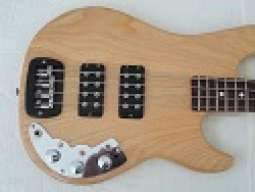
We have a rotation of players who all have their own basses. One thing I have noticed is that bass players who bring a bass with two pickups.......99% of them crank both pickup volumes (or have the blend knob dead center).

WOW. Just wow. I was positively shocked at reading this. I spent a lot of time on how to respond effectively and politely. I don't think I did a very good job with what I came up with, but regardless, here goes...

I played bass for 21 years, 14 with a road band, struggling with record deals and all the crap that goes with it.

After that, I entered the sound business and became a pro sound guy, mixing for several region groups and assembling, tech-ing, maintaining, and deploying the largest PA in the state (which, considering the state, isn't saying a whole lot, but we did with with several hundred national acts over my 21 years with this company). I am still the FOH guy for the MS Symphony Orchestra, and for two years, I've been playing bass again, pretty much full-time, while working part-time at that PA company doing repairs and up-keep.

All this to just list my references and resume before I make my response.

As a soundguy....I have never....EVER...felt the need to ask a bassist to adjust the balance between the pickups on his instrument. EVER. I've run into other issues (buzzing, bad cords, sloppy technique, etc), some things I can address, some things I can't. But one mantra I followed my entire career was to never tell a player how to set his instrument. I would offer solutions to problems (the aforementioned hums and buzzes), but I left their sound and tone alone, UNLESS ASKED, which did happen from time to time. What I was getting wasn't always pleasant, but I worked with it as best I could. I don't know where I stand in terms of being a good or bad soundguy, but bands and musicians loved me for the reasons I stated. As for basses, I understand that some settings will scoop the tone somewhat. I never ran into a bass sound I couldn't do something with, unless the stage volume was over-bearing. Again, I wasn't going to say anything to the player unless asked.

As a bassist...I've never...EVER had a soundguy tell me that the balance of the pickups on my Jazz bass needed adjusting because of problems with the tone. I set them both at 100% for the Jazz bass sound. The phase issues you mention aren't phase issues. Phase issues are a result of problems with time and frequency. In the case of a bass, you'd have to have the signal from one pickup slightly (in milliseconds) delayed or behind the other, causing a null (cancellation) when the two signals are combined. I can't see this happening with the bass. In the case of Jazz basses, I think (guitar techs, tell me if this is incorrect and what the real answer is) the two pickups are wired out of POLARITY (BIG difference between phase and polarity. It will expand your PA knowledge greatly when you learn the difference). This is why each pickup might pick up hum separately, but when combined, they (mostly) cancel the noise. Other pickup arrangements offer dual-coil pickups with switches to make the coils parallel or in series. You might be dealing with with some of this with the other players basses.

You may have other issues as well, but I'm trying to wrap this up quickly as I have other tasks to get to tonight. But I felt this really needed addressing. You really need to look elsewhere for the problems you are experiencing. Or perhaps a bass just has problems that need to be repaired.

Good luck....

Well done, Geri O! Restrained, too. It's always nice to see hyperbole and nonsense pointed out here so that newbies and non-tech guys aren't wrongly influenced by dramatic posters of such.

To add to GeriO's comments above..
How can you even tell what position the pots on a bass - active or passive - unless you ask or get up close??

He can't, case closed. But good question to point out the absurdity.


Geri O: I'm not extremely well versed on the science of even blended pickups, but the way I understand, it is related to each picking up the same notes at differing points on the string at different levels with differing harmonics. And those cancel each other out to some degree.

s0c9: I can usually tell by ear from the sound booth. Then I ask to confirm what I am hearing. I'd say I have 80% to 90% accuracy.

This is beyond hilarious. Also, you said 99% of bassists max out PUPS, or center them. Consequently, you should have much higher accuracy than 80-90% since that 1 guy in 100 should really stand out since the other 99 will sound bad due to their silly centered PUPs. Or does your 80-90% factor in your guessing of eq knob settings, too, in which case I'd LOVE to see that!!!! I can't even tell you where my knobs are at any given time.

By the way, how many bassists does your church have? Tell them to come on TB and discuss the situations y'all have had so we can get some perspective of your superiority.
 
  • Like
Reactions: s0c9 and Geri O
I always have both PUs at 100% running into a compressor. The only time I have experienced a problem playing was when the sound guy had the gain turned up WAY too high--just touching the string was a nasty sound. Some instruments need a little more gain than others, sometimes different pedals have different outputs from the guy who was there the previous week. Recommend you zero the gain, put the volume in the position it normally runs then bring up the gain while the bass plays. If it starts to break down / distort lower the gain. Once the gain is set use the volume to get the level you want. I don't mind folks asking for a particular sound but I do resent them telling me how to adjust my equipment.
 
I think a lot of players just set all knobs on their guitar/bass on 10 and adjust the amp. Generally, I will do that, adjust the amp how I want, and make any small tone or volume changes from my bass - but most of what I do is one pickup and passive.

If it is an issue, take a few minutes with them to get a better sound from them. They will probably appreciate that you are actually listening to them. How many threads do we have here with "all the sound man does is hand me a DI and doesn't care how I sound"?
 
I keep everything centered and change the tone by moving my hands.

I like things that are idiot proof - if I like the sound, how can I remember the exact position of the pots? Was it 65-35 neck pickup? A 10% bass bump? Maybe it was 15% high cut...? What about the Mids?

Nope - I put everything into it's center detent and use my hands to change the attack or basic shaping of the sound. From there, it goes into my pedal board that has 3 presets that I use, and then to my amp which never changes. The KISS rule has saved me a lot of grief.
 
I've only played JJ and PJ basses for many years.

I hardly ever use both pickups at the same volume.

Currently using Dimarzio Area J sets (4 and 5 string), Dimarzio Area PJ set, and Fender Super 55 J set.

Same thing when using older basses with Seymour Duncan SPB-1 and STK-J2 sets.

All sets mentioned are hum-cancel.

I like to use a variety of sounds depending on the song being played.

That might disturb some sound men, ha.
 
Last edited:
I think a lot of players just set all knobs on their guitar/bass on 10 and adjust the amp. Generally, I will do that, adjust the amp how I want, and make any small tone or volume changes from my bass - but most of what I do is one pickup and passive.

If it is an issue, take a few minutes with them to get a better sound from them. They will probably appreciate that you are actually listening to them. How many threads do we have here with "all the sound man does is hand me a DI and doesn't care how I sound"?

Thanks for that post. No matter how poorly worded my OP was, my goal is to help players sound as good as possible in our sanctuary. I've only been running sound a couple years and no doubt have a lot to learn, but I am sharing what experiences I've had and what my ears have heard. Running sound is not an easy job especially in a church with so many variables, rotations of players, different levels of talent, etc. It would be easy to just do the minimal amount of work to get through each service (I've seen that with other sound people), but I truly have a heart for wanting it to sound good. And that sometimes means trying to fix things at the source.....especially with new players with little experience. But this thread has been enlightening as to how dangerous that ground is and is certainly causing me to rethink when and what to say to those on stage, and when to just deal with what I am given and try to do my best with it.
 
Last edited:
Not sure if this was already mentioned, but if all bassists are going DI, they may not be hearing what they want / expect from the monitors. This could be causing them to add in too much bass, etc so it sounds better to them on stage.. but will ultimately hurt their sound out to FOH.

I have been in this situation before. The sound guy and myself had a quick chat, he EQ'd my monitor a bit so I sounded better to myself on stage, I put my preamp closer to how I normally have it so I sounded good out front and we were off to the races.
 
I play a passive-wired Fender PJ, and I sometimes roll off the J pickup volume by 25 or 50%. Sometimes I don't. I just try to hear its tone on whatever stage I'm playing and do what sounds right -- it also depends on whether I'm playing at church or with my original pop-rock band. Maybe I should experiment more with soloing the P pickup or even going the other way and leaning more on the J, but I try to do what feels and sounds comfortable. Not sure if this helps?
 
on my beatle bass I did crank both pickups, generally. They're so far apart that either pickup alone was too extreme, too bassy or too trebly.
on the two humbucker bass I play at rehearsal (alvarez) I prefer to use either pickup alone. I get two different, usable tones out of it
On my jazz bass I'm a convert to the gospel of using one pickup on full and the other dialed back to about 3/4. It opens up the tone nicely.

EDIT: I do play an epi les paul in one band, and I will state that unequivocally that guitar sounds better with the volume knobs dialed back to about half, regardless of the amp settings.
At least on some instruments the difference is obvious.
 
Last edited:
Much better if bassist switch pickups, blends, eq as they see fit for each song, or even the middle of songs. And thier pre-amp has presets they can switch as they see fit. eDrummers switch kits. Guitarist with their big pedal boards, and Keyboards with their 10,000 instruments on board.

Nothing like letting a sound engineer earns their position.
 
I keep everything centered and change the tone by moving my hands.

I like things that are idiot proof - if I like the sound, how can I remember the exact position of the pots? Was it 65-35 neck pickup? A 10% bass bump? Maybe it was 15% high cut...? What about the Mids?

Nope - I put everything into it's center detent and use my hands to change the attack or basic shaping of the sound. From there, it goes into my pedal board that has 3 presets that I use, and then to my amp which never changes. The KISS rule has saved me a lot of grief.

Your second paragraph is exactly my approach to tone and volume on the bass. I want the preamp, don't get me wrong, but I'll never use it, save for rolling off the treble on mellow tunes.

Heck, I don't even have a pedal board! Kinda scared of it, but like everything else, that could change...:D
 
  • Like
Reactions: tfer
As others have said... If you are running a Fender Jazz Bass, dialing up both pups to 100% is the recipe for the classic J Bass tone. Depending on the particular instrument, some of my early 70s Js sound a bit growlier with the neck pickup dialed back about 20% from full volume, while others have the best overall tone with 2x100%.

Now when it comes to a Rickenbacker 4001 or 4003, I find it a lot more involved to get the perfect Ricky tone than just cranking both pups to full volume.

All depends on the instrument you are using and what amp/mixing console/DI Box you are running it through.
 
When I'm playing with a band, I love having both pickups up on a Jazz Bass. It sounds great and I've never had a problem with phasing or had any complaints from sound guys. If I'm playing a solo, harmonics that I really want to pop, or I want a Jaco-esque tone for a song, then I'll solo the bridge pickup. But 90% of the time, I have both pickups cranked and love that tone.