• TalkBass has been independent since 1998. Add your voice.
    Create a free account to reply to discussions, view embedded media, and browse with fewer display ads.
    Join freeLog in
    Want zero display ads or expanded classifieds tools? Compare plans.

bassists who play drop F#

Wow. So you're talking about going down from the low E all the way to F#? That's almost an octave down. I can't imagine there'd be enough string tension to be playable.

I know that double bassists use F#BEA in some classical pieces -- it's called "soloist" or "Viennese" tuning (as opposed to "standard" or "orchestral" tuning, EADG). However, Viennese tuning is a whole step above standard; not below.

I think the Dittersdorf and Vanhal concertos are normally played in that tuning. Possibly even Bottesini's, as well.
 
Do you know any bassists that play in drop F#? Like this:

F#-B-E-A etc. Warwick makes the Vampyre Dark Lord in that, and im curious if anyonje you know pro or not, plays with an F# string.

Juaqo III-X does. He has a bass that (I believe) goes C#-F#-B-E and has recorded an album with it. You might want to PM him if you have specific questions.

Drop refers to a tuning that has the lowest string dropped an additional step, like D-A-D-G instead of E-A-D-G.

F#-B-E-A is simply a fourths-based tuning (just as standard E-A-D-G is) that begins on F#0.

Good point. If you were to take a 5 string (or a 4 tuned BEAD) and try to drop each string that far I doubt you'd get anything but mud.
 
When my Labella roundwound tapercore .185 wears out I'll probably be getting a .169 from Gary Goodman, at octave4plus.com

OctaveZeroEnv%20169.jpg


...Realize that on a 34" or 35"-scale bass that the results might not be as tonally satisfying to you as I found they were on the 39.5"-scale KNUCKLE QUAKE, from Link Removed.

Link Removed

The QUAKE is designed very erogonomically, so even someone with my modest reach found it easy to play down by the nut in spite of the elongated scale. What an authoritative sound!
 
If you can't get the tones you want from a bass with a low B, then you probably hear too good. When it's getting deeper than a B it's getting pretty hard to have an idea of which tone is actually being played. The F# is like 23 hz, and that's DEEP. More thunder than a musical tone imo. Good if you hate your neighbors :P
 
If you can't get the tones you want from a bass with a low B, then you probably hear too good. When it's getting deeper than a B it's getting pretty hard to have an idea of which tone is actually being played. The F# is like 23 hz, and that's DEEP. More thunder than a musical tone imo. Good if you hate your neighbors :P

You must not have ever really listened to the bass notes you play. They are comprised of many overtones from the natural overtone series. As a note is attacked and then decays the various overtones change in energy and balance in relation to the other overtones. This is good because if every instrument had fundamentals only they would all sound pretty much the same when playing the same pitches.

For electric bass low notes, almost always the fundamental is actually a weaker component than the next several overtones, which are an octave up, then an octave-and-a-fifth-up, then two octaves up, and so on: each harmonic a multiple of the fundamental frequency. Ferinstance with a 23 Hz fundamental, the first few overtones are 23 * 2 (46 Hz), 23 * 3 (69 Hz), 23 * 4 (92 Hz), etc.

Here's a pic of the first 16 overtones a low F pitch can make, just to illustrate the natural overtone series:

Invalid Link Removed
 
Do you know any bassists that play in drop F#? Like this:

F#-B-E-A etc. Warwick makes the Vampyre Dark Lord in that, and im curious if anyonje you know pro or not, plays with an F# string.
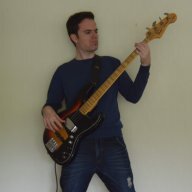
look up extended range bassists like jeff owen, or jeff hughell, they play a 7 string bass, ChaotH, or gregory bruce campbell, they both play a 9 string bass, scott plummer of viraemia (best in my opinion) plays a 10 string bass or jean baudin, he plays a 12 string bass