• TalkBass has been independent since 1998. Add your voice.
    Create a free account to reply to discussions, view embedded media, and browse with fewer display ads.
    Join freeLog in
    Want zero display ads or expanded classifieds tools? Compare plans.

Battle of the B-Strings!

IMO and IME (and according to the laws of physics) the scale makes a difference if all remaining parameters remain constant. If there was no such case, then the C note (pitch-wise) should have the same sound played on the 13th fret of a Low B, on the 8th fret of the low E and on the 3rd fret of the A. Another extreme example is to start detuning a string half a step at a time while fretting the string higher to keep the pitch contact. While the given note will still sound in pitch, the rest of the overtones will start muddy-ing up.

I do have to agree though, that any well made bass, when properly set-up, it will give you the best possible sound
:cool:
I hear what your saying.
I agree.
My point is, a JP 33" scale 5-string.
And, a Stambaugh 33" scale 5-string.
I played, both had killer B strings.
Along with the Roscoe 34" 5-string.
I have no problem playing a 35" scale.
I beleive it is the sum of all the parts.
That make a great bass.

If Rob Allan made a 5-string 31" Mouse bass.
I thing because of that design, the B-string would sound very good.
As to say, a bad designed, 35" 5-string.
Just, food for thought?
 
I do have to agree though, that any well made bass, when properly set-up, it will give you the best possible sound
:cool:
I hear what your saying.
I agree.
My point is, a JP 33" scale 5-string.
And, a Stambaugh 33" scale 5-string.
I played, both had killer B strings.
Along with the Roscoe 34" 5-string.
I have no problem playing a 35" scale.
I beleive it is the sum of all the parts.
That make a great bass.

If Rob Allan made a 5-string 31" Mouse bass.
I thing because of that design, the B-string would sound very good.
As to say, a bad designed, 35" 5-string.
Just, food for thought?

JP and CB also had some phenomenal low B strings in 32" scale as well. I'm not sure if we'd get the desired low B out of a Rob Allen as much as we'd hope for in shorter scale lengths. I'm not sure how feasible it is to allow for very rigid construction and the semi-acoustic resonance he desires.
 
D-I-N-G-W-A-L-L...nuff said...but now that ya got me talking, I played a Yamaha BB5000 for 14 years. Great bass, killer B, with a neck wide enough to land a 747 on. For the last couple of years that I played the Yamahammer, I was in search of replacement, as I had beat it silly and the neck was delaminating. I played Smiths, Modulus', Music Man, Pedulla, Peavey Cirrus, Fenders, Sadowski's, Warrior's, and about everything I could get my mitts on. Nothing did the trick, until I tried a Dingwall Afterburner II. Bought it on the spot and have never looked back. Fabulous instrument! With a B string that is amazing, having both definition and girth, and great tones both passive and active, this beast has it all. From Rickenbacker clank, to P-Bass growl, to J-Bass definition, this truly is a bass for all seasons. If I was stranded on a desert island, and had the choice between my '61 slab board P, my '73 Rick, or the Dinger, the choice would be easy. Thank you Sheldon Dingwall! :hyper:
 
When comparing B-strings, isn't it important to note where you play? tension-wise this should make a difference. Maybe the reason bass X feels 'floppier' than bass Y is just because the neck pickup on bass X where you anchor the thumb is mounted further from the bridge.
 
When comparing B-strings, isn't it important to note where you play? tension-wise this should make a difference. Maybe the reason bass X feels 'floppier' than bass Y is just because the neck pickup on bass X where you anchor the thumb is mounted further from the bridge.

The position of the bass side of the neck pickup has to do only with the tone provided, not with the "Floppier" feeling. My Dingwall Voodoo has the pickups perpendicular to the strings, resulting to having the bass side of the neck pickup closer to the neck (compared to my other Dingwalls); the sound of it is thunderous (Dingwall trade-mark) with an added dimension of extra depth due to the area of the string that the pickup senses. It doesn't feel sloppier, floppier or looser at all
 
As the owner of 2 Dingwall 5-string basses, I know what MY solution is. I'm a believer in physics--quantitative science.

All things being equal, the bass with the longer scale length will have higher tension at the same pitch.

Same thing with string gauge--the thicker the string, the higher the tension. Problem is, a string too thick will start to sound thuddy and dead.

I've played a TON of really nice 5-string basses and tended to be underwhelmed by most of them (Laklands are a notable exception) but the DIngwalls were the first basses where the B string sounded like everything I hoped or imagined that big fat string SHOULD sound like.

But back to the original post--I've also played and owned Modulus basses. While it wasn't the bass for me, the B string was pretty darn good--if the bass you played SUCKED, it was probably a bad string.

Still, my best advice is to go try a Dingwall. Those who go that route RARELY go back--the only person I've seen go back to a normal parallel-fretted bass was a guy who was playing a 4-string Dingwall but had some BEAUTIFUL early 60's Fenders that he couldn't quit.

Couldn't have said it better. I thought my 34" Warwick (very stiff neck) had a great low B until I tried a Dingwall... it's just a whole different level. Now I've got my Dingwall Prima for half a year or so and I've started considering my next fanned fret, 37" B bass. Not going back for anything in the world.
 
the best that i have tried go in this order.

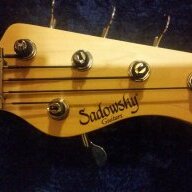
Sadowsky metro 5-24
ebmm stingray5
spector ns5crfm/euro5

this list is very very incomplete because there are a lot of basses that i would like to try...but havent had the opportunity to do so. these are just the best of the ones i have actually tried.

i have tried ibanez, washburn, fender, peavey, warwick thumb, jackson, you know...all of your typical gc basses, i have also tried ken smith, alembic, a metro uv70 and while they sound great...there was something i didnt like about the b string.

again...all of these are only my opinion.

d
 
Modulus and Sadowsky have the best low B's of the basses that I have tried. I own the Modulus, and it's fantastic. Something tells me there was something wrong with the one you tried at GC...

The Sadowsky was a metro modern...the B was thunderous! I also played one of the metro vintage models and it was pretty damn good too. I'd love to get an NYC 5er of some sort, but that's just not in the cards right now!

My Stingray 5 also has a very good low B. Not as good as the Modulus, but still very nice.
 
I've found that the largest impact on the B string is in the time it is being played.
When I picked up my current bass from the luthiers' the B string was average.
Now it blends in very well with the others.
Different brands are also to consider as well as the individual strings within a set.
I have sometimes found that the strings from the same set were of varying quality.
 
IMO and IME, from the sets of strings I've been through (they are alot trust me), the strings sound best when fresh (someone please correct me). The breaking in time refers (again IMO) to smoothing out brightness and initial tuning problems present in very fresh and newly put strings. If the new strings (unless a bad set) don't sound good and even to start with, they will never sound great in the long run (unless dull, lifeless tone is what we are after).

I agree that not all strings are of the same quality all the times, but if a string fails in the beggining I change it (either the one or the whole set)
 
.......
Went to GC Manhattan. Played a $3300 Modulus 6 string (name I can't recall) Sounded beautiful, too bad the B-string felt like a rubber band.

Played a 2 different Bongo 5's again floppy B's.

Played every 5 and 6 strings Fender and Ibanez in the joint and dammnit nothing worked.

Best fiver I played, in terms of a B-String, was a cheap Peavey...........

I betcha I know what was going on....... I've often found cheap 5ers that, in the store, seem to have unexpectedly tight B strings and they sound surprisingly good - then one day it struck me to check the tuning. Sure 'nuff, some of the basses were tuned a half or a whole step high. That goes a very long way in giving an illusion of tightness.

Bottom line - if you're seriously shopping for an extended range bass, bring your tuner and make sure what you're hearing and feeling is legitimate - especially when shopping places like Guitar Center.
 
I have yet to play a bass with a better B-string than my Dingwalls.

I am not so sure about some comments that the scale length is the least contributing factor to the sound of the B-string. Why would so many manufacturers go to a 35" scale (over 34") for their 5-string models?


It seems like a bit of a crapshoot though. I've tried some 35" scale length basses with floppy Bs while other 34" ones are pretty good. The StingRay5 is good as are the Laklands, but nothing compares to the 37" of the Dingwall. Not even close.
 
The Carvin 5-strings are nice...(At least mine is.) It cost me around $1300 about 5 years ago,but it is a fretless with a peizo made of KOA,and also has an asymetrical neck that makes it a JOY to play.The only other 5-string I played was my brother's G&L....It couldn't hold a candle next to the Carvin as far as playability or B string....(Not that I have anything against G&L...I just like the Carvin better.)
 
I am not so sure about some comments that the scale length is the least contributing factor to the sound of the B-string. Why would so many manufacturers go to a 35" scale (over 34") for their 5-string models?

I agree....to say that scale length has little or impact on the tightness of the B string is silly. Of course it does. But, it can also have alot to do with the overall structural soundness of the bass.

For example, a $2500 bass with a 34" scale is probably built much better than a $600 bass with a 35" scale. If a person played both of these basses and found the B string was tighter and sounded better on the first bass, they might conclude that scale length doesn't make a difference. But the truth is there are other factors such as body and neck woods that were more carefully selected for rigidity and tonal quality, graphite reinforcement in the neck, etc. that the expensive bass likely has while the cheap one does not. So while scale length plays a role, it is not the sole determining factor in how good a B string.

That being said, a well-built 35" scale 5er will virtually always have a tighter feeling and sounding B string than an equally well-built 34" scale 5er. That doesn't mean the 34" scale bass is no good though, they can still be killer sounding.

Dingwall is also the perfect solution for those who don't like what a 35" scale does to D & G strings. Super-tight low B and perfectly normal feeling D & G, with even tone from the 1st fret to the 24th on all 5 (or 6) strings. I like the the feel of my current 35" scale bass fine, but the Dingwall is the best sounding and easiest playing 5er I've felt yet.