• TalkBass has been independent since 1998. Add your voice.
    Create a free account to reply to discussions, view embedded media, and browse with fewer display ads.
    Join freeLog in
    Want zero display ads or expanded classifieds tools? Compare plans.

bedding your bass neck like a rifle barrel

Bedding how? If you mean by using epoxy or a similar material to get a tight fit at the neck pocket and heel that sounds good but, typically, both body and neck are made of wood that will expand and contract with humidity changes. If you make them a press fit when they’re dry and small you’re likely to get cracks in the body when things expand.
 
  • Like
Reactions: Will_White
I did. It's called a set neck.
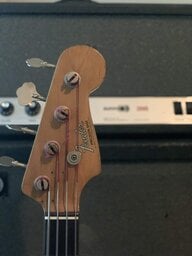
20240626_155128.jpg
 
@Docduval to create void free solid contact=better tone and sustain maybe?

@Matt Liebenau yes, with epoxy, or similar. as to expansion from moisture: even if they're finished/sealed?

@tubedude not if it's not permanantely glued in, it's still bolted on, but i guess it would be conceptually the same thing as the glue filling the voids and hardening.
 
@Docduval to create void free solid contact=better tone and sustain maybe?

@Matt Liebenau yes, with epoxy, or similar. as to expansion from moisture: even if they're finished/sealed?

@tubedude not if it's not permanantely glued in, it's still bolted on, but i guess it would be conceptually the same thing as the glue filling the voids and hardening.


Yes, finished wood still expands and contracts albeit more slowly than if it was unfinished but it still moves. I also question if that would have any benefits for an instrument but I’d definitely read about your experiments with it.
 
  • Like
Reactions: boxerrider
If you think about the reasons WHY rifle barrels are bedded, none of them really apply to a bass neck.
But......the most common bedding on a rifle is applied to a wooden stock so the concept may have merit if the heal of the neck is sealed. The pocket would be the major point of bonding for the epoxy.
Haven't thought about bedding a neck but have bedded many dozens of barrels, enough to know the process quite intimately.
 
I did it with an inexpensive Chinese jazz bass. I wrapped the heel of the neck with one layer of Saran Wrap, reassembled the bass, tipped it up on a bit of an angle, and drizzled thinned out clear coat down the neck edges into the pocket for a couple of days periodically and let it dry. I thought it made a difference not only in tone but also with the perceived stiffness of the neck. One caveat, despite the layer of wrap, I have not tried to remove the neck and suspect it’s in there for good 🤷‍♂️. If I were to do it again I would plug the screw holes in the body and neck while just clamping it in place.
 
There could be some positive to having something like thin mounting tape that could be used between the neck heel and neck pocket floor. This material would “flow” into the voids of the neck pocket floor & neck heel when the neck screws are tightened. Then, the material would harden in place without adhering to the body or neck.

The question is; would it improve the bass enough to make it worth the effort? If there were significant voids between the neck heel and the neck pocket floor, it seems like a way to fill those voids would improve the bass, but there’s no way to tell without experimenting.

The most likely outcome is not enough change to tell any difference at all.
 
I'm a big believer in fitting the structural parts of the bass frame together tightly, with no gaps and full surface area. Inside the neck, I "bed" the truss rod in hard epoxy, fully surrounding it and filling all the space between the metal and the wood. Mounting the bridge and tailpiece to the body, I use machine screws threaded into aluminum blocks which are embedded down in the middle of the body, set in hard epoxy.

At the neck/body joint, I don't use epoxy bedding, but I fit the heel and pocket together tightly. I leave right about 0.010" gap around the sides and back of the heel. After painting, they are a slide fit together. Almost no side clearance. I drill and tap in two 1/8" steel dowel pins to lock them in alignment. And I have brass bars with threaded holes embedded, in epoxy, in the neck heel. Machine screws up through the neck plate and the body thread into the bars. They get tightened to higher clamping force than you can get with wood screws. So, my neck/body joints are very tight and solid, no potential for movement. But it's done by accurate machining, rather than epoxy bedding.

These little details definitely make a difference in the sound of a bass. As with bedding a rifle action into a stock, it's all about minimizing microscopic deflections and movement between parts, during shock loads and vibration. That can affect how the machine kicks and vibrates.

Yes, I have some gunsmithing background, plus I used to be an engineer on howitzers and tanks for the Army. I also have background building engines for race cars. Bedding techniques are used there too, for the same reasons.
 
Last edited:
You could study up on "Liquid Shim". You simply butter up both sides, mate them together, torque the hardware and wipe up the squeeze-out. Goes on like a paste, dries to a hard polymer shim which fills any voids between the two surfaces.

Just a thought. I still don't believe it'll make a quantifiable difference.
 
Glass bedding a stock has a different intention. For a stock, it is about making the platform for the action as stable as possible so it doesn't shift. The carve/cutout for the action is never perfect, the glass bed makes it perfect. This way the action can't shift when shooting and cant effect accuracy. Second, the barrel is usually floated in this process so that it is free to expand and contract without the influence of the wood, again for accuracy.

Most bolt on necks, if from a custom builder, are, for the most part, hand fit and the joint is as tight as a bedded action. This may not be the case with mass produced instruments, but usually they are good enough after finishes are applied. The other issue is you only really have body to mate to on the upper horn side. Their usually isn't enough material around the neck on the lower horn to make the "bed" effective.
 
As others have said, Bedding is fine because mass produced products have tolerances that stack and it's easier to fill the gaps with epoxy then to hand fit a new stock. Instruments are typically hand fit or very tightly fit already, bedding wouldn't have much if any effect.

PS. Free Float is better then bedding 90% of the time, not sure how that translates to bass though.