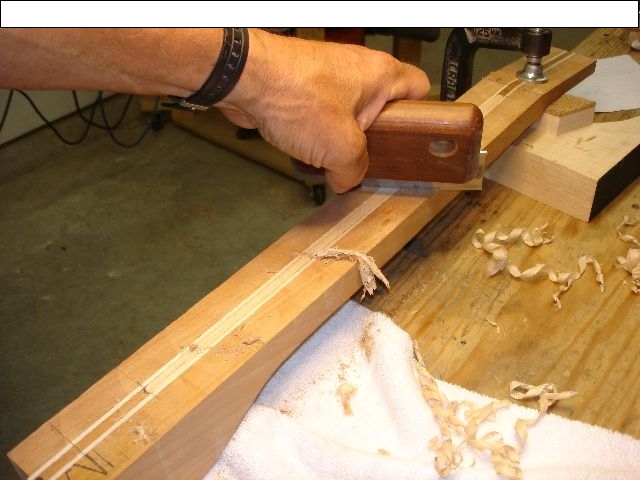
I have a finger plane that is about 7cm long that I use for necks. It was a cheap Chinese one made of wood but honestly, it is the best plane I have. It stays sharp for ever, resists tear out when my No4 digs in and is great for small work like a neck. I have one with a curved sole which is good for the ends of the neck where a flat plane can't go.

Enjoy the benefits of a premium membership!
Upgrade Account
-
TalkBass has been independent since 1998. Add your voice.
Create a free account to reply to discussions, view embedded media, and browse with fewer display ads.
Join free Log in
Want zero display ads or expanded classifieds tools? Compare plans.
You are using an out of date browser. It may not display this or other websites correctly.
You should upgrade or use an alternative browser.
You should upgrade or use an alternative browser.
Best Tools for Neck Carving
- Thread starter Gilmourisgod
- Start date
More options
Who Replied?
For finer work, years ago I made a banana shaped scraper from an old non carbide saw blade from the 50’s. I go straight from the grinder to the workpiece. I don’t even bother trying to manually raise a burr as I think the steel is too hard for that. I can get fine shavings from it and can use either the convex or concave side . The thickness and mass minimize heating up, so no uncomfortable fingertips.I actually have been using a Surform for initial rough, and that hogs off a lot of material quick, so I'm careful with it. Its the finer work I'm having trouble with, I find a longer file or rasp kind of gets in its own way on tight work like heels and volutes. The sheer number of viable options in this thread probably means there is no perfect solution that work for everyone, but I think its one of the hand tool options for me, i dont have the touch yet to do anything really quick. Im more of a slow nibbler, file a little, look at it, feel it etc. Until it feels right. Time to buy some quality tools, for once.
I use my flat rectangular scraper all the time, but I’d like to get one of the “French curve” style ones for heel and volute. I’m only moderately good at sharpening a rectangular scraper, the curved ones look intimidating to sharpen.
Eliminate the burn; make yourself a wood handle to flex and hold your cabinet scraper.
With the one I made I go straight from the grinder to the work. I grind the edge straight on to the wheel surface freehand ending up with a90 degree edge. I find the concave side to be of limited use even though intuition would lead you to believe otherwise.I use my flat rectangular scraper all the time, but I’d like to get one of the “French curve” style ones for heel and volute. I’m only moderately good at sharpening a rectangular scraper, the curved ones look intimidating to sharpen.
I made a second one at the same time of the common “shmoo” shape with larger and smaller rounded ends. This type is very good for smaller surfaces like volutes etc.
I actually thought they had been. Maybe that was just wishful thinking.The chainsaw carving heads should be banned….
I’ve seen some woodwork that clearly involved a distortion.Wait what they make pedals for tools too? I want an overdrive for my framing gun. And a looper for my miter saw, for perfect results every time.

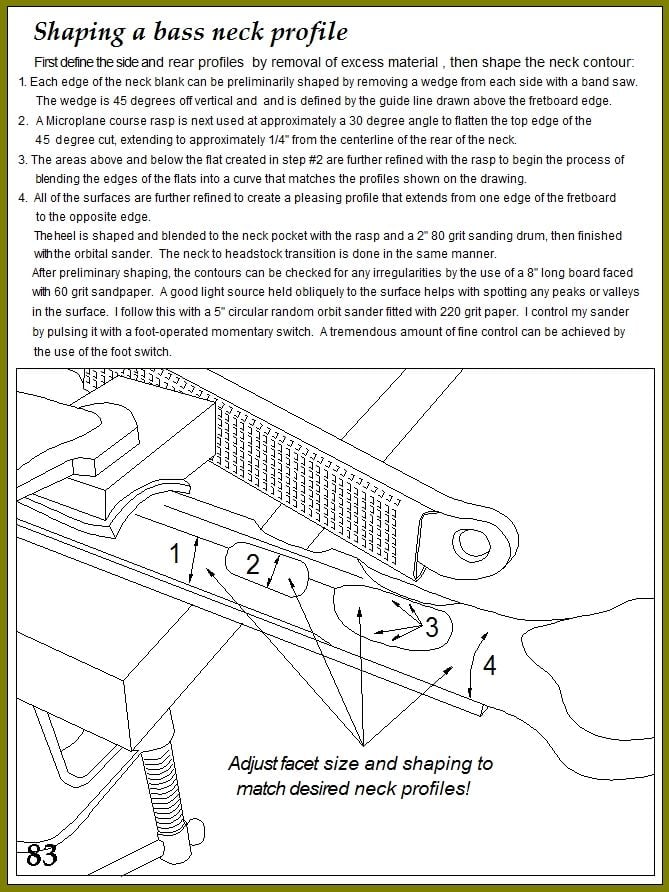
I've tried all kinds of files and handplanes and spokeshaves and now I do 90% of the work with a shinto rasp. The rough cutting face is perfect for removing a lot of material and the finer cutting surface cleans up behind it very well. I've found the key is clamping the neck firmly in place so you can use both hands on the rasp. I can tell you from hard earned experience that trying to hold the neck down while you rasp with the other hand is going to end in bloody knuckles at some point. I like to clamp the neck firmly at table height and then stand over it to get good leverage. I do all the rough cutting and shaping with the shinto rasp and use a dragon rasp to shape the tight corners.
One of the advantages of building neck through instruments is that you have a nice big chunk of wood to clamp in a vise and go to town on.

Big B brings up an important point about shaping necks. Almost all of these tools (except the Finger Plane, I guess) need to be held with both hands, applying power with the shoulders and upper body. They require some human horsepower to carve wood efficiently. Even the electric powered ones. It's really important to somehow clamp the neck down solidly, so that you can apply some horsepower to it. And be able to see what you are doing.
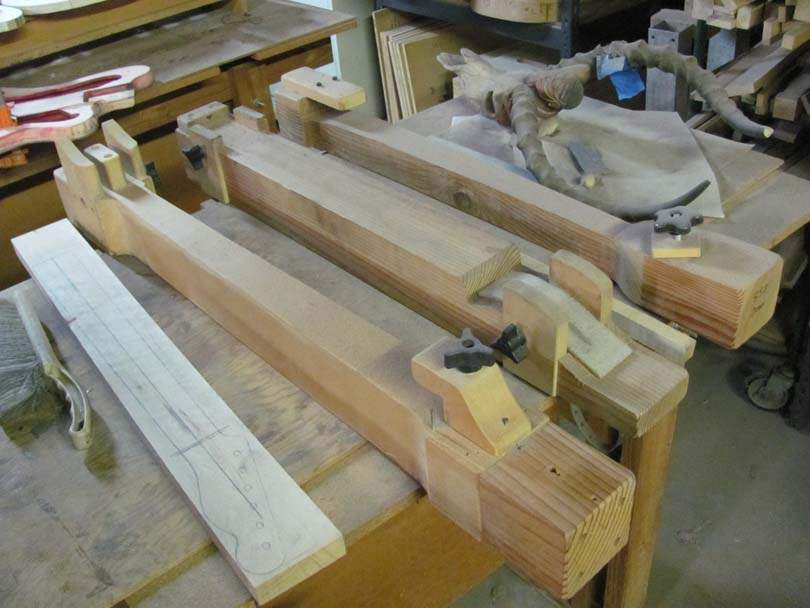
Back in the '90's, I made up the Neck Horse for myself. I think I've used it to carve every neck I've built since then, hundreds of them. It's basically a big sawhorse that clamps special holding fixtures along the top edge.
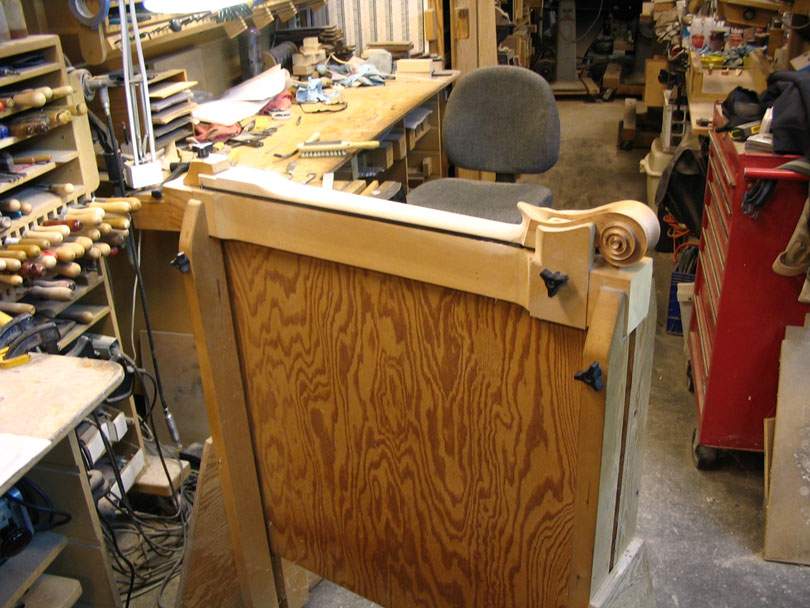
I built it at just the right height that I can comfortably work all around the back of the neck, with both arms, with whatever tool I'm using.
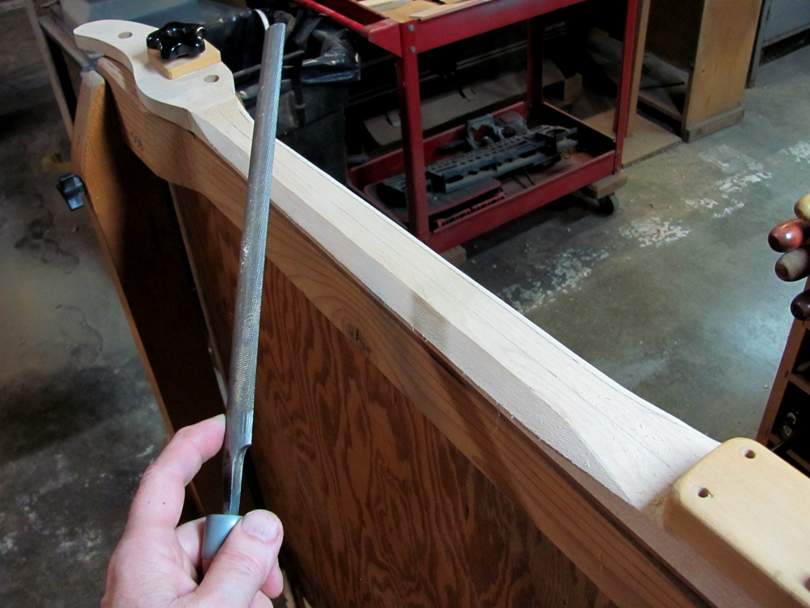
I can also position it in good lighting, so I can see all the ridges, facets and pencil lines as I'm shaping.
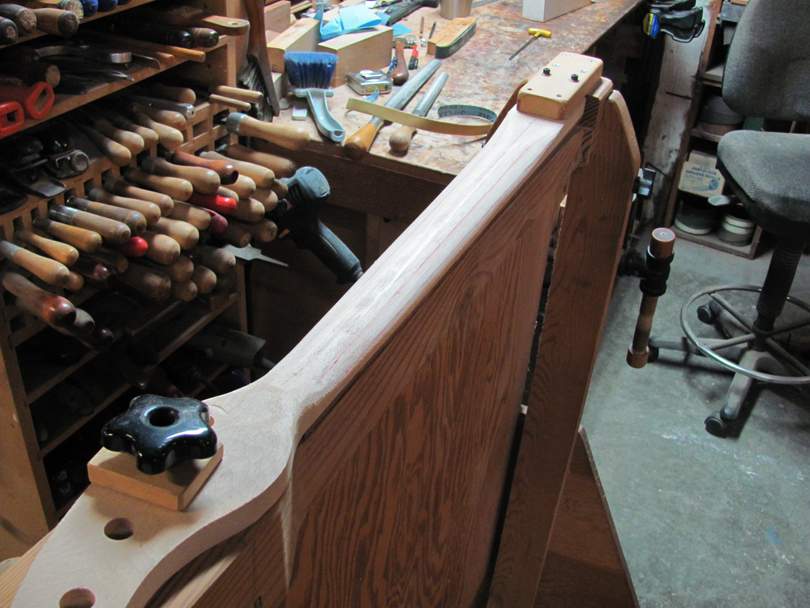
The basic frame of the Neck Horse is made from plywood and 2 x 4's. It sits on four pads on the floor. I built it so the two triangular feet ends quickly unbolt for easier storage. But, I use it so often that I rarely take it apart.
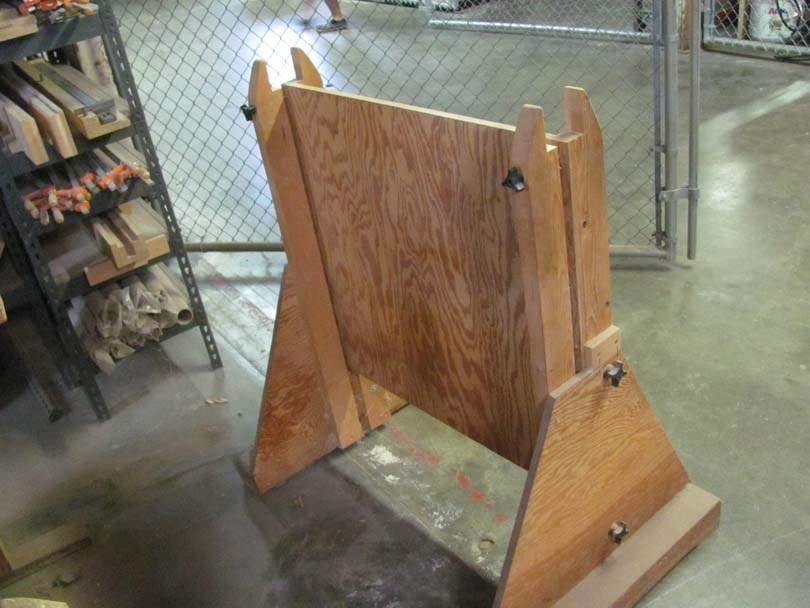
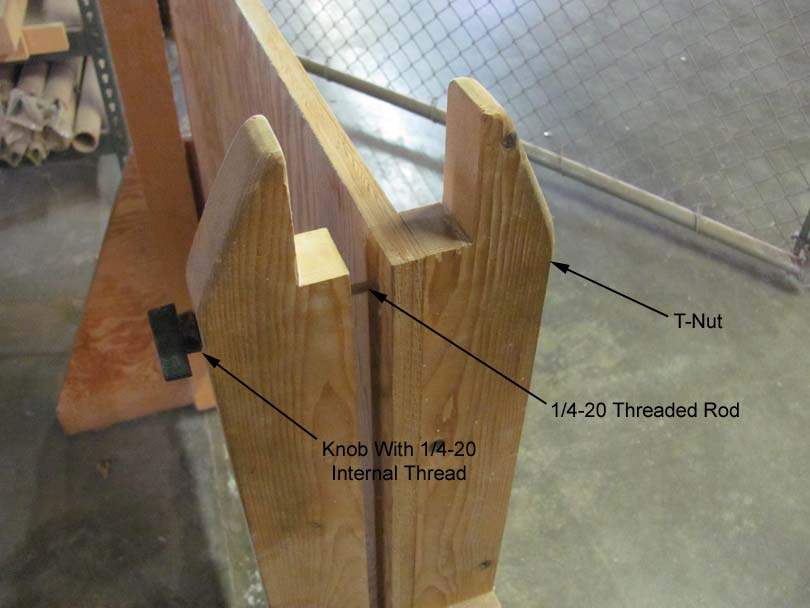
The two ends are made so they quickly clamp onto a 4 x 4. A piece of 1/4-20 threaded rod, a T-nut, and a plastic threaded knob from the hardware store. The left side jaw pivots on a single screw at the bottom.
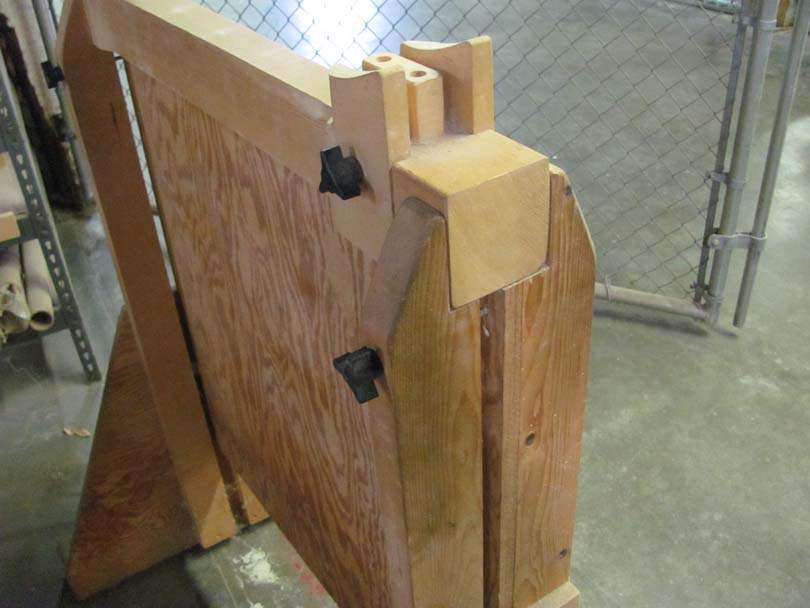
The holding fixtures all start out as a piece of 4 x 4. They clamp solidly onto the Neck Horse in a few seconds.
Over the years, I've made up about a dozen of the holding fixtures. For most of my standard necks, I've made up a pair: Face Up and Face Down. Plus I've made up ones for generic Fender-style necks and others.
The first one here is for my Scroll Bass necks, Face Down. The blocks at the far end hold the scroll headstock securely. The overhand block at the near end holds the heel. I've sawed the center section narrower than the neck width, so I can file all the way around the sides.
The fixture in the middle is Scroll Bass Face Up. I use that one to hold the neck while sanding and polishing the fingerboard, fretting, and leveling the frets. It clamps the heel squeezing from the sides.
The third one is for the SSB neck, Face Down. Tilt-back headstock. This one holds the heel with two 10-32 screws down into the neck's threaded inserts. The large screw and knob go through one of the tuner holes.
Lots of ways to hold a neck. I have many more of these fixtures on the shelves.
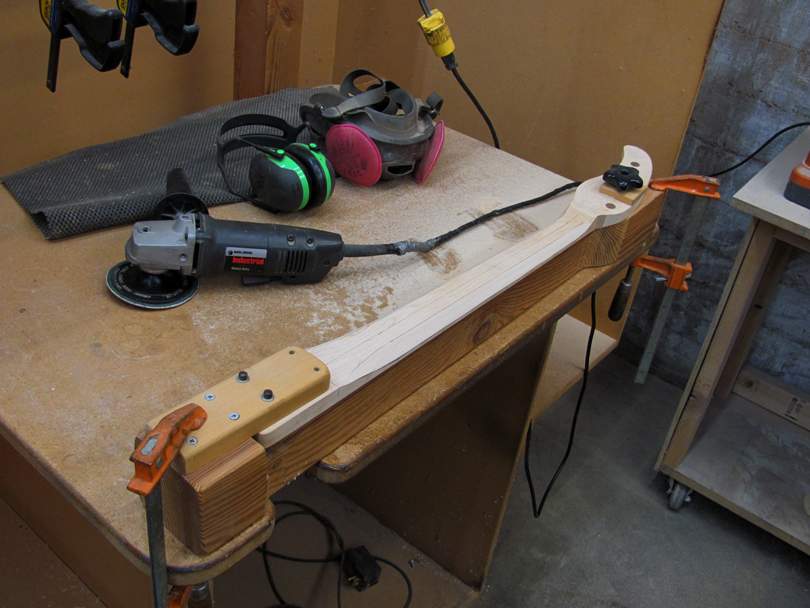
When I'm using the angle grinder for rough cutting the facets, I usually carry the holding fixture itself over to the routing bench and clamp it down. Easier to clean up the big mess. Then it drops right back into the Neck Horse to continue the filing.
I realize that most of you aren't shaping enough necks to justify building a full Neck Horse like this. But think about making up a holding fixture that clamps onto the edge of your bench, or into a Work-Mate. It will justify itself in time saving on your first neck.
Back in the '90's, I made up the Neck Horse for myself. I think I've used it to carve every neck I've built since then, hundreds of them. It's basically a big sawhorse that clamps special holding fixtures along the top edge.
I built it at just the right height that I can comfortably work all around the back of the neck, with both arms, with whatever tool I'm using.
I can also position it in good lighting, so I can see all the ridges, facets and pencil lines as I'm shaping.
The basic frame of the Neck Horse is made from plywood and 2 x 4's. It sits on four pads on the floor. I built it so the two triangular feet ends quickly unbolt for easier storage. But, I use it so often that I rarely take it apart.
The two ends are made so they quickly clamp onto a 4 x 4. A piece of 1/4-20 threaded rod, a T-nut, and a plastic threaded knob from the hardware store. The left side jaw pivots on a single screw at the bottom.
The holding fixtures all start out as a piece of 4 x 4. They clamp solidly onto the Neck Horse in a few seconds.
Over the years, I've made up about a dozen of the holding fixtures. For most of my standard necks, I've made up a pair: Face Up and Face Down. Plus I've made up ones for generic Fender-style necks and others.
The first one here is for my Scroll Bass necks, Face Down. The blocks at the far end hold the scroll headstock securely. The overhand block at the near end holds the heel. I've sawed the center section narrower than the neck width, so I can file all the way around the sides.
The fixture in the middle is Scroll Bass Face Up. I use that one to hold the neck while sanding and polishing the fingerboard, fretting, and leveling the frets. It clamps the heel squeezing from the sides.
The third one is for the SSB neck, Face Down. Tilt-back headstock. This one holds the heel with two 10-32 screws down into the neck's threaded inserts. The large screw and knob go through one of the tuner holes.
Lots of ways to hold a neck. I have many more of these fixtures on the shelves.
When I'm using the angle grinder for rough cutting the facets, I usually carry the holding fixture itself over to the routing bench and clamp it down. Easier to clean up the big mess. Then it drops right back into the Neck Horse to continue the filing.
I realize that most of you aren't shaping enough necks to justify building a full Neck Horse like this. But think about making up a holding fixture that clamps onto the edge of your bench, or into a Work-Mate. It will justify itself in time saving on your first neck.
Last edited:
Thats pretty slick! Ive just been clamping down to my work bench as best I can. I have a home built version of the Stewmac neck jig for fingerboard and fret leveling I could probably adapt for neck carving too.
The Iwasaki files look interesting, the Crimson guitars guy raves about them. For people who bought them, which ones, coarse, medium or fine, and what size? Im thinking a large flat one would be good for faceting long flats, but maybe just the 6" fine ones for volute and heel.carving?
The Iwasaki files look interesting, the Crimson guitars guy raves about them. For people who bought them, which ones, coarse, medium or fine, and what size? Im thinking a large flat one would be good for faceting long flats, but maybe just the 6" fine ones for volute and heel.carving?
The "neck horse" system is brilliant!
I use a neck jig that is mounted to my substantial in weight workbench and can be easily rotated to any angle so any portion of the neck can be held at the right position. It mounts or removes in seconds and I do quick modifications for various instruments.
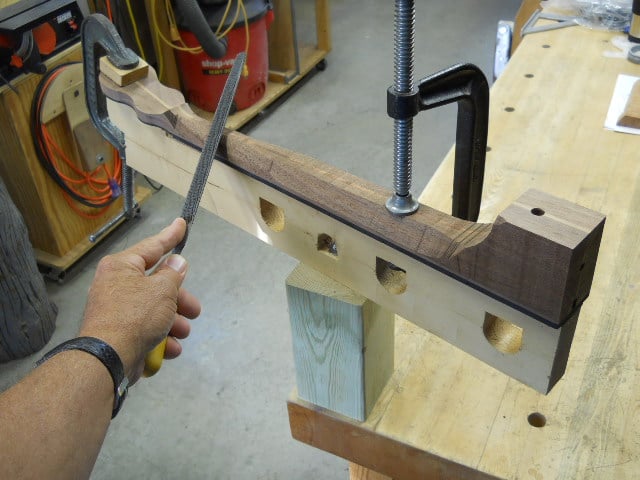
I used to clamp the neck directly to the bench, but the adjustable mount is much better to establish correct height and position,
I use a neck jig that is mounted to my substantial in weight workbench and can be easily rotated to any angle so any portion of the neck can be held at the right position. It mounts or removes in seconds and I do quick modifications for various instruments.
I used to clamp the neck directly to the bench, but the adjustable mount is much better to establish correct height and position,
Last edited:
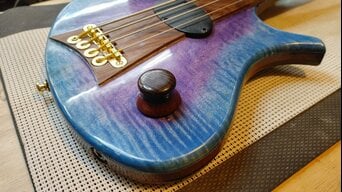
I'm in the shinto camp. I love that thing and use it for the bulk of my carving, even for the bulk of things like fore arm and belly carves on the body too. If they made a half round shinto, I'd buy one in a heartbeat. I do understand the "uncomfortable in the hands" deal, but I wear a pair of gloves, which helps alleviate a lot of that.
Other than my shinto, I have a fairly course half round file that I use quite a bit behind the shinto or on areas where I wish I had a half round shinto. After that it's a small fine round file for anything I need to get into and need a tighter radius, such as a volute, and then it's the RoS or spindle sander to clean things up. I have one of those 2" foam pads for the RoS, which helps it "curve" quite a bit. Highly recommend.
I'm really wanting to get some dragon rasps, even if it is just the cheap Harbor Freight ones to start with. I don't do enough necks to warrant high priced ones, so I'm sure the HF ones would be fine. I just haven't done it yet. We're kinda snowed in today, so my planned excursion to the harbor of freight probably won't happen today, even we live basically 10 minutes from the harbor.
Like Bruce, I also built a (much lamer version) neck clamping jig when I did the neck on Lucifer -

It made a huge difference in just helping me get it at the right height, leave my hands free and all that. It got kind of worn out on that build (because it was much lamer than Bruce's) so I may just build a new one or find a way to sturdy this one up. You don't need something crazy to hold it, I basically made this out of scraps laying in my boss's burn barrel. As you can see, no fancy clamping mechanism, I just grabbed some cheap clamps from the harbor and gave 'em a squeeze. If I had a leg vice on my workbench, I would have clamped the "jig" (using that term loosely) in that. But I don't, so clamps to the bench, clamp the neck to it, work on one end, move the clamp to the other end and work on that end.
I highly recommend the shinto. I highly recommend building some lame holding jig. I want to get some dragon rasps, maybe one day some iwasaki files. I can't bring myself to us an angle grinder because I'm scared of how fast I could screw that up. Rasps and files are much slower for me, which is needed.
Other than my shinto, I have a fairly course half round file that I use quite a bit behind the shinto or on areas where I wish I had a half round shinto. After that it's a small fine round file for anything I need to get into and need a tighter radius, such as a volute, and then it's the RoS or spindle sander to clean things up. I have one of those 2" foam pads for the RoS, which helps it "curve" quite a bit. Highly recommend.
I'm really wanting to get some dragon rasps, even if it is just the cheap Harbor Freight ones to start with. I don't do enough necks to warrant high priced ones, so I'm sure the HF ones would be fine. I just haven't done it yet. We're kinda snowed in today, so my planned excursion to the harbor of freight probably won't happen today, even we live basically 10 minutes from the harbor.
Like Bruce, I also built a (much lamer version) neck clamping jig when I did the neck on Lucifer -
It made a huge difference in just helping me get it at the right height, leave my hands free and all that. It got kind of worn out on that build (because it was much lamer than Bruce's) so I may just build a new one or find a way to sturdy this one up. You don't need something crazy to hold it, I basically made this out of scraps laying in my boss's burn barrel. As you can see, no fancy clamping mechanism, I just grabbed some cheap clamps from the harbor and gave 'em a squeeze. If I had a leg vice on my workbench, I would have clamped the "jig" (using that term loosely) in that. But I don't, so clamps to the bench, clamp the neck to it, work on one end, move the clamp to the other end and work on that end.
I highly recommend the shinto. I highly recommend building some lame holding jig. I want to get some dragon rasps, maybe one day some iwasaki files. I can't bring myself to us an angle grinder because I'm scared of how fast I could screw that up. Rasps and files are much slower for me, which is needed.
Oh, I will also add, for things like the neck heel on this neck-thru build -
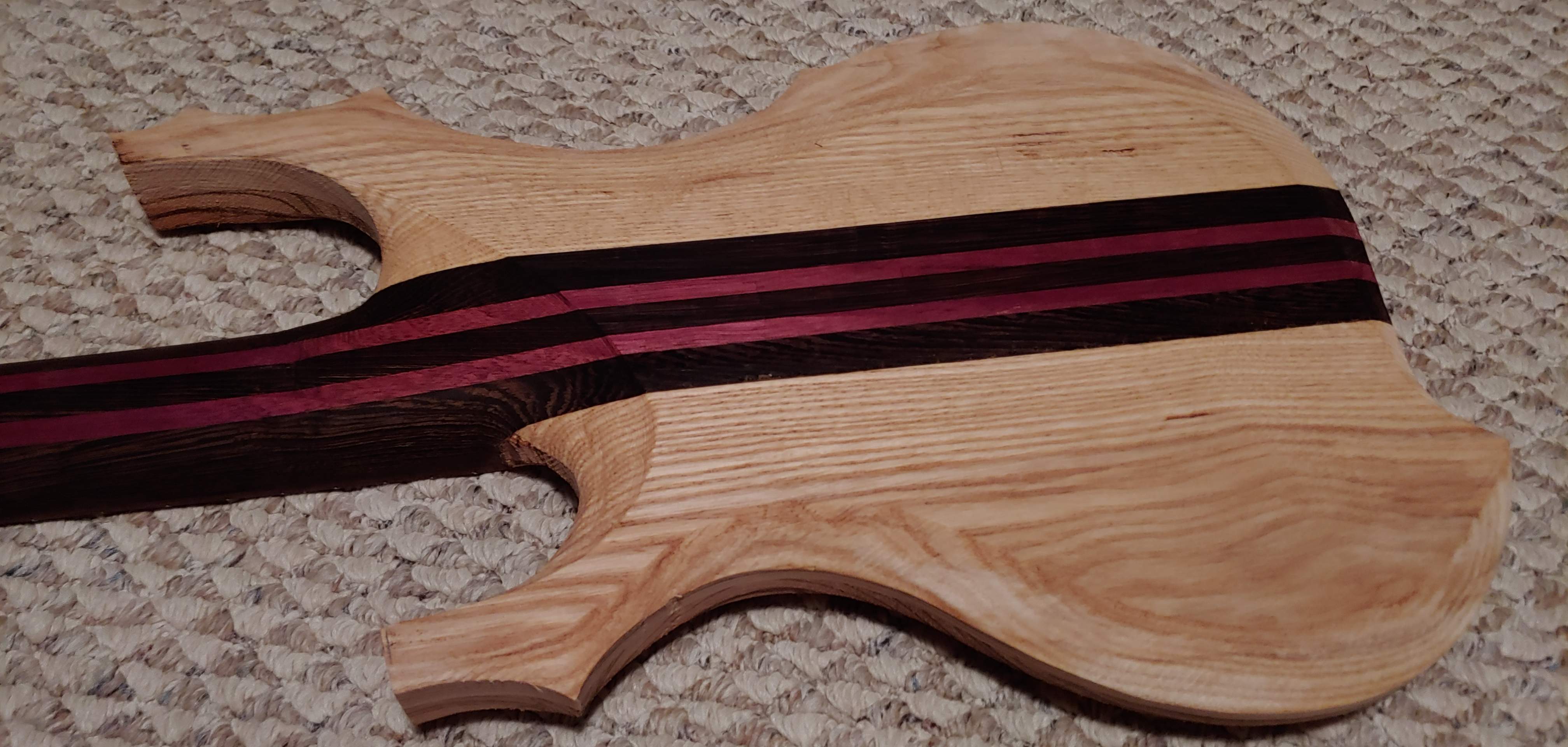
I used a medium grit Saburr ball bit and medium grit cone bit in my Dremel with a whip attachment. Then came back with a lot of hand sanding.
But you didn't ask about bodies, you asked about necks, didn't you?
I used a medium grit Saburr ball bit and medium grit cone bit in my Dremel with a whip attachment. Then came back with a lot of hand sanding.
But you didn't ask about bodies, you asked about necks, didn't you?


I made this skinny table a while back. It's come in real handy over the years.
I’ve been reading this thread and had previously thought that the Stewmac razor files sounded good but were very expensive. $49.59 each for the small ones with the red handles plus $17.00 postage to France plus customs duty.
Now I find that they are Iwasaki files and I can order them from Crimson Guitars for $24.60 each but postage is $17.70. Dearer from UK to France than US to France! That’s what Brexit has done. But they’re out of stock!
Then I found that a German tool supplier has them for $19.72 each plus $8.70 postage.
Now I find that they are Iwasaki files and I can order them from Crimson Guitars for $24.60 each but postage is $17.70. Dearer from UK to France than US to France! That’s what Brexit has done. But they’re out of stock!
Then I found that a German tool supplier has them for $19.72 each plus $8.70 postage.
I've got a new neck carving tool to show off.....
I had a little bit of extra tool-buying money, so I bought myself the biggest file I've seen listed. It's a Nicholson 16" Half-Round Bastard File. $50 from McMasters. I've always wanted one.
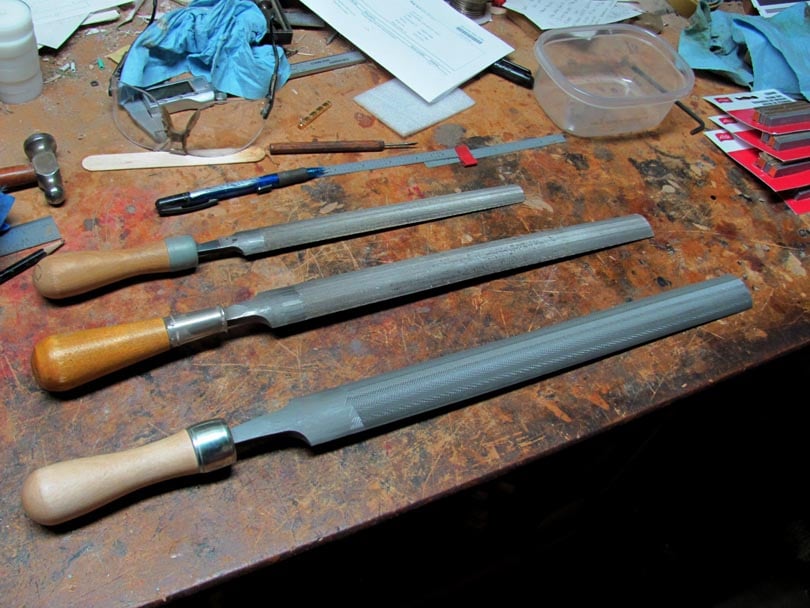
Now that's a file! Above it are a standard little 10" file and the 14" file that's been my favorite neck carving tool....until now.....
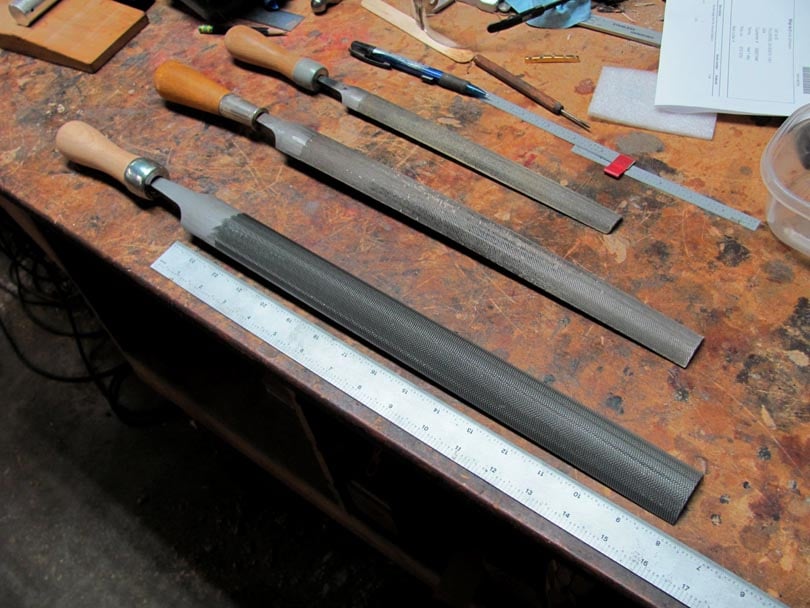
This thing should be awesome for shaping necks. Longer stroke, wider and it's new and very sharp. It'll probably rip off wood as fast as a rasp, but leave a much smoother surface.
The important thing will be to keep it sharp. I'll use it only for shaping necks, and make up some kind of a soft holder/sleeve to protect it.
I had a little bit of extra tool-buying money, so I bought myself the biggest file I've seen listed. It's a Nicholson 16" Half-Round Bastard File. $50 from McMasters. I've always wanted one.
Now that's a file! Above it are a standard little 10" file and the 14" file that's been my favorite neck carving tool....until now.....
This thing should be awesome for shaping necks. Longer stroke, wider and it's new and very sharp. It'll probably rip off wood as fast as a rasp, but leave a much smoother surface.
The important thing will be to keep it sharp. I'll use it only for shaping necks, and make up some kind of a soft holder/sleeve to protect it.

A wooden slotted rack was the place the files lived at college metal shop. Kept them organized and out of harm's way. Find a bit of camphorwood and you can ward off rust, too.I'll use it only for shaping necks, and make up some kind of a soft holder/sleeve to protect it.


