• TalkBass has been independent since 1998. Add your voice.
    Create a free account to reply to discussions, view embedded media, and browse with fewer display ads.
    Join freeLog in
    Want zero display ads or expanded classifieds tools? Compare plans.

Big difference in P basses?

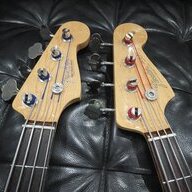
Both strung at the same time with same strings. To me the 70 almost has a “chorusey” sound on the E and A strings.
But have they been played the same amount? I've had strings on a bass in a case for 5 years sound brand new and sets that were dead within months due to excessive playing. Strings don't change much if left static. Not saying it isn't the pups (my 75 seems quite bright), but in my experence, string always make the biggest difference.
 
  • Like
Reactions: Lowendchamp
Not a scientist or sound engineer but I do own 4 P basses that I play regularly. They all sound different with the exception of my MIM Player P and my MIM P Special with the bridge pup all the way down. One is pao Ferro board and the other is maple with binding and blocks. With the same strings they sound the same. That is direct passive sound I'm speaking of for comparison purposes. For that reason I'm convinced it has mostly to do with the pups.
 
  • Like
Reactions: J_Bass and 58kites
I know. I've posted that many times here. :laugh:
In the last several weeks several fellas over at the EMG GZR pickup thread are preaching that the whole tone spectrum sounds different between a .022 an .047 and a .1mF cap when the the tone knob is fully open. They claim that the pickup (with the tone knob fully open) delivers more low mids and less high mids when you change the cap to a higher value. :whistle:
 
Last edited:
  • Like
Reactions: bobyoung53
Not a scientist or sound engineer but I do own 4 P basses that I play regularly. They all sound different with the exception of my MIM Player P and my MIM P Special with the bridge pup all the way down. One is pao Ferro board and the other is maple with binding and blocks. With the same strings they sound the same. That is direct passive sound I'm speaking of for comparison purposes. For that reason I'm convinced it has mostly to do with the pups.
I do too...by a large margin. Pickups, strings, hand techniques, amp and it's settings...I think everything else has a much smaller effect.
 
  • Like
Reactions: J_Bass
In the last several weeks several fellas over at the EMG GZR pickup thread are preaching that the whole tone spectrum sounds different between a .022 an .047 and a .1mF cap when the the tone knob is fully open. They claim that the pickup (with the tone knob fully open) delivers more low mids and less high mids when you change the cap to a higher value. :whistle:


I suppose if you know nothing at all about electronics you may think that. How about the ones who take out the tone control entirely? :laugh:
 
  • Like
Reactions: 58kites
I can easily get that much sonic difference by a small change in how I attack the strings. Both sound like P's - thick in the lower mids - you can make a Jazz sound kinda like that, but not with both pickups on.
That is a characteristic that attracts me to one bass over another. How does it respond to different touches? That can mean the possibility of implying emotional nuance in different passages in a tune is more easily realized. Even between two adjacent notes.
 
Not P bass related but instrument related and instruments are instruments. In our college orchestra out first seat violinist took four or five of "exactly" the same instrument to every rehearsal, concert or contest because each had its own, if only very minimally different sound. But she was VERY, VERY good so if she heard a difference I'd concede that there was a difference. So I can see a P bass or any instrument having a slightly different sound.
 
  • Like
Reactions: chadds
Hi Audio Atelier :)

Welcome to Talkbass (TB)! :hyper::hyper::hyper:

What are your thoughts?

I am not surprised! Both basses are from very different Fender manufacturing periods.

The 70s is from the CBS years and your newer model tries the best not to be anything like that. :D

see below

I think 70s P pickups tend to be wound a little hotter than 60s P pickups, although both can vary quite a lot.

CBS used a different wire in the 70s and different methods to produce pups than Leo!

Leo had a small staff (mostly women working part time ,when their kids were at school) producing machine wound but hand guided pups (the wire was moved by hand to fill the pup) you better be focused on what you do there!

CBS had a huge staff ( hire and fire full time) producing machine wound pups (sometimes guided sometimes not :D)

Smoking was allowed in the factory (the good old days) even at work=> you won't find two pickups that have the same number of windings or are guided the same way.

The 70s pups vary a lot more than the pre CBS pups! (QC as we know it wasn' even invented!)

I wonder if Fender had that in mind and altered the pickup winding process?

see above :D

CBS certainly aimed at a brighter sound though! (in the 70s)!

Remember: The Jazz Bass bridge pup position changed! (to get a brighter sound!!!)

And the 70s were not the golden age of the P bass! Brighter sounds (for roundwound strings) were what folks were looking for! (gotta keep up with synths!)

No surprise a 70s P Bass pup sounds more agressive than one made in the 60s!

The 60s sound is what most of today's Ps are meant to reproduce (the 2016 P does that)

Voilà la différence ! :D

when you change the cap to a higher value.

When I wear my black leather cap I sound more heavy! ;):laugh:


Wise(b)ass
 
That is a characteristic that attracts me to one bass over another. How does it respond to different touches? That can mean the possibility of implying emotional nuance in different passages in a tune is more easily realized. Even between two adjacent notes.

Although I work on having sonic diversity in my little herd of basses, I do want them all to be somewhat "neutral" - meaning that they don't sound overly aggressive or laid back when I'm playing normally. I don't want to have to play timidly because the bass is too aggressive, or have to bust my fingers all the time because it's taking all the energy out of my playing.
 
  • Like
Reactions: chadds
I suppose if you know nothing at all about electronics you may think that. How about the ones who take out the tone control entirely? :laugh:
The claim is that the cap (of a higher value) has a different load on the circuit so it alters the sound of the pickup while wide open as well as when the tone control starts being dialed down to zero. :cool:
 
  • Like
Reactions: bobyoung53
The claim is that the cap (of a higher value) has a different load on the circuit so it alters the sound of the pickup while wide open as well as when the tone control starts being dialed down to zero. :cool:


I suppose that could be true, on a related note someone once had a recording of a Fender P bass side by side with a Fender P/J bass saying the J pickup loaded the split pickup and altered the sound. I did notice a tiny difference between them and could tell them apart, most people couldn't.
 
Hi Audio Atelier :)

Welcome to Talkbass (TB)! :hyper::hyper::hyper:


I am not surprised! Both basses are from very different Fender manufacturing periods.

The 70s is from the CBS years and your newer model tries the best not to be anything like that. :D

see below


CBS used a different wire in the 70s and different methods to produce pups than Leo!

Leo had a small staff (mostly women working part time ,when their kids were at school) producing machine wound but hand guided pups (the wire was moved by hand to fill the pup) you better be focused on what you do there!

CBS had a huge staff ( hire and fire full time) producing machine wound pups (sometimes guided sometimes not :D)

Smoking was allowed in the factory (the good old days) even at work=> you won't find two pickups that have the same number of windings or are guided the same way.

The 70s pups vary a lot more than the pre CBS pups! (QC as we know it wasn' even invented!)


see above :D

CBS certainly aimed at a brighter sound though! (in the 70s)!

Remember: The Jazz Bass bridge pup position changed! (to get a brighter sound!!!)

And the 70s were not the golden age of the P bass! Brighter sounds (for roundwound strings) were what folks were looking for! (gotta keep up with synths!)

No surprise a 70s P Bass pup sounds more agressive than one made in the 60s!

The 60s sound is what most of today's Ps are meant to reproduce (the 2016 P does that)

Voilà la différence ! :D


When I wear my black leather cap I sound more heavy! ;):laugh:


Wise(b)ass

there’s quite a bit of variance, intentionallty, within the 60s and even within the range of pre-CBS pickups. They wound by hand but they did wind to a specific DC resistance at least.
 
In the last several weeks several fellas over at the EMG GZR pickup thread are preaching that the whole tone spectrum sounds different between a .022 an .047 and a .1mF cap when the the tone knob is fully open. They claim that the pickup (with the tone knob fully open) delivers more low mids and less high mids when you change the cap to a higher value. :whistle:

I know it should work this way, and the science behind it makes sense that when the tone knob is fully open, there would be no affect on the tone. But, listen to this recording, and let your ears be the judge using good heaphones:

I have tried the same swap in some of my own basses, and there is a slightly wider sound even at full on tone settings. Now, which one is better? Very subjective, and I honestly still don't know which I prefer. You get a little more mid/treble punch with a .047, and plenty of bass can still be dialed in with most any good amp. But, there is a slight "larger than life" sonic push at .1uf in a way, but that may have some players reaching to turn down the bass knob for certain styles. In the end, they are just slightly different variations of how one particular instrument sounds and feels, IMO, but neither is so far apart from the other from my own experience.
 
Last edited: