• TalkBass has been independent since 1998. Add your voice.
    Create a free account to reply to discussions, view embedded media, and browse with fewer display ads.
    Join freeLog in
    Want zero display ads or expanded classifieds tools? Compare plans.

Bizarre Warwick Dolphin, Interesting History

I wasn't even going to speculate that is what it was... so let me see if I have this straight - 3 screws remove the cover to allow access to the tr... instead, a hinged door within it makes the need for a screwdriver unnecessary. However.., lifting the door to have access requires removing or de-tuning the strings, where as once the three screws are removed, the cover (if it was a simple flat cover) could be slid under the strings and the tr accessed w/o removing or de-tuning the strings. brilliant.
No, the cover is not hinged. It is easily removed by de-latching the little spring clip. No need to de-tune or remove strings.

fast forward to 1:00
 
I wasn't even going to speculate that is what it was... so let me see if I have this straight - 3 screws remove the cover to allow access to the tr... instead, a hinged door within it makes the need for a screwdriver unnecessary. However.., lifting the door to have access requires removing or de-tuning the strings, where as once the three screws are removed, the cover (if it was a simple flat cover) could be slid under the strings and the tr accessed w/o removing or de-tuning the strings. brilliant.
No not hinged, pops up one end slides out completely pretty slick actually
 
No not hinged, pops up one end slides out completely pretty slick actually
Here's close to what it looks like in factory + trim
upload_2019-3-9_12-56-22.png

Dolphin.jpg
 
Last edited:
I wasn't even going to speculate that is what it was... so let me see if I have this straight - 3 screws remove the cover to allow access to the tr... instead, a hinged door within it makes the need for a screwdriver unnecessary. However.., lifting the door to have access requires removing or de-tuning the strings, where as once the three screws are removed, the cover (if it was a simple flat cover) could be slid under the strings and the tr accessed w/o removing or de-tuning the strings. brilliant.
Close, but no. The “door” is just a panel that clips into place. It isn’t hinged and you can slide it right out without doing anything with the strings.
 
Thanks for all the feedback guys. To those who have asked, the bridge definitely is not as it should be. You can see where fresh wood is exposed from a previous owners attempt at doing....something. right now the plan is to fit a temporary shim in to level it to it's original position, and see what's up from there. It does play "ok" as it is, but for some background on what set my girl down this path of restoring it....

I recently acquired a Fender Jazz 5 which I posted here a few days ago. I did some setup work on it, and got the action extra low (how I like to play). I had my girlfriend try it, she remarked that that was how she'd like her Dolphin to feel, action wise, and that led to a closer look at the bridge which revealed the problems being discussed in this thread. I'll keep you all posted as things develop.

Also, returning it is off the table. It was bought at is, and regardless of its playability she'd keep it as a die hard Prince fan.
 
Last edited:
  • Like
Reactions: lowdownthump
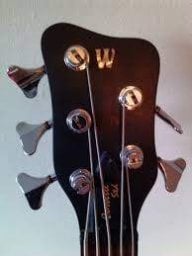
Not long ago my girlfriend picked up an early 90's Warwick Dolphin NT 5 string which had previously belonged to Sonny Thompson (a bassist most well known for his work with Prince). She ordered it from Reverb, so was unable to inspect it closely before purchase. It is almost certainly Sonny Thompson's old dolphin; she had him look at it in person and he immediately recognized it, but also remarked "who the heck did this stuff to it?" When she had first shown it to me my reaction was similar, which brings me to the pictures:
View attachment 3681134 View attachment 3681134 View attachment 3681135 View attachment 3681136 View attachment 3681137

The first thing that jumped out at me when I saw this bass was how poorly the bridge fit. Apparently it originally had all gold hardware, the nut being the only remaining piece in this finish. At some point after Sonny sold it, the hardware was changed to black Warwick brand hardware; I have no idea who along the line of ownership did this. Where it gets more interesting is the other modifications that were made in the process. Certain knobs were also removed, and the drill holes where they would have sat were replaced with small wooden plugs. Even more curiously, the wood beneath the bridge tail piece has been routered out, which is why the bridge now sits at such a goofy angle. If you look closely in the pictures you can see the differentiation in the older, weathered wood, and the more freshly exposed wood. There are small slots cut in to the body to allow the strings to pass through to the bridge at this lower depth. a D-tuner was also added to the B-string.

My hunch is that this bass at some point fell in to the hands of a bassist/woodworker who thought they might "improve" the G-D-A strings by lowering the bridge tail, thus increasing the break angle of the strings. A person operating under this notion might also have made the other "improvements" now present on this bass. So if you've made it this far I have a few questions:

1 - Do you think my bassist/woodworker hypothesis is correct?
2 - What would be the best way to shim the routered bridge tail cavity to level out the tail piece?
3 - Has anyone here personally seen this bass before, or have any insight to offer to its origins and history of ownership?

Thanks!

Sonny played left handed.
Don't remember him with an upside down Dolphin.

I'll have to review Prince "The Undertaker".
 
It's a bit of a sad fate for that bass. I hope you can work out a way to get it back in good shape. One of the biggest issues with these 'tweaker specials' or 'sander enthusiast' projects is that once the wood is gone, it's gone. Particularly on a natural finish bass like that where you can't just build it back up and finish over it.

I sometimes think that when people start to sand or saw at wood, they don't know where to stop, kind of like the guy who makes a mistake shaving his sideburns and ends up cutting back and cutting back until he has shaved half of his head!
 
  • Like
Reactions: TFunkadelic
Your girlfriend is a die hard Prince fan and a bassist? Hats off to you!

So it is "okay" now? What do you see needing attention?

Ya, shes a keeper ;)

The bridge was probably the biggest issue in my eyes, from a functionality and playability perspective. The rest is largely aesthetic. Maybe one day she'll decide to put gold hardware on it again, but that's not a big issue to her (I myself prefer the black) and I have a feeling it'll stay the way it is now, bridge corrected, for a long time before anything more is done.
 
  • Like
Reactions: lowdownthump
I wasn't even going to speculate that is what it was... so let me see if I have this straight - 3 screws remove the cover to allow access to the tr... instead, a hinged door within it makes the need for a screwdriver unnecessary. However.., lifting the door to have access requires removing or de-tuning the strings, where as once the three screws are removed, the cover (if it was a simple flat cover) could be slid under the strings and the tr accessed w/o removing or de-tuning the strings. brilliant.
Yeah, I've always thought the hinged Warwick truss rod cover was completely stupid.
 
  • Like
Reactions: JIO
No, the cover is not hinged. It is easily removed by de-latching the little spring clip. No need to de-tune or remove strings.

fast forward to 1:00

Oh, okay! That's way less stupid, then, haha! I've never adjusted a Warwick truss rod. Back when I had a Thumb BO, I was afraid of screwing instruments up and had my setups done at a local shop, and now that I work on them all the time I just happen to have not gotten one in my hands yet.
 
  • Like
Reactions: JIO

Latest posts