• TalkBass has been independent since 1998. Add your voice.
    Create a free account to reply to discussions, view embedded media, and browse with fewer display ads.
    Join freeLog in
    Want zero display ads or expanded classifieds tools? Compare plans.

Black Widow 15 inch @200 Watts

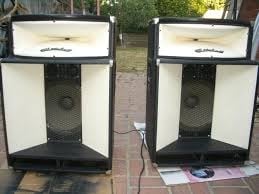
I have a chance to buy a 15 inch 4 ohm Black Widow speaker. It is in a cabinet that looks to be from a PA system. It is 4 ohms. I am wondering if my 200 watt class d amp would push this enough to get some deep floor shaking tone at lower volumes? Cabinet is like the pic except no horn on top.

pacab.jpeg
 
Last edited:
Low volume for practice is like any other 15" You can get plenty of low end with EQ and can rattle the room pretty good.
Band levels you wouldn't want a single 4 ohm speaker. And using practice EQ boost would give you distortion trying to cover a drummer.
For practice is ok for band levels you would want 8 ohm Black Widows in a typical bass 2x15. Amount of EQ boost for bass is marginal.
Be basic common sense, you will hear the distortion. Sounds like maybe you just started playing. Comical somewhat to us old farts.
Basically any live player would have heard and know exactly what a Black Widow does and does not do as a 1x15. We usually all started with
100 watt Peavey combos. As a 2x15 not much different than Ampeg 4x10 as far as covering a drummmer. Going through the learning process
of having fun with deep bass practicing. Then lighten up EQ when playing live.
 
LOL for sure.
Remember the first time cranking up my 1x15 combo. Guess you find out.
Best way to put it, at least now I can look back and laugh. Isnt any different than most 1x15.
That’s not at all true. Many 115’s have quite substantial low frequency extension, but they are not the same type of driver as those early Black Widows, which are more of a guitar and extended midrange type driver than a driver optimized for bass guitar.
 
I have a chance to buy a 15 inch 4 ohm Black Widow speaker. It is in a cabinet that looks to be from a PA system. It is 4 ohms. I am wondering if my 200 watt class d amp would push this enough to get some deep floor shaking tone at lower volumes? Cabinet is like the pic except no horn on top.

View attachment 7115509

For me anyway, the first things that came to mind were Sawzall and Vermont Castings.
 
  • Haha
Reactions: FRoss6788
The early Black Widows were pretty awful, they didn’t last very long and evolved through 5 or 6 distinct versions.

The earlier versions were an attempt at a “universal” driver family that fell short for bass guitar and real low frequency applications but had an acceptable voicing for guitar, steel guitar and general PA use (from 60 - 70Hz on up). It was an improvement on what was available in the lower end of the market but had a tremendous flaw that was addressed in the 3rd or 4th version. The use of an aluminum former (first one piece with the dust cap which which had to be fabricated on a fixture and may have been the original reason for the replaceable basket because they can’t be reconed using traditional techniques, then an aluminum bobbin with a separate aluminum or paper dust cap).

The aluminum former had a different thermal coefficient of expansion than the VC wire, when heated it couldn’t expand and would blister on the inside surface causing a nasty rub on the pole piece. This is what limited the thermal power to ~200 W.

Later evolutions used Kapton and then glass fiber bobbins, thicker VC wire, increased magnetic gap widths and evolved motor geometry/gap depth. These basket kits are not backwards compatible with the earlier motors, even though some of the model numbers were similar. It’s very important to check with Peavey CS to determine n sure you get the correct parts. My understanding is that some are no longer available.

The later BW drivers are quite good, the newer improvements are very significant.
 
Last edited:
That lines up with a (C)2024 Peavey document I have that shows the following 15" 4 ohm BWs no longer available:

1501-DT4
1505-DT4
1504-DT4 (Peavey notes it's for horn loaded boxes)

Strangely, that document did not list any currently available 15" 4 ohm BWs.

I have a (C)1993 Peavey document that shows a 1502-DT4, but it's not mentioned above, and I can't find it for sale at Parts Express or US Speaker. In fact I can't find any 4 ohm BWs for sale at either seller. Peavey on its own site shows a 1508-4 SPS BWX for direct sale, but I get the sense that isn't part of the Black Widow family, because there are other SPS BWX models that have "Black Widow" as part of their name -- but this one doesn't. Also, Peavey doesn't appear to be selling any 15" 4 ohm BW baskets.

Anyway, thank you for that info, Agedhorse. That was impressive. Frankly, I don't see how anyone can keep it all straight.
 
  • Like
Reactions: DJ Bebop
That lines up with a (C)2024 Peavey document I have that shows the following 15" 4 ohm BWs no longer available:

1501-DT4
1505-DT4
1504-DT4 (Peavey notes it's for horn loaded boxes)

Strangely, that document did not list any currently available 15" 4 ohm BWs.

I have a (C)1993 Peavey document that shows a 1502-DT4, but it's not mentioned above, and I can't find it for sale at Parts Express or US Speaker. In fact I can't find any 4 ohm BWs for sale at either seller. Peavey on its own site shows a 1508-4 SPS BWX for direct sale, but I get the sense that isn't part of the Black Widow family, because there are other SPS BWX models that have "Black Widow" as part of their name -- but this one doesn't. Also, Peavey doesn't appear to be selling any 15" 4 ohm BW baskets.

Anyway, thank you for that info, Agedhorse. That was impressive. Frankly, I don't see how anyone can keep it all straight.

You have to remember that most of Peavey's amp offerings during the time that the 4 ohm models were more popular were small... they were the first MI manufacturer of significance to rate their amps at 2 ohms. You had, for example, manuy of their amp models that used the PA-400 module. These amps were rated at 400 watts into 2 ohms and about 250-275 watts into 4 ohms (also about 150 watts into 8 ohms). The DDT limiting also contributed to maintaining reasonable power under high drive conditions.

This is why there was no real concern that the original BW speakers were only rated for 200 watts rms (a somewhat conservative rating provided the signal was high passed via the preamp and there was effective limiting).

One thing about Peavey of that era is that most of their products made sense if you understood their mindset. Their chief engineer at that time was Jack Sondermeyer, well qualified, thorough and had a good grasp of how the industry was changing.
 
There was a post here not long ago from a person with a great deal of knowledge of the Peavey BW ..he basically told the story of the BW and all it's changes over years and knew Hartley Peavey in some way and said to him they should re introduce the 4 ohm BW but he wasn't interested in doing that

Leslie
 
The early Black Widows were pretty awful, they didn’t last very long and evolved through 5 or 6 distinct versions.

The earlier versions were an attempt at a “universal” driver family that fell short for bass guitar and real low frequency applications but had an acceptable voicing for guitar, steel guitar and general PA use (from 60 - 70Hz on up). It was an improvement on what was available in the lower end of the market but had a tremendous flaw that was addressed in the 3rd or 4th version. The use of an aluminum former (first one piece with the dust cap which which had to be fabricated on a fixture and may have been the original reason for the replaceable basket because they can’t be reconed using traditional techniques, then an aluminum bobbin with a separate aluminum or paper dust cap).

The aluminum former had a different thermal coefficient of expansion than the VC wire, when heated it couldn’t expand and would blister on the inside surface causing a nasty rub on the pole piece. This is what limited the thermal power to ~200 W.

Later evolutions used Kapton and then glass fiber bobbins, thicker VC wire, increased magnetic gap widths and evolved motor geometry/gap depth. These basket kits are not backwards compatible with the earlier motors, even though some of the model numbers were similar. It’s very important to check with Peavey CS to determine n sure you get the correct parts. My understanding is that some are no longer available.

The later BW drivers are quite good, the newer improvements are very significant.
I remember reading back in the 80’s, when both Journey and Lynyrd Skynyrd endorsed Peavey, that both bands replaced the Peavey speakers with JBLs across the board. I may be misremembering of course. Also possible that I’m remembering accurately but what I read back then was inaccurate. I remember disliking the sound of all Peavey speakers back in the day though and confidence is high on that one.
 
  • Like
Reactions: agedhorse
I used a 15" Peavey Pro rider CU-CP in the very first cabinet that I built, and I think that it would have sounded good after a little adjusting to the cabinet.
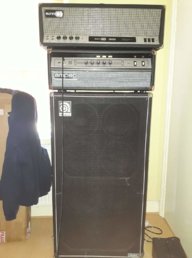
I was looking for a single peavey 15 bw or even a 215 I would couple with Ampeg 2x12, with 75 v4b, sunn2000S 150Wrms, or the SVT VR, thing is I can not understand the outcome in terms of output like is the 1x15 peavey 4 ohm 350w rms loud enough with a sunn2000S 150W or a v4b , my idea is to run both heads on separate cabinets one 2x12 for the v4b and the peavey for the sunn2000s, also I ve found a peavey 2x15 enclosure must be from the 80s or late 70s I believe, i can not understand how many watts it is , i know the 1x15 bw is 4 ohm350rms,but i can not find info about the 2x15 enclosure here are the photos
 

Attachments

  • FB_IMG_1474586770171.jpg
    FB_IMG_1474586770171.jpg
    676 KB · Views: 28
Last edited:
All you really need to know about watts is if your speaker cabs are rated at a high enough maximum power level to be safely driven by your amp(s). Since neither of your amps is particularly high-powered, you should be OK with pretty much anything. I agree with @Milo Spleen that a 215 would probably be a more appropriate match to your 212; I don't think a single 15 cab would keep up with the 212 very well, even with more power. One consideration is what the output impedance of your amp is: if your Sunn amp will only safely power a 4Ω or higher load, and if you have a 4Ω 115 cab, you would not be able to parallel another cab with it. You CAN parallel two 8Ω cabs on the output of an amp capable of driving a 4Ω load.
 
  • Like
Reactions: Sunnampeg