• TalkBass has been independent since 1998. Add your voice.
    Create a free account to reply to discussions, view embedded media, and browse with fewer display ads.
    Join freeLog in
    Want zero display ads or expanded classifieds tools? Compare plans.

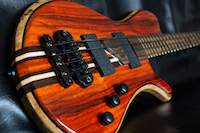
Blackhearted Sassafras on Victorian Ash

Harry Cahyadi

Guest
Commercial User
Apr 11, 2013
343
131
Clayton, VIC, Australia
facebook.com
Disclosures
C Basses Owner & Builder
Guys,

I started a new build for a client few weeks ago, so I have done some of the work already.

This is a "budget" build so I'm not using an exotic wood combination. I might disappoint all wood lovers out there ;)

There are many great luthiers on Talkbass already, so I won't bore you with to much process pictures.

The point of the post is just want to give some reference to Australian wood, just in case there are some people out there are looking to build using Oz woods.

I don't think Oz wood is getting much of love in TalkBass yet.:D

Specs:

Construction:
- 5 string
- Bolt-on
- 35" scale
- Rear route, with front jack input

Contours:
- Tummy
- Forearm
- Neck joint

Body:
- 2-piece Victorian Ash
- Wood control cavity

Top:
- Blackhearted Sassafras (not bookmatched)
- Wenge accent veneer under the top

Neck:
- 2 piece Victorian Ash
- Matching headstock plate

FB:
- Poplar, 24 fret, 15" radius
- Black side dot markers

Frets: Mandolin frets

Hardware:
- Dual action truss rod
- Tuners: black, 5 string tuner set
- Bridge: black, hipshot type B
- Nut: Buffallo horn nut (black colour)
- Knobs: black, aluminum knobs
- Straplock: black, Schaller style straplock
- White C Basses logo

Electronics:
- Pickups:
- Neck: Bartolini XXP25M-B
- Bridge: Bartolini XXP25C-T

- Preamp:
- Tone monster (3 band, active/passive)
 
Some of the progress:

The materials
10127275185_c94f7ee2b7.jpg


The design
10127328656_62b20605f6.jpg


Gluing the top
10127344986_6686d49efb.jpg


Gluing the body
10127401403_321d36bc95.jpg


Gluing and dressing the neck - those 2 pieces of wood came from the same board, I just want to make the end grain to be \\\/// , so it will be more stable
10127170094_9fc6c6996d.jpg
10127351063_ef5e1dcc2c.jpg
10127339603_fab4b696a6.jpg
9785879765_41d036f6d7.jpg


Prepping the body
10127136074_d1eeec4839.jpg
10127129024_3a7aa7fbdf.jpg
10127312853_bd5648fa6a.jpg


Gluing the top and the headstock plate
10127082804_ed83fd6514.jpg
10127044254_256491e34c.jpg
10127017494_26a26cb6fb.jpg


Routing cavities
10126939364_436bd263cc.jpg
10126929074_b75922b3ac.jpg
10126828654_33c2c196ed.jpg


Shaping the top and overall look
10126888764_94b4b9a8db.jpg
10127074213_5c238d1eb6.jpg


Enjoy and thanks for looking...


Harry
 
How did you find Sassafras cheaply!

From Distinctive Timbers. It was Ray, the guy I dealt with.

They have got an eBay store as well.

I bought 1 bookmatched boards (2 boards, total dimension was 1.7m x 20mm x 25mm). I got it resawn into 2 bookmatched boards (4 boards). All for $210 I think.

Free shipping and if I'm not mistaken he didn't charge me for the resawing service.

I can get at least 6 tops out of those and some off cuts (enough for pickup cover, cavity cover or trus rod cover). It comes to $35 even each top, which I think quite good/cheap deal.

He has some rare oz burls as well, like tassy myrtle burl, tassie musk burl and sometimes tassie blackwood burl

Great guy to deal with.


Harry
 
I've read that sassafras wood is a direct toxin, in case you didn't know.

That bass looks really great. :)

Thanks for the info and compliment. Your work with the buckeye is awesome too.

I did a research about the species, and I found that the toxic part is the oil extracted from the roots and wood.

I'm not sure whether blackhearted sassafras is in the same family as sassafras, but it is a common wood in here. It is used to create all sort of things. Table, cabinet, bowl, guitars, etc.

Thankfully, I have always been working with respirator (with particulate and odour filter), eye protector and ear protector at all times.

I hope you are doing the same thing, since burls can cause health issues as well.

Apart from all of the scary facts, blackhearted sassafras is an awesome wood to work with. Reasonably hard for tops, I don't think sealer is necessary, plus the natural black streaks are adding some goodness to the look.

I'm highly recommending it...:D


Harry
 
Thanks for the info and compliment. Your work with the buckeye is awesome too.

I did a research about the species, and I found that the toxic part is the oil extracted from the roots and wood.

I'm not sure whether blackhearted sassafras is in the same family as sassafras, but it is a common wood in here. It is used to create all sort of things. Table, cabinet, bowl, guitars, etc.

Thankfully, I have always been working with respirator (with particulate and odour filter), eye protector and ear protector at all times.

I hope you are doing the same thing, since burls can cause health issues as well.

Apart from all of the scary facts, blackhearted sassafras is an awesome wood to work with. Reasonably hard for tops, I don't think sealer is necessary, plus the natural black streaks are adding some goodness to the look.

I'm highly recommending it...:D


Harry

That's good to know, all I've seen is lists of "toxic woods" and they never seem to give any explanation of what exactly is toxic about it or how to avoid that part of it.

The sassafras you're using is beautiful. I really like the look of it.

I honestly didn't know that burls could cause issues. I've tried looking it up and haven't found anything, so I'm glad you let me know. I try to wear a dust mask and safety glasses (although, I'll admit I don't always) and I've been using skin shielding lotion too.
 
That's good to know, all I've seen is lists of "toxic woods" and they never seem to give any explanation of what exactly is toxic about it or how to avoid that part of it.

The sassafras you're using is beautiful. I really like the look of it.

I honestly didn't know that burls could cause issues. I've tried looking it up and haven't found anything, so I'm glad you let me know. I try to wear a dust mask and safety glasses (although, I'll admit I don't always) and I've been using skin shielding lotion too.

I think the burl wood itself might not be that bad, except of course if you inhale the dust constantly. However, some of them requires hardening using hardening agent. Generally, all hardening agent are very toxic.

Thanks for the compliment, you should try blackhearted sassafras in the future...:D


Cool new build! The sassafras is a really interesting topwood. I've never head of it before. What is the ash like for the neck? I haven't seen alot of ash necks, but it seems like it would be a good wood to use.

The sassafras that I'm using is the one which grows in tasmania, Australia.

Like the sassafras, the ash is neither swamp nor northern ash. It is oz ash, which is quite different in my opinion. Not sure why the call it ash.

The grain is tighter and more uniform. It is quite hard and reasonably light weight.
All those opinion is based on my observation only, no real measuring activity done yet.
 
LOVE Vic ash. It's the same wood species as Tasmanian Oak too. I've built all my necks from it and used it for fingerboards too. Like Harry said, its very hard, similar to rock maple maybe a little softer. The grain is more open and stringy than US maples, so you have to grain fill more, but it's very, very strong and stable. The only down sides I've found with it are that the end grain tears out easily with a router and that you tend to get scorch marks if you linger with the router or power sander.
 
The only down sides I've found with it are that the end grain tears out easily with a router and that you tend to get scorch marks if you linger with the router or power sander.

This is what I hate the most... Other than that it is very easy to work with.

This is my first time using VIC ash. Actually, got the idea from your build... :D

I normally use TAS myrtle for neck. You should try it some other time, I think it is stiffer for neck, but a little heavier.


Harry
 
Blackheart is genus Atherosperma, american sassafras is Sassafras albidum. The american stuff is very coarse grained so very different.

The discoloration of buckeye burl is caused by spalting, iirc. Spalt is fungus, not good to breathe in. The blackline coloration of blackheart sassafrass also seems to be a spalting process, so keep that respirator on. Can't be too safe.
 
Blackheart is genus Atherosperma, american sassafras is Sassafras albidum. The american stuff is very coarse grained so very different.

The discoloration of buckeye burl is caused by spalting, iirc. Spalt is fungus, not good to breathe in. The blackline coloration of blackheart sassafrass also seems to be a spalting process, so keep that respirator on. Can't be too safe.

Yeah. The black line comes from a spalting process.

I'm not taking my respirator off...:D

Thanks for the info