Enjoy the benefits of a premium membership!
Upgrade Account
-
TalkBass has been independent since 1998. Add your voice.
Create a free account to reply to discussions, view embedded media, and browse with fewer display ads.
Join free Log in
Want zero display ads or expanded classifieds tools? Compare plans.
You are using an out of date browser. It may not display this or other websites correctly.
You should upgrade or use an alternative browser.
You should upgrade or use an alternative browser.
More options
Who Replied?
Another thing… the previous owner swears that this is a 1982 bass because of the E3 serial number. He also had the pickups and controls changed to Fender from the original Lace Sensors which he described as being "weak"Here's mine which I believe is a 1989 even though the serial number is E3xxxxx it's a Precision Plus btw not a Jazz


Can I also join!10 year update, I posted the comment above about 10 years ago. Paid about $500 for the bass back around 2010, asking price on Reverb these days is $1500 and up. Looks like they exceeded my growth expectations. I haven't played mine in a while, need to dust it off and give it a good workout.
I also bought mine for about 500 USD around 2005, she was originally somewhere in US and listed in eBay. she was shipped to my friend who lived in Dallas that time. She stayed under his bed for a year or two, until he moved back to Finland and I have been enjoying the bass ever since, my number one and last to leave. I use Fender Nylons (9210 series?) strings on her
Attachments


- Jun 30, 2010
- 49,632
- 222,245
- Disclosures
- musician/artist/owner - Gildaxe
That is what my '93 looked like. I think that colour was called Lipstick Red. As I've often said, a very underrated 22fret made in US Fender Jazz bass. The TBX stacked tone-pot made it sound different from a standard J, a bit more modern.Can I also join!
I also bought mine for about 500 USD around 2005, she was originally somewhere in US and listed in eBay. she was shipped to my friend who lived in Dallas that time. She stayed under his bed for a year or two, until he moved back to Finland and I have been enjoying the bass ever since, my number one and last to leave. I use Fender Nylons (9210 series?) strings on her
- Jun 30, 2010
- 49,632
- 222,245
- Disclosures
- musician/artist/owner - Gildaxe
The American Standard J was Fenders' first 22 fret bass neck. Before that only 20 frets on all P's & J's, other than the short-lived MIJ Performer ('85-'86) that had 24 frets. (another Fender 1st) After that, yes - 22 frets became more common on Fenders.TL DR.
22 frets of FSO are pretty common.
I think most of my Jazzes have them. certainly none have 20 frets.
Last edited:
- Jun 30, 2010
- 49,632
- 222,245
- Disclosures
- musician/artist/owner - Gildaxe
E3 would designate it as being produced in nineteen Eighty 3. My '93 A/S has a body stamped 1992 & neck stamped N3... -'93 which is not uncommon, probably a Dec-Jan overlap. So being that it left the factory in '93 - it's a '93 regardless of what the body was stamped.Another thing… the previous owner swears that this is a 1982 bass because of the E3 serial number. He also had the pickups and controls changed to Fender from the original Lace Sensors which he described as being "weak"
Last edited:
I'm not disputing what you're saying but my research has shown something different. It seems that my bass is in fact a 1990,I removed the neck and snapped a few picturesE3 would designate it as being produced in nineteen Eighty 3. My '93 A/S has a body stamped 1992 & neck stamped N3... -'93 which is not uncommon, probably a Dec-Jan overlap. So being that it left the factory in '93 - it's a '93 regardless of what the body was stamped.
- Jun 30, 2010
- 49,632
- 222,245
- Disclosures
- musician/artist/owner - Gildaxe
That is confusing - if the hs reads E3 that (usually) indicates the neck was made in '83 and the 22 fret Precision Plus was introduced in 1989. (as in, no 22 fret P or J neck was made in '83) So your bass (body I'll assume) marked as a '90 is correct for the model with 22 fret neck, but it must have been mis-decal'd. (stranger things have happened)I'm not disputing what you're saying but my research has shown something different. It seems that my bass is in fact a 1990,I removed the neck and snapped a few pictures
George Blanda & Dan Smith developed the "longhorn" P+ & American Standard J body designs to accommodate the ('88-'94 for the A/S J, '89-'92 for the P+) longer 22 fret neck. Compared to later 'ramped' necks which could work on a standard P or J body - the body was redesigned with a longer horn so the bass balanced correctly.
Yeah I read somewhere that decals were left over from Fullerton and serialized. Also read that they were only used on Precision basses in 1989 and 1990 until the stock was used up…Technically I have seen them called American Standard Precision and Precision bass Plus denoting the extended 22 fret neck.That is confusing - if the hs reads E3 that (usually) indicates the neck was made in '83 and the 22 fret Precision Plus was introduced in 1989. (as in, no 22 fret P or J neck was made in '83) So your bass (body I'll assume) marked as a '90 is correct for the model with 22 fret neck, but it must have been mis-decal'd. (stranger things have happened)
George Blanda & Dan Smith developed the "longhorn" P+ & American Standard J body designs to accommodate the ('88-'94 for the A/S J, '89-'92 for the P+) longer 22 fret neck. Compared to later 'ramped' necks which could work on a standard P or J body - the body was redesigned with a longer horn so the bass balanced correctly.
- Jun 30, 2010
- 49,632
- 222,245
- Disclosures
- musician/artist/owner - Gildaxe
It was a transitional period for Fender so it's not surprising. Cool bass whenever it was made! Rock it!Yeah I read somewhere that decals were left over from Fullerton and serialized. Also read that they were only used on Precision basses in 1989 and 1990 until the stock was used up…Technically I have seen them called American Standard Precision and Precision bass Plus denoting the extended 22 fret neck.



I must admit, I've sold mine. Very nice bass, but I have a matching paor of fretted/fretless Overwater Vs, a fretless Jazz 'bitzer' and three custom builds on the go, so I felt I was being a bit greedy.

I did a search to make sure I wasn't repeating, but these should be called the Viagra Basses!Haven't posted here here in a long time..... happy to report I still have my boner!.... in fact, it will get some play time later today. Still my favorite jazz bass!
Played it at rehearsal yesterday......In the past I loved ss rounds on it.... in particlar, the dr lo riders. I haven't been playing this a whole lot over last 18 years or so. I'd use it with Sadowsky Black Label flats to fill the thump lane.
Anyway, it's sat the last few years with an old set of D'addario xl's. Meh......
I threw on a set of Sunbeams last week, and played with it some through the week. My plan for rehearsal was to just use it on a few songs to gage how the Sunbeams worked on it. Wow, it sounded fantastic! I played through a Shaw B150 with a Shaw 115 (no horn], and it was stellar! The tbx was super cool sounding in a cabinet without a horn..... added clarity with zero harshness....This will get some more play time for sure! And it felt so comfortable..... this was my primary player from '93 until '08. It was a bit like coming home. I had been toying with selling it ..... not anymore.
Anyway, it's sat the last few years with an old set of D'addario xl's. Meh......
I threw on a set of Sunbeams last week, and played with it some through the week. My plan for rehearsal was to just use it on a few songs to gage how the Sunbeams worked on it. Wow, it sounded fantastic! I played through a Shaw B150 with a Shaw 115 (no horn], and it was stellar! The tbx was super cool sounding in a cabinet without a horn..... added clarity with zero harshness....This will get some more play time for sure! And it felt so comfortable..... this was my primary player from '93 until '08. It was a bit like coming home. I had been toying with selling it ..... not anymore.
- Jun 30, 2010
- 49,632
- 222,245
- Disclosures
- musician/artist/owner - Gildaxe
Interesting to see the A/S J rising in price, but basically everything that used to be affordable has been rising in price ~
As an eBay Associate, TalkBass may earn a commission from qualifying purchases.
I played mine at a gig last night for a set. The Sunbeams need to tame down a bit, but it sounded great. I'm glad I never sold it.... I haven't been a JB guy for a long time, but I've had a great time playing it the last few weeks. The SD Antiquities (33 years old now) still sound fantastic.... and the neck is to die for. I maintain the increased distance between the strap buttons improves balance and allows the weight to distribute across your shoulder and upper back in a way that makes it feel a pound lighter than it actually weighs.
- Jun 30, 2010
- 49,632
- 222,245
- Disclosures
- musician/artist/owner - Gildaxe
Nice to hear accolades about the American Standard J. Traditionalist have long mocked it for its differences from a standard J. I agree about liking the 22 fret neck and that was the main reason for the redesign in '86. As indicated in my post above, the asking price for them has gone up, and as it is now a 40yr old vintage made in USA bass... still worth it.I played mine at a gig last night for a set. The Sunbeams need to tame down a bit, but it sounded great. I'm glad I never sold it.... I haven't been a JB guy for a long time, but I've had a great time playing it the last few weeks. The SD Antiquities (33 years old now) still sound fantastic.... and the neck is to die for. I maintain the increased distance between the strap buttons improves balance and allows the weight to distribute across your shoulder and upper back in a way that makes it feel a pound lighter than it actually weighs.

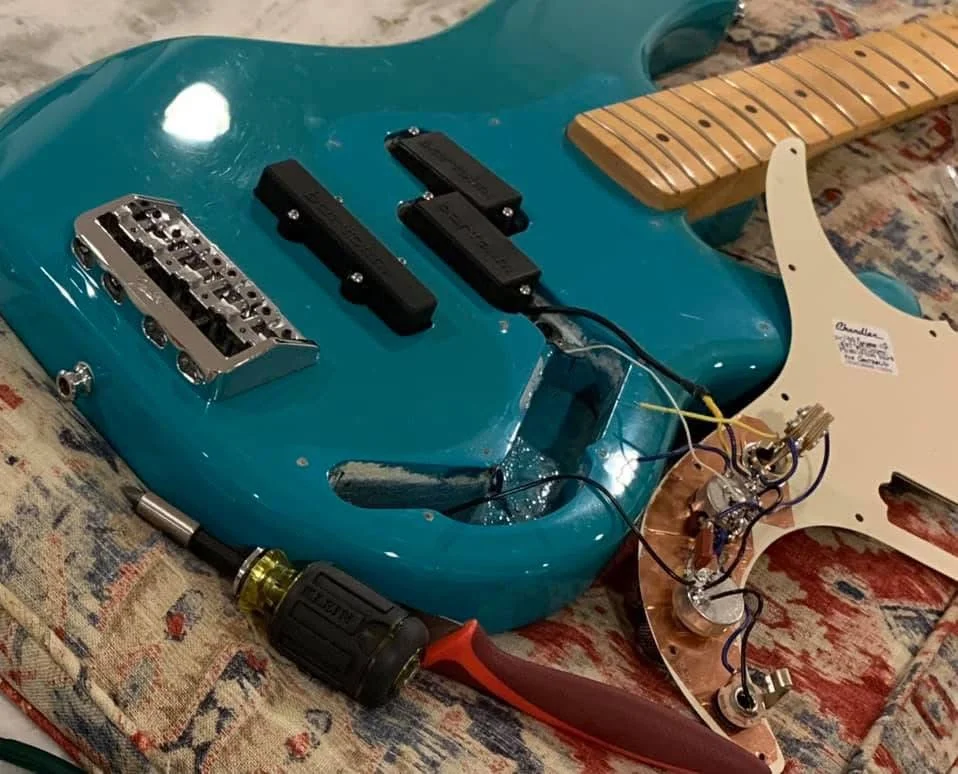
My PBass Plus is my main gigging bass, has been for years. Don't really use any others in the stable these days except for a Warwick fretless when that's called for. I was curious about the color of my bass as I have never been able to identify it in a catalog or see that many Boners in this color. I dumped the picture into Google and it said the color is fairly rare for that era of manufacture: Taos Turquoise. Y'all concur?