
Enjoy the benefits of a premium membership!
Upgrade Account
-
TalkBass has been independent since 1998. Add your voice.
Create a free account to reply to discussions, view embedded media, and browse with fewer display ads.
Join free Log in
Want zero display ads or expanded classifieds tools? Compare plans.
You are using an out of date browser. It may not display this or other websites correctly.
You should upgrade or use an alternative browser.
You should upgrade or use an alternative browser.
Double Bass Bottesini Concert no 2 highest part
- Thread starter Skumbas
- Start date
More options
Who Replied?
I also need help with the c! B natural is the last note on my fingerboard.Hi,
How do you play the highest note in Bottesini concert no 2 first mov. above the fingerboard? I only find the natural harmonics d and f but don't find the e (f# in solo tuning).

Good question. Not sure about that specific passage. But that high E can be played in various ways. These are the options as far as I know (maybe there are more?). Neither of them is easy and you have to do some effort to make them sound clear:
1) beyond the fingerboard one step from the high D harmonic. In fact every chromatic note (also the high C you were asking) can be played if you hold the side of your finger against the string. Not easy to get good sound though.
2) artificial harmonic. Play the a on the G string with your thumb and lightly touch the e ( a 5th above) not pressing down the string
3) play between harmonic D and F# on the D string. Discovered this today after reading your question. Thanks for that!
Curious what others have to say.
1) beyond the fingerboard one step from the high D harmonic. In fact every chromatic note (also the high C you were asking) can be played if you hold the side of your finger against the string. Not easy to get good sound though.
2) artificial harmonic. Play the a on the G string with your thumb and lightly touch the e ( a 5th above) not pressing down the string
3) play between harmonic D and F# on the D string. Discovered this today after reading your question. Thanks for that!
Curious what others have to say.
If it isn't on your fingerboard, then one of the most common ways to get the note you need is to pull the string to the side to play it. You are still shortening the string which is what you do by putting your finger down on the fingerboard. You will have to experiment with the distance between your bow and the bridge, the amount of weight you are applying to the bow, and the bow speed you are using. It isn't an ideal situation and even after experimenting you are not necessarily going to achieve as nice of a sound as a stopped note on the fingerboard, but you really aren't hanging out up there very long anyway.
I wouldn't recommend an artificial harmonic in the specific context we are discussing. They aren't that easy to use at the best of times even if you do practice them regularly, and it would be quite difficult to not only get it in tune, but to play it smoothly in context.
I wouldn't recommend an artificial harmonic in the specific context we are discussing. They aren't that easy to use at the best of times even if you do practice them regularly, and it would be quite difficult to not only get it in tune, but to play it smoothly in context.
Ok thanks! I've just tried to find it by have finger on the string. So it's gonna be on the side of the string?Good question. Not sure about that specific passage. But that high E can be played in various ways. These are the options as far as I know (maybe there are more?). Neither of them is easy and you have to do some effort to make them sound clear:
1) beyond the fingerboard one step from the high D harmonic. In fact every chromatic note (also the high C you were asking) can be played if you hold the side of your finger against the string. Not easy to get good sound though.
2) artificial harmonic. Play the a on the G string with your thumb and lightly touch the e ( a 5th above) not pressing down the string
3) play between harmonic D and F# on the D string. Discovered this today after reading your question. Thanks for that!
Curious what others have to say.
Ok thanks! I've just tried to find it by have finger on the string. So it's gonna be on the side of the string?
When I play off the fingerboard, my finger is still mostly on top of the string, but as I am pushing down on the string, I am also pushing "out". (away from the centre of the bass instead of towards it) that way I don't have to dramatically alter my left hand from what I am doing on the board and any harmonics off it, and I can transition easier. Some people do it a little differently, or there is more "out" than "down". If the string itself were a clock, I would say that my finger tip is centred at about where the hour hand would be at 12:30-1:00. Not very much of a shift from where it usually is positioned.
If it isn't on your fingerboard, then one of the most common ways to get the note you need is to pull the string to the side to play it. .
You mean like bending the string sideways to a higher pitch (like on electric guitar). I bend a harmonic to a higher pitch like that sometimes. But only a half step is possible for me (say harmonic D to Eb). I can do a whole step but it is very tensed and not comfortable. Not sure if you mean the same thing?
Really like how Miros La Vitous is playing those high notes beyond the neck. Problem with playing these notes is that they are hard to get to sound good. It sort of a hit or miss thing.
I don't know that Bottesini passage but I think you should really try my option 3). That is a natural harmonic E that is fairly easy to get. Didn't know it was there until yesterday.
When I think of a bend on an electric guitar, I think of it in the context of somewhere on the fretboard. In that case, I'm fretting a note, and then bending in order to raise the pitch to that of a higher fret or if it is the last fret, then a note higher than that. In that context my finger is behind the fret that would produce let's say an E, and I am pulling "out" (away from the centre line of the guitar to stick with my previous directions) or "in" if I want to go in that direction instead to produce an F, F#, G, or something in between any of those notes. Other than a bend on the last fret or harmonics, I don't know how I would produce a note higher than that on an electric guitar/bass, because I really don't spend a lot of time up there on those instruments.
On a double bass, it isn't really what I think of when I think of a bend. The E in question is the last note on my fingerboard. If I was trying to get an F I wouldn't press the string down in the place that would produce an E on the fingerboard and then pull until I reached an F, I would put my finger on the string between where the two notes would be just a little bit flat of the F, so when I push down (into the void that is the space beyond the fingerboard) and pull out ever so slightly, the resulting note would be an in tune F. The technique would be the same if I was trying to achieve a G because that harmonic is extremely flat, (I'm in 5ths so I have an A string on top, it would be the F harmonic almost three octaves above the open string) or if I was going for the Bb even higher than that or any other note.
I have no idea why the slight pull instead of just pushing straight down seems to work better, but it does. It was the way I was taught and the way I get the best results. I would guess it has something to do creating a more complete stop and if you're using a down bow then you are pulling in opposing directions on the string, but that's just speculation on my part.
On a double bass, it isn't really what I think of when I think of a bend. The E in question is the last note on my fingerboard. If I was trying to get an F I wouldn't press the string down in the place that would produce an E on the fingerboard and then pull until I reached an F, I would put my finger on the string between where the two notes would be just a little bit flat of the F, so when I push down (into the void that is the space beyond the fingerboard) and pull out ever so slightly, the resulting note would be an in tune F. The technique would be the same if I was trying to achieve a G because that harmonic is extremely flat, (I'm in 5ths so I have an A string on top, it would be the F harmonic almost three octaves above the open string) or if I was going for the Bb even higher than that or any other note.
I have no idea why the slight pull instead of just pushing straight down seems to work better, but it does. It was the way I was taught and the way I get the best results. I would guess it has something to do creating a more complete stop and if you're using a down bow then you are pulling in opposing directions on the string, but that's just speculation on my part.
I was comparing to the guitar bends because of the outside/sideways movement of the string. On double bass you bend the G string away from the D string. I think that is what you mean too?
Always hard to describe those things. You have to see it.
Always hard to describe those things. You have to see it.
Put a recording of this piece.. I'd love to hear it.

Thanks a lot for the explanation! I was able to experiment some with this technique this evening and the E is pretty clear now when I'm able to find the position, weight and speed with the bow. This technique is so much easier for me than trying to find the harmonic without pulling the string out. Just a slightly flat e and pull. Mystery solved.When I play off the fingerboard, my finger is still mostly on top of the string, but as I am pushing down on the string, I am also pushing "out". (away from the centre of the bass instead of towards it) that way I don't have to dramatically alter my left hand from what I am doing on the board and any harmonics off it, and I can transition easier. Some people do it a little differently, or there is more "out" than "down". If the string itself were a clock, I would say that my finger tip is centred at about where the hour hand would be at 12:30-1:00. Not very much of a shift from where it usually is positioned.

this is not only a great video and recording, it's also a great example of what @MikeCanada is talking about. The fingerboard of the bass Rinat is playing is very short, and he needs to push the string to the side to get many of the high notes.
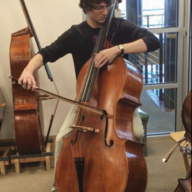
for others reference
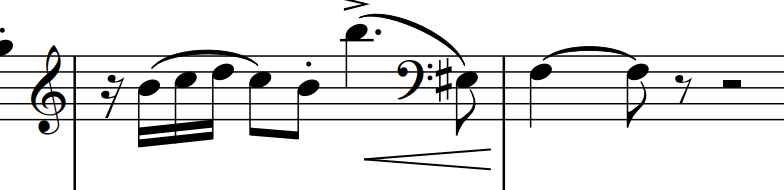
it occurs at around 2:17 in the Rinat video above. It is actually all natural harmonics. B is a harmonic on the G string, C is on the D string, D is on the G string, and then back down. The high B above the staff must be played with an artifical harmonic.
I apologize for bumping this old thread, but seeing the above inquiry go unanswered was a bummer as this is a common question. I think people will find this via google as I did.
it occurs at around 2:17 in the Rinat video above. It is actually all natural harmonics. B is a harmonic on the G string, C is on the D string, D is on the G string, and then back down. The high B above the staff must be played with an artifical harmonic.
I apologize for bumping this old thread, but seeing the above inquiry go unanswered was a bummer as this is a common question. I think people will find this via google as I did.
Rinat was one of a kind. What a sound and what deep, committed playing.

I use an artificial harmonic for a couple of these. I can't remember which one because it's in muscle memory not brain memory (some would say I only have the former). I'll check when I have the bass this afternoon.

I play that high A as an artificial harmonic: on the G string I place my thumb roughly around the node where that note pops out on the string over the fingerboard (a whole step above the 2nd octave G), and I extend my third finger to roughly around where that harmonic occurs off the fingerboard. Maybe it’s because I’ve worked on it so much, but I feel like there’s a little more wiggle room that way compared to trying to hit the harmonic with just the thumb or third finger. I think I’ve also experimented with playing that whole passage on the G string (where the low A, B, and C are all stopped notes), but right now I prefer playing it as all harmonics.for others reference View attachment 7218642
it occurs at around 2:17 in the Rinat video above. It is actually all natural harmonics. B is a harmonic on the G string, C is on the D string, D is on the G string, and then back down. The high B above the staff must be played with an artifical harmonic.
I apologize for bumping this old thread, but seeing the above inquiry go unanswered was a bummer as this is a common question. I think people will find this via google as I did.
Same thing goes for that high E on the first page: I play A G as 2-1, and while I’m playing the G I move my thumb over to touch the 3rd partial on the D string and then play the E artificially with thumb and 2.


