• TalkBass has been independent since 1998. Add your voice.
    Create a free account to reply to discussions, view embedded media, and browse with fewer display ads.
    Join freeLog in
    Want zero display ads or expanded classifieds tools? Compare plans.

Double Bass Bow Technique in Mendelssohn's Ruy Blas overture

Hi,
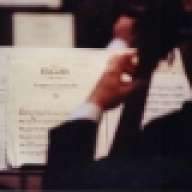
I recently performed Mendelssohn's Ruy Blas overture with my school orchestra. While most things in there didn't post much of a trouble, there are these fast arpeggios in the coda section that would span all four strings, like the attached photo.

Capture.jpg

How am I supposed to approach this figures so I can make it clean and precise?
Thanks
 
Don't play the G open. That reduces it to a 3 string passage.

As a generality, if you need to choose between making a passage difficult for the left hand or the bow, choose the left hand. I think I learned that from Greg Dugan in Indianapolis. Worked well for me.
 
As jallenbass suggested, this should be a three string passage. Try the fingering below, barring the 2nd finger for the first two bars.
attachment.png


You can work the bowing separately, with a metronome, by playing the open strings without any left hand. Pay close attention to how far you move between string changes, and see what you can do to keep everything compact. Even at a slow tempo while working, try to use as little bow as possible and keep the hair in constant contact with the strings. This stroke is entirely in the string with strong articulation.
attachment.png
 

Attachments

  • Screen Shot 2014-02-24 at 12.26.04 AM.png
    Screen Shot 2014-02-24 at 12.26.04 AM.png
    13.1 KB · Views: 511
  • Screen Shot 2014-02-24 at 12.36.47 AM.png
    Screen Shot 2014-02-24 at 12.36.47 AM.png
    14.7 KB · Views: 519
Paul got there just before me, even as I was writing the following!!

Even as a 3 string passage you must sort out which fingering system suits you best. Assuming that you bar from G to C and set fingers 1 & 2 for G to B then to play the last note in each group do you (!) move your thumb each time (2) anchor your thumb and pivot your fingers, or (3) open your hand out and play 1-2-3-4 style, even 1/2 pivoting and 1/2 stretching.

Another consideration when approaching this passage is where to bow and how much bow to use. This is important for timing and coordination between hands. I would suggest (1) not near the end of the fingerboard (2) near or at the balance point of the bow, and (3)using only enough bow to balance the effort of the left hand and produce a clear musical sound. This last might mean only using a few inches of bow length. Another factor can be bow tension - too stiff or too slack. Keep the bow hair on the strings.

Whatever you choose to do start practicing slowly in order to accurately encrypt the brain. Speed will then come more easily later. Don't think of speed as being a barrier that you must burst through. See it as a free-spinning bicycle wheel that simply spins faster with no extra tension in your body movements. The bow length should shrink as speed increases.

Cheers,DP
 
I would suggest (1) not near the end of the fingerboard
If the tempo is lightning fast, I would definitely come toward the fingerboard. The strings are closer together the further up you come, meaning the string crossings take less movement, and the strings will respond to less weight. You lose a little clarity, but if you need it fast this is the way to go.
 
In addition to closing the top G, I'd play this Do-wn, Up, Up so you can keep the sweet spot of the bow in the same place each time you go back to the E-string.
At tempo, that won't work unless you just slur everything. This recording puts it around half=112, but I could imagine it being as high as 126. Sounds like the excerpt in question comes around 7:35. Take it as it comes.

 
Les Fret, I said "at or near the balance point". This is where the weight of the bow is halved (about 1/3 of its length away from the frog end of the stick) if you hold the stick between your thumb and forefinger. It is the magic place to do fast string crossings because the bow is "in neutral". Closer to the frog the bow weight between hair contact point and the tip works against you. Closer to the point and the increasing distance your arm must travel to change strings works against you. In the above passage you still also have to experiment with all the other variables (bow speed and length, bow weight, angle of hair and contact point, etc) as you listen for the result you want
Cheers,DP
 
Hi,
I recently performed Mendelssohn's Ruy Blas overture with my school orchestra. While most things in there didn't post much of a trouble, there are these fast arpeggios in the coda section that would span all four strings, like the attached photo.
Capture.jpg

How am I supposed to approach this figures so I can make it clean and precise?
Thanks
Roger Scott never told his students how to do anything. These sorts of questions make you soft and weak.
"There's an eight-letter word that starts with a P, go do it." -RS
 
Fez 1, I find it hard to believe that Roger Scott would have told a beginner to intermediate-level student to figure this out for themselves. And he did not teach this level. Students coming to Curtis would have been more advanced technically?

In another current thread Don Higdon said "but practice does not make perfect. Practice makes permanent. The more you practice without the watchful eye of a teacher, the greater the risk of making a wrong technique permanent".

Would you agree that we can all learn something from the questions and answers in these Talkbass forums without considering ourselves soft and weak?

Cheers, DP
 
Fez 1, I find it hard to believe that Roger Scott would have told a beginner to intermediate-level student to figure this out for themselves. And he did not teach this level. Students coming to Curtis would have been more advanced technically?

In another current thread Don Higdon said "but practice does not make perfect. Practice makes permanent. The more you practice without the watchful eye of a teacher, the greater the risk of making a wrong technique permanent".

Would you agree that we can all learn something from the questions and answers in these Talkbass forums without considering ourselves soft and weak?

Cheers, DP

When I started playing bass, I had two lessons and then my teacher got kicked in the chest by a horse and was gone for the rest of the school year, and I had to figure most of the stuff by myself, by experimenting or observing the pros play, and I would have gone a lot farther if I had learned to ask questions earlier. Sure, I can turn on my accelerating metronome to start with quarter=60 to gradually work up to quarter=220, but there would be a bottleneck somewhere and the result would be a beautifully faked passage instead of a genuinely played one.
Thanks everyone for responding, and I urge that other one person to not undervalue the approach by asking question.
 

Latest posts