• TalkBass has been independent since 1998. Add your voice.
    Create a free account to reply to discussions, view embedded media, and browse with fewer display ads.
    Join freeLog in
    Want zero display ads or expanded classifieds tools? Compare plans.

Double Bass Brahms 1

So, this kinda under orchestra technique and auditions. I am currently in college and summer has already started for us. The bass section audition for chair placement is Brahms Symphony 1. Now, out of all composers, I would say I know the least about Brahms and how to play Brahms. I will talking with my teacher about this a lot (and other teachers that I am taking lessons from this summer.)

Do you have any personal suggestions about Brahms 1?
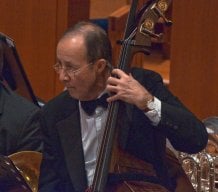
 
Brahms is generally played quite dark and warm. No short strokes like mozart....keep things long and connected. There are plenty of great excerpts in 1 and in the other 3. Brahms' Father was a bass player....that's probably why his bass parts are so great.
 
Well, if you're referring to something like rehearsal E, I would say you really are aiming for a fat heavy sound. Especially with the 8th notes there you don't want too much separation between them. I used a hooked bowing with the quarter note 8th note figures that i think start in the 4th measure? This is really hard to explain on a computer...

I think you should really try to get your hands on as many recordings as you can and listen to them. Personally, I'm a fan of Houston with Eschenbach conducting, but I'm sure any recording with a notable orchestra and conductor will steer you in the right direction.
 
The recording of Cleveland with Szell is an amazing recording. I think it's on Sony records so it should be easy to get.

Brahms is a very warm, dark kind of sound but make sure it doesn't get too aggressive. Rhl E in the first mvt is probably the most aggressive that Brahms gets. Make it fat but not too edgey.
 
Cory Palmer said:
The recording of Cleveland with Szell is an amazing recording. I think it's on Sony records so it should be easy to get.

Brahms is a very warm, dark kind of sound but make sure it doesn't get too aggressive. Rhl E in the first mvt is probably the most aggressive that Brahms gets. Make it fat but not too edgey.

I also love the Szell, I recently tossed away my Bernstein/Wiener for it.


Funny, I just checked my repertoire list and I'm actually performing this symphony with the Johannesburg Symphony Orchestra in South Africa next week, best start practicing.
 
Snakewood said:
I also love the Szell, I recently tossed away my Bernstein/Wiener for it.
This inadvertently illustrates the problem.
Conductors have their own viewpoints, regardless of what we say here.
My advice would be to master the notes, fingering etc., so that instead of burying your nose in the music, you can watch the conductor and respond to his interpretation, whatever that happens to be.
 
Don Higdon said:
This inadvertently illustrates the problem.
Conductors have their own viewpoints, regardless of what we say here.
My advice would be to master the notes, fingering etc., so that instead of burying your nose in the music, you can watch the conductor and respond to his interpretation, whatever that happens to be.

Can you please explain your post? I didn't understand what you were getting at. It's important to not only master the technique of a given score but also FEEL the music and LISTEN to the other instruments asides from your own. Before I begin playing a piece, I always research the history behind it. By understanding the COMPOSER, you can bring forth greater knowledge as to how to go about playing these notes. Too many players pick up an orchestral excerpts book and play Stravinsky and Donizetti exactly the same in emotion and interpretation but still consider themselves advantageous due to their flawless technique. What seperates a good player from a greater player isn't the amount of notes you can play, it's what you can do with those notes.
 
reedo35 said:
And then the conductor will tell you how he wants them played.:smug:
So, Like Don said, it is beneficial to Know the notes and fingerings
so you can keep your eye on him/her.

Not to pick any fights towards anyone, but, in general, aren't there certain characteristics, which come to mind when playing a specific composer..characteristics that transend the interpretation of the conductor (generally)? For example, BGreaney mentions a "fat sound," something not found in Classical symphonies.

Also, I think that Machina is asking us about the Brahms 1 excerpt because he does not have a conductor upon whom he can rely (perhaps even in the time before the audition)? I think the question at hand is how do most bassists play the excerpt for auditions or performance.

Just some thoughts.

Alex
 
kontrabass said:
Not to pick any fights towards anyone, but, in general, aren't there certain characteristics, which come to mind when playing a specific composer..characteristics that transend the interpretation of the conductor (generally)? For example, BGreany mentions a "fat sound," something not found in Classical symphonies.

The frustrating thing though is that now you get into a conductor's interpretation of a fat sound. Without over analyzing this though, I think the biggest thing 90% of the time is showing that you understand the aspects of an excerpt to a point where although it might not be exactly with each conductor (or panel member for that matter) is looking for, it's also not really something they can listen to and say that it was played incorrectly.
 
I neglected the point that this is about an audition, not an ensemble performance. In this case, there's a committee of conductors giving no instructions at all.
Well, this is an audition for bass playing, not conducting.
BGreaney's advice:
BGreaney said:
I think you should really try to get your hands on as many recordings as you can and listen to them....I'm sure any recording with a notable orchestra and conductor will steer you in the right direction.
is more helpful than fixing on a particular recording. Listen to them all, and let the piece speak to you.
The point I tried to make was, suppose everybody on the committee prefers the Bernstein to the Szell?
 
the general style will still be there - it's about how long the eigths are, or rather the spaces between. It's also about if you sound like you know what everybody else is doing while you're playing your lick. that comes very clearly behind a curtain. interpretation won't be that wildly different if you know what else is going on. it's a bit like missing the forest for the trees, you know?
buz
 
I feel that the excerpt at letter E in the first movement is a great exercise in articulation... you've got dots, sforzatti (sp?), accents. Everything said about the first movement is tend to agree with, like making a "fat" sound. The last movement, though, I hear as being alot lighter. Just have the Ode-to Joy-esque theme in your head when practicing the sixteenth-note passages, and you should get to the articulation he was going after. The yummy fat and heavy qualities can be applied too often as a blanket statement with Brahms, which I think is not always the case.

As for preparing this piece for an audition, I think there is alot of room in this symphony, and in Brahms' music in general, for interpretation. You should also not be afraid, rather you should strive, to make the excerpts your own. A trumpeter in the Chicago Symphony has a very helpful article on this subject on Jay Friedman's site: http://www.jayfriedman.net/reflections/20051111Winning_Is_Not_Everything.php

Good luck!
 
Cory Palmer said:
The recording of Cleveland with Szell is an amazing recording. I think it's on Sony records so it should be easy to get.

Brahms is a very warm, dark kind of sound but make sure it doesn't get too aggressive. Rhl E in the first mvt is probably the most aggressive that Brahms gets. Make it fat but not too edgey.


Great recommendation! One can't go wrong if the Szell recording is the first point of reference. (Plus a teacher who can demonstrate it, also helps.) Bassists often talk the Brahms excerpt to death, and it is hard to make sense of the pedagogy babble unless there is a good recording handy.
 
ILIA said:
it is hard to make sense of the pedagogy babble unless there is a good recording handy.

And vice versa. So much is lost in recordings, especially older ones. To say that recordings should influence your technical understanding of an excerpt is dangerous in my book, but they're totally fine for getting a handle on the interpretation of the music. Pedagogical babble has its place, as do recordings.
 
Just to add:
I am going to be playing this for a conductor that I have already played for. In addition to him, I am playing for the violin and cello professors at our school.
I was asking about the piece just to see what everyone thought about "playing Brahms" and the styles that go along with that. I am going to discuss the Brahms 1 excerpt with multiple teachers that I am taking lessons from over the summer.
 
Does anyone (or everyone collectively) have interest in compiling info to compare to Mr. Doug Yao's website? It has actual excerpts with commentary. It is interesting to look through his comments, even though they are for them trombone things.

[Invalid or Expired Link Removed]
 
You should listen to lots of recordings to get an image of the overall sound you want in your ear (that may not be like any of them!), and then learn to produce it. You have to determine your own sound and then play in the style of whatever excerpt you happen to be playing (lots of good Brahms 1 commentary above for that). If you always try to second-guess what the individuals on the panel might want... well, I hope you're a good gambler!