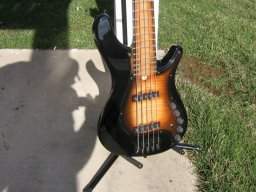
I know a lot of like to tinker with pickups but these are I think the third generation pickups in the sc5 and they are the bomb. I feel no need to upgrade at all even my recent jjx5 sounds mean and will stay stock the sc5 has all that but seemed even sweeter tone wise and the neck even faster like a brute on steroids. The merlow finish is also sweet along with being satin to. I love satin finish
I can confirm that these are the third generation of the pickups.
Now guys, this silliness regarding body woods and pricing has gotten a little out of hand, and has gotten a little bit personal, so I'd like to share my opinion, being that of a guy who's been on the wholesale, retail, manufacturing and marketing sides of this industry equally and continually for many years... and also being someone who truly has no dog in this fight;
Pricing: This of course is the heart of all matters. I have seen all kinds of philosophies, starting with one of two baselines: 1) How can one give the customer the most amount of product for the least amount of money or 2) How can one incur the least expense in providing a product that can be marketed at a certain price point. EVERYTHING starts from one of these two baselines. (no pun). Most of the smaller manufacturers start with 1, and most of the mass-market manufacturers, with a few notable exceptions, strive forward from 2. With small manufacturers like Brubaker... beginning to offer an import line is a gigantic undertaking. All new connections have to made.... one has to fly to China, meet factory reps, develop shipping and logistics plans and execute them, design, prototype, sample... and all the little stumbling blocks along the way.... problems with import / export tarrifs, customs issues, logistics and shipping problems, production problems, production deficits and surfeits and it goes on and on. For a smalltime builder its a years-long and minimum $25K - $50K investment before they see even the first run of saleable product. Obviously not something done on a whim, and I shouldn't be surprised to find out that the Brute line has been a total loss at this point in the game, financially speaking. And after all this, one comes to the decision of pricing. Having determined, within a given percentage of error, what total costs will be, the smalltime builder must now determine how to get the product into the hands of the consumer.... the lion's share of the profits must go to the dealer. Most dealers large and small are interested in only two things: A)
will the product, by virtue of the quality, features and marketing set forth behind it, actually drive traffic to their store and sell well, and B)
will the product be worth the space it takes up in the store and generate enough money by it's profit margin to be worth stocking as opposed to some other more established product. Large dealers like Sam Ash and GC spec out their stores by average margin (dollars of profit) per square foot of retail space per quarter or per year. That's why you see lots and lots of entry level & mid-priced stuff in these stores because via per-unit margin and per quarter quantity sales per sku, these products produce the most dollars of profit per square foot per quarter or per year. So, the builder must build in at least average (18% - 20%) or greater than average profit margin for the dealer in order to make it attractive enough for a dealer to want to carry it. The dealer must also be assured that there will be sufficient marketing put in place to raise awareness of the product to the point anyone will even know the product is available and what the product offers. Then of course, there is the distributor to think of. They must warehouse the product in bulk, incur the expense of getting the product to the retailers by whatever means, plus the payroll costs associated. There's another 10% -15%. Working backwards, the builder must then build in enough of a margin above his costs for himself to pay himself back for his investiture within a given period (usually a matter of YEARS, not months) all using a made-up number of "projected" sales which usually amounts to nothing more than wishful thinking and fingers-crossed, wing and prayer guesswork on how many units will sell. In the case of the larger manufacturers....the design process goes in the reverse... sophisticated market analysis determined the viability of a product priced at $X. A marketing plan is produced, approved and finalized (before they even know what the bass is.... the bass is born FROM the marketing plan, not the reverse). A budget is approved. Using hard numbers from products already on the market, they design the bass from the top down, with quality of build and materials and feature-set being the absolute last considerations on the list. Basses that fall under this category are and have been lauded by purists and gear-snobs as recently as this thread...
In short, the decision of pricing is quite a bit more complicated than just looking at what the market offers in competition and trying to get as much as one thinks one can get away with. Is $1,200 a lot for a chinese bass? Sure it is when one is using the Squier Deluxe active Jazz bass as one's basis for comparison. When one uses a successful import line like the Lakland Skylines or the MTD Z-Series as their basis for comparison... no it's not a lot of money. When comparing an all-passive, bolt-on, 4 string jazz bass copy to an all-active, 5 string bass with a unique neck-joint and First In the Market singlecut design... $1,200 is a positive bargain.... And yes, of course, there are the American Basses available in this price range.... take the Fender American Standard Jazz Bass for example. Dollar for dollar we'd be comparing the 4 string Fender to the 5 string Brute SC. So we start with a deficiency right there. Woods? Brute is 1-pc solid Ash. Fender is often 2 or 3 pieces of either Ash or Alder. 4-Way Adjustable bridge? Yes to both. Excellent fretwork? Yes to both, with Fender being spotty... Active electronics?
Brute wins. Access to higher frets / contoured neck heel?
Brute wins. Neck and Tuning stability? Remains to be seen, but Fender has not set the bar very high....Unique to the market or advanced construction techniques?
Brute wins again.
Routing out and creating the 4-sided "Bolt-Thru" neck joint on the Brutes requires a level of machining sophistication and human effort which has never been attempted in an import bass before. The $400 differential between the Brute SC and the median MAP or Street Price for the vast majority of top-of-the-range Import basses from Schecter, Ibanez etc is justified by this alone, disregarding the quality of the bass overall and the SC configuration...which both add additional value. The Skylines are so popular because they play incredibly well and sound fantastic. If the Brute plays at least as well, and sounds at least as good to the end buyer, they represent a fantastic value at even $,1350 since there is a feature set on offer from the Brute that cannot be found on the Skylines. It has everything the Skyline has and greatly more. This is one piece of the recipe used to determine final street price. And, as a last word on the topic of pricing, rest assured most people not familiar with the industry would be fall out of their chair, knock-down SHOCKED at how little room there is between the cost of this bass AT THE POINT WHICH IT ARRIVES IN THE USA, disregarding the costs of shipping, logistics, dealer profit and all other associated costs. Creating this unique bass is an expensive proposition, especially considering the fact that each bass much be played and inspected and worked-on for perfect fretwork by a human being.... something completely unique on all other Asian Imports except the Skylines. The cost of one of these basses at the point of entry into the US is probably more than the retail cost of the basses some people here are trying to compare it to......
Lastly, one must also take into account the emerging uniformity of machining. These new Chinese factories are using THE EXACT SAME MACHINES to route the necks & bodies, slot the fingerboards, seat the frets and assemble the instruments as the top American Builders like Gibson, Fender and Musicman. Add a fellow named Quong at the end of the assembly line who spot-check the neck joint, plays the bass and files a few uneven frets here and there.... and you have the EXACT SAME build process from start to finish as the USA basses costing twice as much or more. The ONLY difference in these basses from the top-of the line American Basses is the Country of Origin and the fact the Press-Machine operator isn't in a union making $38 / hr pushing a lever, as much as I defend his right and ability to do so. Those who walk around thinking there is vast or even ANY difference in the construction procedure between a Gibson Les Paul Standard and a comparably-equipped Epiphone are very much behind the times. I've been to the factories. Believe me I know. Want an all-handmade bass with hand-rubbed finish and perfectly filed fretwork? Well... that's what guys like Kevin Brubaker, Pete Skjold, Keith Roscoe, Marco Cortes and others are in business to provide you with.... get ready to pony up the cash.
Woods: The age old beef.... Here's the deal kids....and please feel free to repost elsewhere and use my words as your own... for here is the end of this debate stated so plainly and succinctly that to detract from the clear and simple truths that follow are to declare one's self a fool and a knave:
Wood matters.... TO SOME, only in certain applications, and NOT for the most commonly cited reasons.
Still reading? Good! Prepare yourself for the certain knowledge that has been exploited by builders of instruments, cabinets and flooring for a hundred years;
90% of the value of woods is in
PERCEPTION. Put me in a room with a wood snob & 4 basses of different woods, completely painted black....
and I will make a fool of him every single time. Sure, he may find his favorite out of the four, but even given a 25% chance of success, he will fail to identify the Ash from the Agathis, the Mahogany from the Maple. Every time. More often than not, the snob will say he prefers the Basswood bass to the others.... as Basswood, despite being slightly softer than the ideal, is an EXCELLENT wood for stringed instruments but gets peed on because of it's low cost. Please, PLEASE believe the manufacturers have learned to exploit this. A piece of improperly kilned or low-quality Spanish Cedar or Koa has no greater value in this application than a chunk of BALSA. More importantly, you can build a bass from one solid piece of the highest quality Bubinga or Figured Walnut... assemble it with an uneven or imperfect neck joint, or shoddy hardware, a poorly cut nut, or low break-angle at the nut and / or bridge etc ......
and it wont matter one shiite if the body is cut from purest jesus-blood, the bass will play and sound like crap.... wood matters ONLY in the case of an otherwise very well-constructed instrument.... and ones' perception of the wood trumps all..... Alder, Ash, Basswood, Cedar, Walnut and Mahogany, fir, and yes even Nato.... all properly dried and brought to a very low moisture content are all great woods for stringed instruments and all have their inherent tone, but their suitability has NOTHING to do with their COST and add value ONLY with respect the overall build quality and components of the rest of the instrument. What some of you consider very hi-quality body woods are, in fact, extremely common, very cheap to buy and even considered worthless scrap by some other industries.... and their end-cost and attendant "exclusivity" comes from the fact that they are difficult woods to machine, produce toxic dust or take a large toll in terms of wear on cutting machines. I will take a quality piece of Brubaker Nato or Musicman Basswood over a soakin' wet floor-scrap piece of Gibson Mahogany ANY DAY OF THE WEEK. Nato, along with a related species called Kiri, have been used to make the KOTO for more than 1,300 years.....kinda hard to argue with that kind of mileage out in the field.....
For those out there who scoff at this and fold their arms, lift their nose skyward and shake their heads in disgust at any wood which is either inexpensive, readily available, used by Squier, or heretofore not widely used in this application here in the united states.... I congratulate you.... you fuel an aspect of several industries which survives by manipulating your peevish and gullible perceptions of luxury and quality and gladly uses your fine sensibilities to rip you off. It's the same concept that faux-luxury restaurants use to peddle you $300 per plate meals of the most revolting and indigestible parts of rare and endangered exotic animals at bowel-emptying profits. If that makes you angry feel free to PM me or even call me, and I will give you enough examples to either reform you, or shame you into feigning reform.
Read [Invalid or Expired Link Removed] on wood and learn yersself some book. The overall moisture content, density (not stiffness), ductility and tensile strength determine suitability for stringed instruments... NOT cost or availability. I own a $3,000 bass made from common Fir... and it resonates like a hollowbody and sustains long enough to lull the cats to sleep....
I PERSONALLY cant wait to get my Brute SC, and think that if it comes in anything less than $1,300 it will be a bargain, less than $1,200 an INSANE bargain and know beyond a shadow of a doubt that the greatest portion (or smartest portion) of people who ultimately own one will make their decision after PLAYING one, rather than pissing around about it not being made of their favorite expensive rare wood, despite the fact that the latter couldn't effectively differentiate the sound of Flamed Koa and Soft Maple even 2 out of 5 times if their very lives depended on it....
Flame on.....


 .
.