knuckle_head
Commercial User
- Jul 30, 2002
- 2,621
- 58
- Disclosures
- Owner; Knuckle Guitar Works & Circle K Strings
TapyTap - a .049 for D
AmadeusXeno - Yours is a loaded statement/question. Histrionics explain why all those who have gone before us have used what they use - the sets we play are gauged the same as they were 60 years ago. And most everyone wants to cop the sound they've heard, or know as bass.
String makers have been selling sets with lower tension E strings since the 50's. This has been in part to compensate for rigs that even today cannot present the actual fundamental of that E. Back in the day rigs didn't even have the capacity to present even the second harmonic of a low E. Here's why;
If a string is looser it moves more - it is louder as a result. If it's louder it is more present when reproduction begins to fail. In a way it's like bumping up the low fundamental on an EQ, except it is done physically with the instrument.
We are blessed with rigs that today easily give us an octave more room on bottom to use since the rigs of the 50's provided. Current era, we have a similar constraint in reproduction for B much as we had in reproduction of the E in the 50's. This is all physics readily proved out by the analysis of speaker enclosure designs alone over time.
As to why you want to exceed manufactured tension when playing, when a string is made the individual wraps are basically touching along the length of the string. As the string is under tension as it is wound, when you release the tension on it the winds collapse on themselves. It makes the string that much more rigid as a result. If at pitch the string is not pulled beyond the tension it was made at the string is not as flexible as it can or (IMO) should be - it is robbed of overtones that some find pleasant and useful.
Nothing wrong with what's come before, but that's not to say there isn't a better way.
AmadeusXeno - Yours is a loaded statement/question. Histrionics explain why all those who have gone before us have used what they use - the sets we play are gauged the same as they were 60 years ago. And most everyone wants to cop the sound they've heard, or know as bass.
String makers have been selling sets with lower tension E strings since the 50's. This has been in part to compensate for rigs that even today cannot present the actual fundamental of that E. Back in the day rigs didn't even have the capacity to present even the second harmonic of a low E. Here's why;
If a string is looser it moves more - it is louder as a result. If it's louder it is more present when reproduction begins to fail. In a way it's like bumping up the low fundamental on an EQ, except it is done physically with the instrument.
We are blessed with rigs that today easily give us an octave more room on bottom to use since the rigs of the 50's provided. Current era, we have a similar constraint in reproduction for B much as we had in reproduction of the E in the 50's. This is all physics readily proved out by the analysis of speaker enclosure designs alone over time.
As to why you want to exceed manufactured tension when playing, when a string is made the individual wraps are basically touching along the length of the string. As the string is under tension as it is wound, when you release the tension on it the winds collapse on themselves. It makes the string that much more rigid as a result. If at pitch the string is not pulled beyond the tension it was made at the string is not as flexible as it can or (IMO) should be - it is robbed of overtones that some find pleasant and useful.
Nothing wrong with what's come before, but that's not to say there isn't a better way.
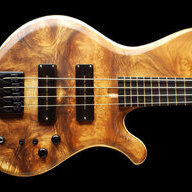
 I used to think a B needed to be a bridge cable but I think I was wrong.