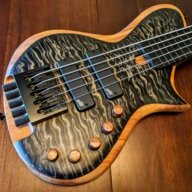
So, the finish line is approaching. I'll be ready for glamour shots by EOW, and will post them here and in the build-off thread.
But prior to that -- and mainly since I don't want this post to get lost in the chain of kudos that often follows completion -- I thought to share my retro.
This is my second build, first on my own, and it's only four years ago that I bought my first tool and started playing with wood. Point is, I have a long way to go and a lot to learn.
So after a major project like this, I like to assess. At the risk of over-sharing, or sounding like a diary entry (I don't think it is, but I understand if others do), here are my learnings and level-ups from this project.
1. Better choices
A lot of my level-ups happened during the design and planning phase.
- Better body. My first bass is pretty skewed. Not quite Ritter, but still very dynamic. This one has a flatter bottom, so it sits better on a stage stand. It's also beveled rather than rounded, which made it much easier to get a top-shelf set of contours.
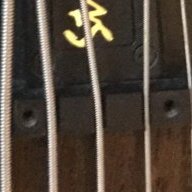
- Better hardware. I really don't like the Hipshot headless hardware that I used on my previous instrument. I took a risk and bought a set of T4M headless hardware, and I'm a big fan.
- Better finish. I don't have (or want) a spray booth, so finishes need to be wipe-on. Last build used Osmo hard wax oil, which is the go-to for most of my projects. I just couldn't get a high enough sheen with it (I was going for satin, got matte), so this instrument used Tru-oil. With good technique, I was able to get it all the way to medium-gloss very easily.
- Better neck. I went from one-piece maple to laminated wenge. Big upgrade! I also used BruceBars, which I'm sold on. All of these factors are part of what gives this instrument the best B string I've ever had.
2. Technical level-ups
This is about my workmanship:
- Finish. And by "finish" I mean "prep." I didn't leave a single sanding mark on this baby. The finish is clear as a summer's day, and I'm proud of it. I'm mostly proud of having upgraded my value system from "this is good enough" to "I'll seriously regret every corner I cut."
- Drill press. Seems weird to say, but I feel like this is one of my weak spots. I made lots of drilling mistakes on my last build. So I invested in an awl and several sets of brad-point bits. I'm not quite where I want to be, but I was able to be much more precise with getting holes exactly where they belong.
- Accessories. I don't mean cables and a strap; this is my category for secondary parts of the build. In particular, I made my first set of pickup covers (actually, two sets, since I didn't like the wood I made the first one from), and my first knob recesses. Both projects are basically simple, but I learned a lot from each.
3. To work on
I still have a long way to go.
- Tools. Every project ends with me thinking how much easier it would have been with some better tools. Well, here we are. I've gotten by without a jointer, band saw, or spindle sander. I doubt I'll buy a band saw, just because of space limitations, but I really really really wish I had a jointer and a spindle sander. The sander is just a time-saver compared with hand-sanding with a dowel, but the jointer would let me do much better work. It might be time.
- Knobs. I'm not satisfied with my knob technique. They're ok, and ironically, one of the first things that people comment on when they see my instruments in person. But they're not perfectly centered, sit too high above the body, and not even sophisticated enough for the other design elements of my work. I really want to up my game here.
- Router technique. I upgraded from a palm router to a 2.5hp plunge. But I'm not comfortable with the plunge base yet. And my bits all have straight flutes; it's probably time to invest in spirals. Especially since this is all very teary-outy wood.
- Nut. For my first bass, I cut half a dozen nuts. I'm still not comfortable doing it. I need to buy my own files and really get down to practicing. For this bass I gave up before I started and just bought a pre-cut nut. Lol, problem is that it's radiused and my board is flat, so I'll still have to file the three middle slots. :shakesfist:
There you have it. Intermediate woodworker reflects! I find that doing a public retro helps solidify the level-ups and ensure I make the changes that I need to improve.