

Enjoy the benefits of a premium membership!
Upgrade Account
-
TalkBass has been independent since 1998. Add your voice.
Create a free account to reply to discussions, view embedded media, and browse with fewer display ads.
Join free Log in
Want zero display ads or expanded classifieds tools? Compare plans.
You are using an out of date browser. It may not display this or other websites correctly.
You should upgrade or use an alternative browser.
You should upgrade or use an alternative browser.
Build II - Paradox MJ5 - New design!
- Thread starter roberthabraken
- Start date
More options
Who Replied?
good to see you back at building Rob.
I see the slots cleaning more of slow and boring task than a particularly difficult one (perhaps that's what you meant).
What works for me is to use the dull edge (the one opposed to the cutting edge) of a cutter or exacto knife. Really works beautifully.
I'm also curious why are you shaping the neck after fretting (I realize that it's nice to hammer on the frets onto a perfectly squared block but on the other hand you need to watch out for those frets while shaping).
I see the slots cleaning more of slow and boring task than a particularly difficult one (perhaps that's what you meant).
What works for me is to use the dull edge (the one opposed to the cutting edge) of a cutter or exacto knife. Really works beautifully.
I'm also curious why are you shaping the neck after fretting (I realize that it's nice to hammer on the frets onto a perfectly squared block but on the other hand you need to watch out for those frets while shaping).

Common guys! The F-clamp you saw on the first pick:
So what's the big deal? People use those during woodworking, don't they? It's not balsa I placed it on, but Macassar Ebony...
I sure won't use this technique while and after finishing. And I'm more careful than most of the guys I see around on TB. I place all my work on a cleaned bench, covered with thick paper sheets to protect them, and I check my work piece and bench each time before clamping, so I do not clamp sawdust in between the sandwich (because that would mark and scratch your working piece). It's not like I put my work on the pavement outside, to showcase it
Thanks! Great tip, I might get one!
Thanks
Cool you've mentioned me in your discussion! Thanks for the compliments. I actually enjoyed a La Trappe Double while posting my last update yesterday It's good beer, I think it's great to brew your own!
The cork is a good idea to apply further down the road while building. Thanks.
Not necessary, see above...
Yeah, that's what I meant, dull, boring, slow, annoying. It ain't difficult..
I'll try the dull edge of an exacto, may be just fine too (and less change of damaging the wood).
The reason why I shape the neck after fretting is that it's much easier to hammer in the frets while the neck is still square at the back, just as you say. The frets are not in my way while shaping, if they would, I would be damaging the straight line of the neck and the edges of the fingerboard... so in my opinion, it's a good measure to just not touch the fret ends while shaping. Also, when the frets are in alreay, I have less change of damaging the fingerboard while shaping, because the neck is resting on the frets. Besides that, I'll still use some soft cloth to put in between my bench and the finished fingerboard while shaping.
Thanks all for your interest and good ideas!
- was barely tightened
- has a rubber shell where it contacts the wood
- was placed on a fingerboard full of excess glue and pieces of little lumps of melted binding due to the UHU Allplast I've used for the binding (a little bit too much that is)..
- while the fingerboard isn't finish sanded at all, only rough sanded up to 320 grit
So what's the big deal? People use those during woodworking, don't they? It's not balsa I placed it on, but Macassar Ebony...
I sure won't use this technique while and after finishing. And I'm more careful than most of the guys I see around on TB. I place all my work on a cleaned bench, covered with thick paper sheets to protect them, and I check my work piece and bench each time before clamping, so I do not clamp sawdust in between the sandwich (because that would mark and scratch your working piece). It's not like I put my work on the pavement outside, to showcase it
Looking good!!!
I've seen a tool used to remove glue from fret slots, it's sort of a hook shaped scalpel.... something like this... but not quite...
ok, here it is, it was easy to find on stewmac:
Invalid Link Removed
Thanks! Great tip, I might get one!
Looks great!
Thanks
My wife and I were just talking about this bass last night Rob, specifically how much I have a lot of respect for your patience and discipline. Too many builders rush their builds after having been propped up by all the "whoa, nice build dude!" and "want to see more progress" posts.
That and Trappist brews. We're planning on a making our own batch of a Chimay Blue clone and thought of you. :-D
Incidentally whilst I think of it....those F-clamps you're using to secure the neck to your table....grab a piece of cork board such as a flooring tile and put that between the clamp pad and your board otherwise those pads'll mark up your Macassar, especially when you hit them with the higher finishing grits! Bugs me to see those things in direct contact with a workpiece.
Cool you've mentioned me in your discussion! Thanks for the compliments. I actually enjoyed a La Trappe Double while posting my last update yesterday
It's good beer, I think it's great to brew your own!The cork is a good idea to apply further down the road while building. Thanks.
Looks great.
And, that clamp on the fretboard was scaring the crap out of me, too.
Not necessary, see above...
good to see you back at building Rob.
I see the slots cleaning more of slow and boring task than a particularly difficult one (perhaps that's what you meant).
What works for me is to use the dull edge (the one opposed to the cutting edge) of a cutter or exacto knife. Really works beautifully.
I'm also curious why are you shaping the neck after fretting (I realize that it's nice to hammer on the frets onto a perfectly squared block but on the other hand you need to watch out for those frets while shaping).
Yeah, that's what I meant, dull, boring, slow, annoying. It ain't difficult..
I'll try the dull edge of an exacto, may be just fine too (and less change of damaging the wood).
The reason why I shape the neck after fretting is that it's much easier to hammer in the frets while the neck is still square at the back, just as you say. The frets are not in my way while shaping, if they would, I would be damaging the straight line of the neck and the edges of the fingerboard... so in my opinion, it's a good measure to just not touch the fret ends while shaping. Also, when the frets are in alreay, I have less change of damaging the fingerboard while shaping, because the neck is resting on the frets. Besides that, I'll still use some soft cloth to put in between my bench and the finished fingerboard while shaping.
Thanks all for your interest and good ideas!

Heh ;-)
I hate the rubber and plastic pads on my F-clamps because they pick up dirt (and glue) like anything. I've made the mistake of thinking my clamps clean and forcing debris into a nicely sanded board before. I actually removed the plastic pads and instead use wood and cork cauls now, firstly because they distribute clamping force better plus I am forced to check they are clean.
That night we were walking back from Invalid Link Removed here in Pori after having had a Chimay Blanche, La Trappe Dubbel and a pair of Duvel. The barkeeps also have the wherewithal to leave the last 50ml or so in the bottle since it is bottle conditioned. Wonderful.
Nina suggested that I enquire to see how much it is to get a crate of Chimay sent over, given that Alko (state regulated alchol store chain) have stopped stocking it. Bar stewards! Either that or we'll have to go on a cruise to Estonia to stock up on the essential stuff.
I hate the rubber and plastic pads on my F-clamps because they pick up dirt (and glue) like anything. I've made the mistake of thinking my clamps clean and forcing debris into a nicely sanded board before. I actually removed the plastic pads and instead use wood and cork cauls now, firstly because they distribute clamping force better plus I am forced to check they are clean.
That night we were walking back from Invalid Link Removed here in Pori after having had a Chimay Blanche, La Trappe Dubbel and a pair of Duvel. The barkeeps also have the wherewithal to leave the last 50ml or so in the bottle since it is bottle conditioned. Wonderful.
Nina suggested that I enquire to see how much it is to get a crate of Chimay sent over, given that Alko (state regulated alchol store chain) have stopped stocking it. Bar stewards! Either that or we'll have to go on a cruise to Estonia to stock up on the essential stuff.
Yeah, I need to keep those plastic pads clean and I usually cover them with tape, so they don't pickup dirt and are easily cleaned (by removing / replacing the tape). But believe me, I'm careful
And I'm sure going to try the cork thingy!
And I'm sure going to try the cork thingy!

Dont feel too bad robert, I use the rubber pads on my clamps all the time. I'd have no problems using them for a fingerboard as long as it wasnt finish sanded.
Minor marks on the board aren't too bad to deal with until those pesky frets go on :-D
Hell is buying an instrument and finding that the previous "owner" left cross-grain scratches up next to the wire. Grr.
Hell is buying an instrument and finding that the previous "owner" left cross-grain scratches up next to the wire. Grr.
Thanks Big B.
And thanks Gonzalo! I found your tip of using the back of an X-Acto-type knife very useful! I bought one today and spent a little over 90 minutes and one blister scraping and removing excess glue from the fret slots. I first cut the little lumps loose from the sides of the slot and from the binding, removed as much as I could with the tip and then scraped the slot flush to the original depth using the back of the knife.
I noticed it widens the slots a little locally, but not so much it causes problems, I guess. And a few times the fragile tip of the knife broke (just a tiny piece), but I was able to remove those succesfully.
Right now, I'm exactly halfway the fingerboard (only did the treble side), so I'm hoping to finish this task in a little less than two hours, somewhere later this week. After that I would finish sand the fingerboard and touch up the binding, so I can start fretting.
After fretting it's installing the side dots, shaping the neck and assembling everything (drilling holes mostly). Of course, that would leave finish sanding, finishing, the electronics, final installation and some dressing and fine tuning, before I could play this bass.... but at least, we're getting close
And thanks Gonzalo! I found your tip of using the back of an X-Acto-type knife very useful! I bought one today and spent a little over 90 minutes and one blister scraping and removing excess glue from the fret slots. I first cut the little lumps loose from the sides of the slot and from the binding, removed as much as I could with the tip and then scraped the slot flush to the original depth using the back of the knife.
I noticed it widens the slots a little locally, but not so much it causes problems, I guess. And a few times the fragile tip of the knife broke (just a tiny piece), but I was able to remove those succesfully.
Right now, I'm exactly halfway the fingerboard (only did the treble side), so I'm hoping to finish this task in a little less than two hours, somewhere later this week. After that I would finish sand the fingerboard and touch up the binding, so I can start fretting.
After fretting it's installing the side dots, shaping the neck and assembling everything (drilling holes mostly). Of course, that would leave finish sanding, finishing, the electronics, final installation and some dressing and fine tuning, before I could play this bass.... but at least, we're getting close
Some more progress!
I spent last night cleaning up the fret slots at the bass side of the neck, it's a slow process, but it didn't turn out as tedious as I thought it would be. You can clearly see the difference between a slot with excess glue in it and a cleaned out slot:

So, that means I'm ready to finish sand the fingerboard:
Link Removed
I just bought some quality sandpaper of 180, 240 and 320 grit.... I'll keep you posted.
I spent last night cleaning up the fret slots at the bass side of the neck, it's a slow process, but it didn't turn out as tedious as I thought it would be. You can clearly see the difference between a slot with excess glue in it and a cleaned out slot:
So, that means I'm ready to finish sand the fingerboard:
Link Removed
I just bought some quality sandpaper of 180, 240 and 320 grit.... I'll keep you posted.
One enjoyable evening closer to a finished bass: I've sanded the fingerboard up to 600 grit. And much to my surprise (still), but the quality sandpaper made this a breeze, really. 600 grit isn't that high for a fingerboard, but I like the look and feel of real wood while still having a nice smooth surface rather than a plastic-ish shiny 'wood print' fingerboard.
The finished fingerboard, ready for fretting:

Link Removed

As you can see the fingerboard shows some mild reflections (look right below the jar):
Link Removed
I am really pleased with the result. The Macassar really stands out and the combination with the white binding and pearl dots makes it stand out even more. Now lets hope I don't screw up while fretting or shaping the neck, and we should have a very nice bass neck in the end!
The finished fingerboard, ready for fretting:
Link Removed
As you can see the fingerboard shows some mild reflections (look right below the jar):
Link Removed
I am really pleased with the result. The Macassar really stands out and the combination with the white binding and pearl dots makes it stand out even more. Now lets hope I don't screw up while fretting or shaping the neck, and we should have a very nice bass neck in the end!
Agreed. Hand grease soon ruins glossy Ebony anyway. You could buff it with Carnauba wax to seal the lustre at this stage also. Macassar is beautiful to work with.
I finally started fretting today. It's a nice job that I really enjoy doing.
Link Removed
My cheap modified regular nippers that now serve to undercut fretwire work great:
Link Removed
Hamering some more frets in:

And I stopped after exactly one half of the fingerboard:

So far, so good...!
Link Removed
My cheap modified regular nippers that now serve to undercut fretwire work great:
Link Removed
Hamering some more frets in:
And I stopped after exactly one half of the fingerboard:
So far, so good...!
I have that exact same hammer, except mine is infinitely more "seasoned". You need to some dirt in your projects, Rob!
And they're all in!
Link Removed
Funny thing.. you might remember the neck bent slightly forward (cup) due to the fact that I glued the carbon rods in with very low humidity (~20%) and the fact that the maple expanded when humidity got back to a more average level. Well, after hamering in all frets, the neck bowed back a little, just enough to correct almost all forward bow. The slots weren't tight at all, and I could've used a little more back bow, but all in all it's as good as it gets I guess; the rest is up to the truss rod.
Now I have to finish the fret ends. I let them protrude only about 0.5 to 1.5 mm and the ends that came out longer were cut of in the process as close to the fingerboard as I possible. On my first build I used my Dremel to grind of the ends, but I didn't like that approach because the neck is easily damaged in the process. I was thinking I could start right away with the fret bevel file and work my way up to the fingerboard (because of the undercut wires, there's a lot less material to file off). Another option would be to file the ends off with a regular file and then start beveling with the fret bevel file.
Any advice would be highly appreciated!
Link Removed
Funny thing.. you might remember the neck bent slightly forward (cup) due to the fact that I glued the carbon rods in with very low humidity (~20%) and the fact that the maple expanded when humidity got back to a more average level. Well, after hamering in all frets, the neck bowed back a little, just enough to correct almost all forward bow. The slots weren't tight at all, and I could've used a little more back bow, but all in all it's as good as it gets I guess; the rest is up to the truss rod.
Now I have to finish the fret ends. I let them protrude only about 0.5 to 1.5 mm and the ends that came out longer were cut of in the process as close to the fingerboard as I possible. On my first build I used my Dremel to grind of the ends, but I didn't like that approach because the neck is easily damaged in the process. I was thinking I could start right away with the fret bevel file and work my way up to the fingerboard (because of the undercut wires, there's a lot less material to file off). Another option would be to file the ends off with a regular file and then start beveling with the fret bevel file.
Any advice would be highly appreciated!
If your fret bevel file is something like this one you'll get rid of 1.5mm pretty quickly. It's the sort of thing you can pay Stewmac $65 for, or make yourself for next to nothing (especially if you've already got a file).
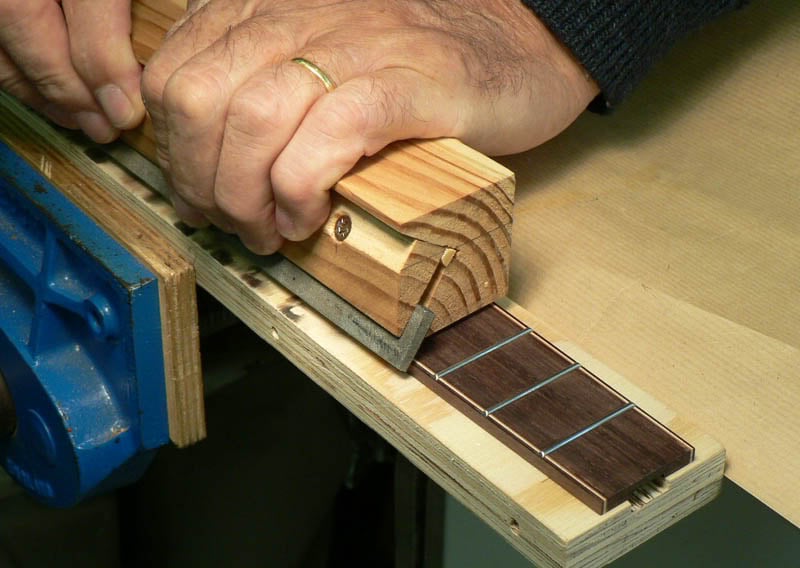
I already have one (and didn't pay that much!), my question referred to the method especially, not so much about the tool itself, but thanks.
I heard from a friend that if you try to do it like that, and you accidentally hit a protruding edge with your bevel block file, you'll easily bend it over the binding, because it isn't anchored in the fingerboard at the ends. So wouldn't it be better to first file them of with a regular file first? I also see you have a very small board with tiny frets as an example / a reference. With Dunlop 6105, would your statement still apply?
I heard from a friend that if you try to do it like that, and you accidentally hit a protruding edge with your bevel block file, you'll easily bend it over the binding, because it isn't anchored in the fingerboard at the ends. So wouldn't it be better to first file them of with a regular file first? I also see you have a very small board with tiny frets as an example / a reference. With Dunlop 6105, would your statement still apply?
I guess that if you have access to a grinder, grinding rounded edges over the back and the front of the file will prevent snagging.

I guess that if you have access to a grinder, grinding rounded edges over the back and the front of the file will prevent snagging.
Thanks, good one!
It's just rocking along, isn't it?
Isn't it

Call me old fashioned, but, I learned to do the bevel by hand. Works okay, but, I will invest in a holder soon enough. Looking great Robert!


