Great ideas, guys. Here are some pics of the donor amp cleaned up and ready for the build. The power supply I'm going to begin with is the existing one, putting out 500 VDC, unloaded. It's right around 475 during operation with the old Acoustic 164 circuit and 4 6L6GC's. I think I'm going to go with the B15 and Fender BMT dual preamp idea. I have a schematic for the Fender Bassman 100. I'd like to have a well defined tone from the B15 side...I know there are different versions of it but I need some direction as to which to choose...I see that Ampeg makes a reissue that has a '66 and a '68 channel. I am looking for a clean, fat, well defined tone without much grit or overdrive. Any idea as to which B15 circuit to pick, and where I might find a schematic?

Enjoy the benefits of a premium membership!
Upgrade Account
-
TalkBass has been independent since 1998. Add your voice.
Create a free account to reply to discussions, view embedded media, and browse with fewer display ads.
Join free Log in
Want zero display ads or expanded classifieds tools? Compare plans.
You are using an out of date browser. It may not display this or other websites correctly.
You should upgrade or use an alternative browser.
You should upgrade or use an alternative browser.
Build your dream bass amp!
- Thread starter premiumplus
- Start date
More options
Who Replied?


There is one in the Heritage B-15 [Invalid or Expired Link Removed]. There are a couple of errors in this schematic in the power amp, the bias circuit and the heater pin numbers. This version is nice in that it combines the pre-amps of two popular revisions of this amp. There are two topologies, one with the tone stage between the first two pre stages, the other shifts the position of the tone stage to after the second pre-amp stage. The latter allows hotter signal to hit the tone stage, providing a bit more grit.
Here is a schematic of a vintage 1963 B-15NA followed by a 1965 B-15NF, and then a 1972 B-15N. All have voltages on the schematic which is useful. The 72 adds more tonal variation with the ultra-hi and ultra-lo capability at the expense of complexity.
Here is a schematic of a vintage 1963 B-15NA followed by a 1965 B-15NF, and then a 1972 B-15N. All have voltages on the schematic which is useful. The 72 adds more tonal variation with the ultra-hi and ultra-lo capability at the expense of complexity.

For the B15 preamp, I would stick to what beans-on-toast provided, i.e. actual Ampeg issued schematics. There are also some (very nicely) re-drawn Ampeg schematics by Joe Piazza floating around on some sites, but the indicated cap values for the treble control are an order of magnitude too small so beware of those. Otherwise they're fine.
Ahhh, thanks so much, gentlemen! Now I'm going to study these and develop a layout for turret board construction. This should be a really interesting project, and I truly appreciate the advice. It should be cool to have an Ampeg and a Fender tone available in one amp, and I'm excited about the build.

I dislike the standby switch positioned in the secondary centre tap. It's a great place to put a B+ fuse. Switching to operate allows the high voltage to be applied while the bias is still ramping up. I feel that this stresses the tubes.
I agree with Paul, the standby switch on the center tap of the high voltage winding isn't the best way to go.
Now I'm going to study these and develop a layout for turret board construction. This should be a really interesting project, and I truly appreciate the advice.
I would start by studying pics of the layout of these amps. Take what works. The ground layout is important. Ampeg used an approach that was different than what Fender typically did. In the case of the original B-15, there was a single chassis ground point at the instrument input that ran along the eyelet board to the electrolytic capacitor cans of the power supply. It ran from low current to high current with the various stages tying on to the bus along the way. This proved to be ultra quiet. This isn't necessarily the best approach but it worked well. A modified star ground with each stage having a ground point works well. If you don't want to use the chassis, each star ground could be tied to a bus.
The James tone stack is built on the pots on the vintage amps. On the Heritage B15, they implemented it on the eyelet board. Either approach works. Here is a guide showing one way to build the circuit.
In addition to the Piazza schematics that were mentioned by Gerry, there are some very nice redrawn schematics available at the Link Removed web site. Mark has done an amazing job documenting what was done. There is also a nice layout diagram at this site. Here is another site that documents a B15 build in great detail.
Here is a pic of a 64 B-15 to illustrate the layout.

- Feb 13, 2008
- 1,249
- 1,917
- Disclosures
- Owner, Vintage Blue (repro cabinets)
I've gotten very lax about keeping my blog updated, which is where I first started posting the schematics that I've redrawn. I have since added a separate page on my web site that has all the variations I've done so far: Link Removed
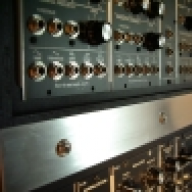
This is an easy one for me. I'm currently building my dream amp right now.
Solid state power amp. As pristine-clean as possible. Since I can't afford (whatever that might be) I'm currently using a Mackie 1400i. WAY too much power, perfect for boatloads of headroom.
Preamp is 100% modular. Every single stage of the preamp is built into a separate removable module. The gain stages, each and every EQ stage (or "frequency band" as it were), various compression stages, and so on. Every single stage, be it part of the gain structure or part of the tone shaping structure is it's own discrete module. That way if I happen to like a Hi Pass filter of a certain type with a given slope with certain construction and certain parts for the low end, I can have it. Same way with the midrange chain, and for the top end I can select and chose a Low Pass filter of the design I end up preferring. I can distort just the mids, or just the lows, or just the highs, or cominations of those stacks. I can compress just the lows/mids/highs or use different compressors at different points in the tone stack - or none at all. I can run various filters in parallel, or series, or series/parallel. Everwhat. I have a lot of tonal research and discovery ahead of me!
Input and output gain stages stages are also of my chosing, and completely discrete and changable as well. I can insert any kind of effector at any point between any of the modules at any point in the entire signal chain. I can split any part of the chain off and reocrd it on it's own discrete track if I want too.
The bass guitar itself has two separate outputs, one for each pickup with no internal preamp - just independant volume controls - or one for both .. my choice via simple switching matrix on the bass itself. Each pickup is routed through it's own discrete and independent signal chain. I can sweep between the two pickups with a foot control rather than a hand operated knob, so I can change or mix pickups (and their individual signal chains) in realtime. The EQ array is also sweepable in any manner I chose through the use of foot controllers as well. Any single knob or control can be swept with a foot controller - one controller can affect over a dozen separate aspects, and I cna use three (four?) foot controllers at once with one foot by placing handmade metal connectors into position with a filp of the foot to mechanically connect the foot controls together so that using only one makes all three (four?) move heel-to-toe in unison. Each foot controller can manipulate about a dozen functions.
After the signal leaves the preamp section, it is then either left as a 2 channel signal chain and piped out to their own discrete amplifier channels and their own speaker cabs - OR - they can be mixed together and run through my choice of speaker cabs via footswitching matrix. The cabs currently consist of a ported neo 12+6 and a ported neo 2x10, I may add a 15 in there somewhere at some point.
This is what I call a dream amplification system. And I'm not just dreaming about it, it's currently about 75% complete!
http://www.talkbass.com/forum/f36/experimental-fully-modular-bass-rig-902681/
I've already owned full-blown tube amps of several types - full-on digital stuff - solid state stuff - literally hundreds of stompboxes - built my own tube heads - built my own subcircuits - just about everything except built digital stuff and built my own speaker cabs. Wood and I have differences of opinions .. haahaa! I've owned 4x10s, 6x10s, 2x10s, 1x12s, 1x18s, custom PA-type 4-way cabs, sealed, ported, open back. And since 1990 I've owned 26 basses.
I've learned that each one of those idioms offers something useful .. so I'm building the ultimate hybrid. Well, by my own definition of course. Everyone has their own ideas about what "good" is.
Good luck to everyone participating in this thread! I hope you realize whatever it is you're dreaming of. Whatever it is, don't just dream about it ... ACT! Move! Put inspiration into motion. You CAN do it!
Solid state power amp. As pristine-clean as possible. Since I can't afford (whatever that might be) I'm currently using a Mackie 1400i. WAY too much power, perfect for boatloads of headroom.
Preamp is 100% modular. Every single stage of the preamp is built into a separate removable module. The gain stages, each and every EQ stage (or "frequency band" as it were), various compression stages, and so on. Every single stage, be it part of the gain structure or part of the tone shaping structure is it's own discrete module. That way if I happen to like a Hi Pass filter of a certain type with a given slope with certain construction and certain parts for the low end, I can have it. Same way with the midrange chain, and for the top end I can select and chose a Low Pass filter of the design I end up preferring. I can distort just the mids, or just the lows, or just the highs, or cominations of those stacks. I can compress just the lows/mids/highs or use different compressors at different points in the tone stack - or none at all. I can run various filters in parallel, or series, or series/parallel. Everwhat. I have a lot of tonal research and discovery ahead of me!
Input and output gain stages stages are also of my chosing, and completely discrete and changable as well. I can insert any kind of effector at any point between any of the modules at any point in the entire signal chain. I can split any part of the chain off and reocrd it on it's own discrete track if I want too.
The bass guitar itself has two separate outputs, one for each pickup with no internal preamp - just independant volume controls - or one for both .. my choice via simple switching matrix on the bass itself. Each pickup is routed through it's own discrete and independent signal chain. I can sweep between the two pickups with a foot control rather than a hand operated knob, so I can change or mix pickups (and their individual signal chains) in realtime. The EQ array is also sweepable in any manner I chose through the use of foot controllers as well. Any single knob or control can be swept with a foot controller - one controller can affect over a dozen separate aspects, and I cna use three (four?) foot controllers at once with one foot by placing handmade metal connectors into position with a filp of the foot to mechanically connect the foot controls together so that using only one makes all three (four?) move heel-to-toe in unison. Each foot controller can manipulate about a dozen functions.
After the signal leaves the preamp section, it is then either left as a 2 channel signal chain and piped out to their own discrete amplifier channels and their own speaker cabs - OR - they can be mixed together and run through my choice of speaker cabs via footswitching matrix. The cabs currently consist of a ported neo 12+6 and a ported neo 2x10, I may add a 15 in there somewhere at some point.
This is what I call a dream amplification system. And I'm not just dreaming about it, it's currently about 75% complete!
http://www.talkbass.com/forum/f36/experimental-fully-modular-bass-rig-902681/
I've already owned full-blown tube amps of several types - full-on digital stuff - solid state stuff - literally hundreds of stompboxes - built my own tube heads - built my own subcircuits - just about everything except built digital stuff and built my own speaker cabs. Wood and I have differences of opinions .. haahaa! I've owned 4x10s, 6x10s, 2x10s, 1x12s, 1x18s, custom PA-type 4-way cabs, sealed, ported, open back. And since 1990 I've owned 26 basses.
I've learned that each one of those idioms offers something useful .. so I'm building the ultimate hybrid. Well, by my own definition of course. Everyone has their own ideas about what "good" is.
Good luck to everyone participating in this thread! I hope you realize whatever it is you're dreaming of. Whatever it is, don't just dream about it ... ACT! Move! Put inspiration into motion. You CAN do it!
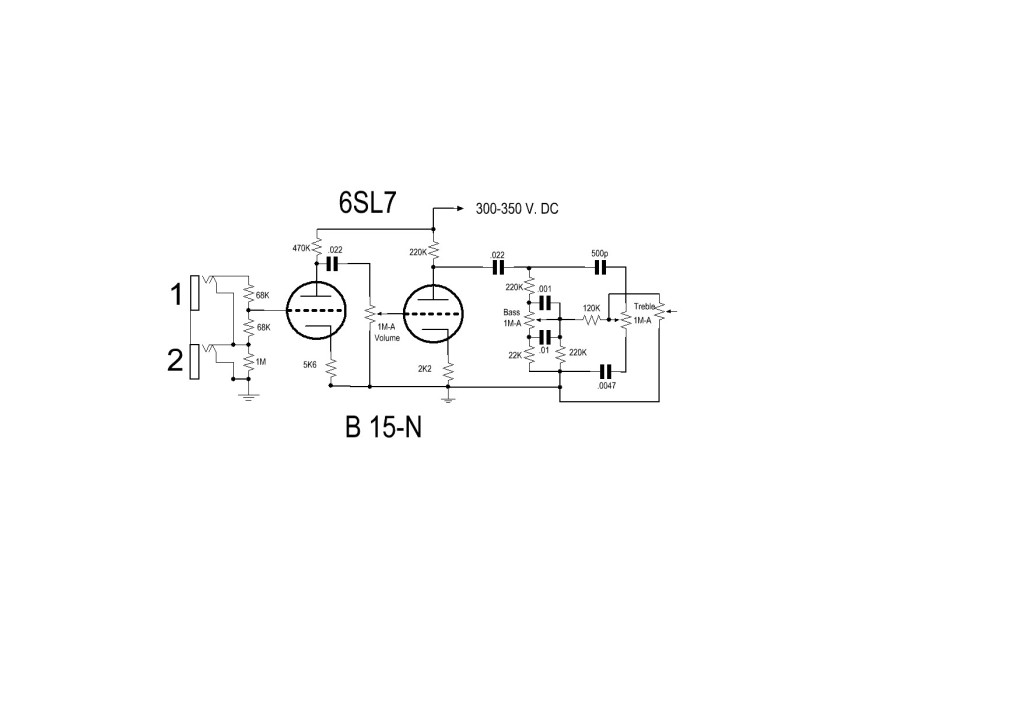
G'day, first post on this forum . Im working on a similar project. I'm using the B15N preamp with 6 x Russian GU50 transmission valves for what I think will be around 220 watts. I'm still in the testing phase of the GU50 at present deciding on power supply design. Here's the B15N schematic that has been used with success by a few Oz builders.
Lindsay
Lindsay
Let's have some fun, and end up with a fine tube amp that you can't buy off the shelf.
Here's the scenario... I've got an old guitar amp chassis for a donor, an Acoustic model 164 100 watt tube amp. It has nice hefty output and power transformers, and is set up for 4 6L6 output tubes at around 100 watts output.
I'm going to gut it and build a bass head out of it, using turret board construction. Thinking of running 4 6550 tubes for the output section, but if I do I'd have to add a separate filament transformer. So let's think primarily 6L6 or EL34 output tubes.
If you could marry the preamp from one amp and the output section from another, which would you choose? I'm thinking about an SVT preamp and a 100 watt Fender output stage. Not the ultralinear, the Bassman 100 that's like the old blackface Bassman upgraded to 100 watts output.I'm pretty old school and love the simple designs that rely on good design and bring out the best that a tube can deliver. Like the 5E3 Fender tweed clone I built a few years ago. Simple circuit with 2 volumes and one tone control...sounds like heaven into a Celestion Blue.
Soooo, what do you think? Help decide what to build and I'll post photos and updates as the project goes forward. I play a jazz bass in a blues band, and also do a lot of praise and worship work at church. I currently have an Acoustic 600b head and a couple of matching 4x10 cabs and want to make the jump to tubes. As a retired engineer and 40+ year guitar/bassist I love tube amps. All my guitar amps are tube, but I just began playing bass a few years back and this solid state Acoustic was my first bass rig. But I played a good tube head the other day and now I can't go back...so let's have some fun!
try out the acoustic, those amps are pretty mint. Theres alot more that goes into building an amp than copying a circuit aswell,
Great ideas, guys. Here are some pics of the donor amp cleaned up and ready for the build. The power supply I'm going to begin with is the existing one, putting out 500 VDC, unloaded. It's right around 475 during operation with the old Acoustic 164 circuit and 4 6L6GC's. I think I'm going to go with the B15 and Fender BMT dual preamp idea. I have a schematic for the Fender Bassman 100. I'd like to have a well defined tone from the B15 side...I know there are different versions of it but I need some direction as to which to choose...I see that Ampeg makes a reissue that has a '66 and a '68 channel. I am looking for a clean, fat, well defined tone without much grit or overdrive. Any idea as to which B15 circuit to pick, and where I might find a schematic?
Just noticed you already gutted it, do you have the old boards? if so could i buy them? The eq circuit in these is awesome.
Sounds like a really interesting project Lindsay. That B-15 preamp version sounds great. Those GU50 tubes have a very different appearance. They look like nothing else.


The new Fender Bassman 100T comes close.
Also a Orange AD140B I played years ago, it was the prototype to the AD200-wonderful amp.
Also the Reeves 225.