• TalkBass has been independent since 1998. Add your voice.
    Create a free account to reply to discussions, view embedded media, and browse with fewer display ads.
    Join freeLog in
    Want zero display ads or expanded classifieds tools? Compare plans.

Burl as a body wood question

Hi guys, question for the pros. I saw a thread where an oak burl was used for a body. It had issues with a "dead zone" as it was described.

Could it be related to the grain pattern in the burl? Can the grain become a "tone killer" in spots as its all over and not like a typical straight grained body wood?

Just curious as to thoughts on this. If I were ever going to build a bass, a burl would not be my first choice, as I've cut birds eye and flamed maple before and it's not exactly fun to work with!!

Thanks in advance.

WG.
 
  • Like
Reactions: denverbarnes
It wouldn't surprise me at all if a solid burl body was not resonant, and, personally, I would have no desire whatsoever to make a body out of the burl of any tree. Burl formation has a very distorted grain, and varies considerably in structure and density. To put it simply, it's not good wood. It just happens to look nice.
 
  • Like
Reactions: denverbarnes
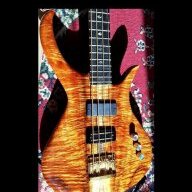
Jens Ritter makes basses with burl bodies
Ritter.jpg


So I don't think its a tonekiller
 
Hi guys, question for the pros. I saw a thread where an oak burl was used for a body. It had issues with a "dead zone" as it was described.

Could it be related to the grain pattern in the burl? Can the grain become a "tone killer" in spots as its all over and not like a typical straight grained body wood?

Just curious as to thoughts on this. If I were ever going to build a bass, a burl would not be my first choice, as I've cut birds eye and flamed maple before and it's not exactly fun to work with!!

Thanks in advance.

WG.
Burl can have voids in the wood. When used as a top, any voids have to be filled in, usually with wood dust in epoxy or something similar. Due to the thickness of the body, there may be undetectable voids in the interior of the wood. That can't be good for tone and sustain.
 
Looking at that Ritter ....... Wow! I mean wow! Nice piece of wood there!! Not quite the same as the burl used in the tread ( haha edit thread) I speak of.
That was I'm sure he selected for many reasons. Not a "hey that looks interesting" "I think that will make an interesting piece".

Don't get me wrong but... I've used plenty of 1/4 sawn white oak for making furniture and tool box's but an oak burl for a bass?
Meh... Who am I to judge? I just am curious. I know nothing of tone wood and only how exotic wood cuts ( very difficultly I might add).

This is the biggest factor (experience cutting exotic wood) that peaked my interest.

Thanks for the input so far!

Cheers,
WG.
 
I wouldn't worry so much about a solid burl body being dead or lifeless as far as tone goes. I would worry about how strong the neck joint would be on a bolt on instrument though. Also how strong the bridge mounting would be.

Burls are really only suited for a top IMHO. It would be a waste of a nice burl to do a whole body anyway.
 
I wouldn't worry so much about a solid burl body being dead or lifeless as far as tone goes. I would worry about how strong the neck joint would be on a bolt on instrument though. Also how strong the bridge mounting would be.

+1 on the bridge and neckjoint.
You can do quite a bit with your onboard electronics to 'help' a burl body.

I would not use one one a passive only bass.