

Enjoy the benefits of a premium membership!
Upgrade Account
-
TalkBass has been independent since 1998. Add your voice.
Create a free account to reply to discussions, view embedded media, and browse with fewer display ads.
Join free Log in
Want zero display ads or expanded classifieds tools? Compare plans.
You are using an out of date browser. It may not display this or other websites correctly.
You should upgrade or use an alternative browser.
You should upgrade or use an alternative browser.
Buying lumber question
- Thread starter James Ippoliti
- Start date
More options
Who Replied?
So, no Home Depot wood
Ironically, if you're looking for dimensioned hard maple (versus rough sawn wood), my local Home Depots are just about the best source in my area. They always have a big stack of S4S maple in different standard widths, thicknessed to 3/4" and they'll cut to length for free. It really takes the guesswork out of buying "raw" lumber. They have poplar too, also at 3/4" thick. You could easily laminate two poplar boards and end up with a nice true 1.5" body blank, probably much more cheaply than a luthier wood supplier. Then grab 3' of maple for a neck blank and you're all set. Nice clean straight dimensioned lumber, ready to go.

My concern would be how it was dried, if at all, and for how long. Ideally, something like that I would keep in my workspace for a minimum of a month for it to acclimatize before using.Ironically, if you're looking for dimensioned hard maple (versus rough sawn wood), my local Home Depots are just about the best source in my area. They always have a big stack of S4S maple in different standard widths, thicknessed to 3/4" and they'll cut to length for free. It really takes the guesswork out of buying "raw" lumber. They have poplar too, also at 3/4" thick. You could easily laminate two poplar boards and end up with a nice true 1.5" body blank, probably much more cheaply than a luthier wood supplier. Then grab 3' of maple for a neck blank and you're all set. Nice clean straight dimensioned lumber, ready to go.
It's kiln dried and has consistently read about 8% for the 20-ish years I've been buying it from the two local Home Depots. I think it helps that they store it inside in a controlled environment which is pretty close to shop conditions. Honestly, it's consistently as good or better than than the maple at any of my local hardwood vendors (and since it's been sitting on the rack for some time since it was S4S, it's arguably more stable than a rough piece you get freshly machined). There are occasionally some really spectacular flamed or quilted pieces, and they all sell at the same price - some of the best figured maple I've ever bought came from picking through the racks at Home Depot. And there's always plenty of perfect clear straight grained flat and quartersawn pieces too.
I know people in specialized hobbies are afraid of trusting big box stores some times, but I think this is a case where they have a good product. I guess my point is, we shouldn't automatically discount the wood just because it came from a chain.
I know people in specialized hobbies are afraid of trusting big box stores some times, but I think this is a case where they have a good product. I guess my point is, we shouldn't automatically discount the wood just because it came from a chain.
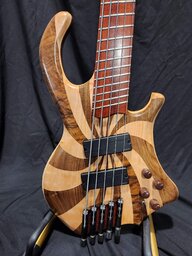
I have also found really good curly pieces at Home Depot.
Now there's going to be a run on maple at Home Depot.

buldog5151bass
Kibble, milkbones, and P Basses. And redheads.
If there are any hardwood lumber mills near you or suppliers for cabinets and custom wood flooring, there will greater supply, and better pricing. It's worth the hunt.

We Luthiers here in the Lab sometimes buy hardwood boards at the local Home Depot. The main reason is convenience. They have pre-milled boards in smaller sizes that you can grab, carry to the cashier, and bring to the shop in your car. A quick errand, with no need to make a truck run.
We've bought Hard Maple, Maple (often with flame figuring), Poplar, and Birch. Almost all of it has been good quality wood, properly dried, no major warpage or cracks, etc. The store personnel pick through the stock and take out boards that look bad. The quantity and quality of the boards depends on the store location; how much of it they sell.
The price is roughly twice, per board foot, what you'd pay at a normal lumberyard. That's the cost of having boards selected and cut to more convenient sizes.
Also, understand that the boards marked Maple are Soft Maple. Here in the Luthier world, when we talk about "Maple", we generally mean Hard Maple. That's what we use in most instrument neck construction, because of its strength and stability. Most of the stores do carry some selection of boards of Hard Maple; they are marked Hard Maple and are noticeably heavier and more expensive.
All the flamed boards will be Soft Maple. Soft Maple is fine for body tops and wings, etc., but I don't recommend it for necks in most cases. A one-piece Fender-style neck in soft maple will usually be springy and unstable. Even though the flame figuring sure is pretty. Basic type necks should be made from Hard Maple; like all Fenders. Soft Maple is okay for outer strips in a multi-lam neck that's well designed.
I sometimes buy the Maple (Soft Maple) boards at Home Depot specifically to saw up into truss rod filler strips. It saves a trip with the pickup to the lumberyard, and having to buy an 8' board.
We've bought Hard Maple, Maple (often with flame figuring), Poplar, and Birch. Almost all of it has been good quality wood, properly dried, no major warpage or cracks, etc. The store personnel pick through the stock and take out boards that look bad. The quantity and quality of the boards depends on the store location; how much of it they sell.
The price is roughly twice, per board foot, what you'd pay at a normal lumberyard. That's the cost of having boards selected and cut to more convenient sizes.
Also, understand that the boards marked Maple are Soft Maple. Here in the Luthier world, when we talk about "Maple", we generally mean Hard Maple. That's what we use in most instrument neck construction, because of its strength and stability. Most of the stores do carry some selection of boards of Hard Maple; they are marked Hard Maple and are noticeably heavier and more expensive.
All the flamed boards will be Soft Maple. Soft Maple is fine for body tops and wings, etc., but I don't recommend it for necks in most cases. A one-piece Fender-style neck in soft maple will usually be springy and unstable. Even though the flame figuring sure is pretty. Basic type necks should be made from Hard Maple; like all Fenders. Soft Maple is okay for outer strips in a multi-lam neck that's well designed.
I sometimes buy the Maple (Soft Maple) boards at Home Depot specifically to saw up into truss rod filler strips. It saves a trip with the pickup to the lumberyard, and having to buy an 8' board.
P.S. Up here in Canada it seems the maple offered by HD is of the hard variety. I haven't gotten any soft from them yet.
P.S. Up here in Canada it seems the maple offered by HD is of the hard variety. I haven't gotten any soft from them yet.
Are they specifically labeling it Hard Maple? Here in So Cal, most of what they have is Maple (which is definitely Soft Maple).
the boards marked Maple are Soft Maple
This may be a sign of regional variations in what and how they market. Here in upstate NY, they have a product sold as "Maple" which is hard maple. There is no soft maple at all in the stores. The other hardwoods are oak and poplar.

A couple post above is Bruce Johnson. He was depicted in Star Wars by a character named Yoda and freely dispenses words of wisdom. Looking though his threads and comments is a good idea when starting. It's kind of like having TalkBasketball and a guy named LaBron on the board giving free tips.
Agree on HD, I've found some very nice figured wood at times that would be sold at a premium elsewhere.
Agree on HD, I've found some very nice figured wood at times that would be sold at a premium elsewhere.


