
Enjoy the benefits of a premium membership!
Upgrade Account
-
TalkBass has been independent since 1998. Add your voice.
Create a free account to reply to discussions, view embedded media, and browse with fewer display ads.
Join free Log in
Want zero display ads or expanded classifieds tools? Compare plans.
You are using an out of date browser. It may not display this or other websites correctly.
You should upgrade or use an alternative browser.
You should upgrade or use an alternative browser.
Cab Speakers?
- Thread starter Cruzer23
- Start date
More options
Who Replied?

Turnaround
Commercial User
DC Resistance is not the same as impedance. A typical 8 Ohm speaker will have a DC resistance of about 6.2 Ohms.

- Feb 12, 2006
- 60,978
- 5
- 220,735
- Disclosures
- Development Engineer-Mesa Boogie, Development Engineer-Genzler (pedals), Product Support-Genz Benz
The impressive depends on DC resistance plus reactance. You are measuring only the DCR part. It’s an 8 ohm nominal impedance woofer.

I realize this guy is gone, but would have been interesting to know what model Mesa 810 he had. I'm guessing the traditional going by the triangle pads to screw the grill down to, and I dont see the hf driver.
My 2010 era 'regular' Powerhouse 810 has cast frame speakers. Here is one of them.
Seen other posts on Talkbass with these same speakers in the 4x10 and 8x10 Mesa Cabs. So whatever they are, I think their legit
First, the wiring was modified because the black-white pair should have been twisted together but while the white wire shows the original twisting, the black wire does not.
The very first thing to do is verify that the cabinet is correctly wired. (Most of the cabinets were 8 ohms, using a series-parallel combination of 8 ohm drivers)
Is there a nominal impedance stated on the driver?
Are they all the same driver... for the 8 ohm cabinet, they SHOULD all be 8 ohms but the one with the missing dustcap may be 4 ohms which may (depending on how wired) have received more power and because those drivers were not designed around extended bass, damaged the dust cap.
Those look like an early driver we used, possibly earliest of what became the Eminence Legend series. Does it have a #761058 stamped on the back of the magnet? I kind of doubt it because the surround doesn't match my data.
I would say no more than 150 watts each as a generality for driver of that era.
Hi Andy, you mentioned before about the wires not twisted together how they originally were.
I've put the wires back together how they naturally linked, giving me two pairs of black & white wires. Also have two short black jumper wires (not pictured here).
Looked at lots of wiring diagrams and YouTube, but could someone explain in layman's terms how to wire 4x 8 Ohms speakers giving 8 Ohms output?
The original twisted pairs would suggest they go to just two speaker directly +/-
Someone obviously separated them to wire the cab differently in the past?

It's hard to tell from the pic, but it appears the two black/white wire pairs are connected in parallel at the input jack. If so, use the black jumpers to create two pairs of speakers connected in series -- the white wire goes to the '+' terminal of one speaker, a jumper connects the '-' terminal of that speaker to the '+' terminal of a second speaker. The black wire of the black/white pair then connects to the '-' terminal of that second speaker. Do that same process to the second pair of speakers. Those two 'series'd' pairs will be connected in parallel at the jack. Look for a diagram of 'series/parallel wiring' on the Interwebs if you're not following that.
I strongly recommend researching and implementing the 'battery test' to check for consistent polarity after you've wired it up.
I strongly recommend researching and implementing the 'battery test' to check for consistent polarity after you've wired it up.
Last edited:
Thanks Mark, I'll give it a goIt's hard to tell from the pic, but it appears the two black/white wire pairs are connected in parallel at the input jack. If so, use the black jumpers to create two pairs of speakers connected in series -- the white wire goes to the '+' terminal of one speaker, a jumper connects the '-' terminal of that speaker to the '+' terminal of a second speaker. The black wire of the black/white pair then connects to the '-' terminal of that second speaker. Do that same process to the second pair of speakers. Those two 'series'd' pairs will be connected in parallel at the jack. Look for a diagram of 'series/parallel wiring' on the Interwebs if you're not following that.
I strongly recommend researching and implementing the 'battery test' to check for consistent polarity after you've wired it up.

I've seen the 9v battery test fluxing the speakers

It's hard to tell from the pic, but it appears the two black/white wire pairs are connected in parallel at the input jack. If so, use the black jumpers to create two pairs of speakers connected in series -- the white wire goes to the '+' terminal of one speaker, a jumper connects the '-' terminal of that speaker to the '+' terminal of a second speaker. The black wire of the black/white pair then connects to the '-' terminal of that second speaker. Do that same process to the second pair of speakers. Those two 'series'd' pairs will be connected in parallel at the jack. Look for a diagram of 'series/parallel wiring' on the Interwebs if you're not following that.
I strongly recommend researching and implementing the 'battery test' to check for consistent polarity after you've wired it up.
I still can't make a visual confirmation; use your multi-meter to confirm that the two white wires and two black wires -- respectively -- have continuity between them.
It's hard to tell from the pic, but it appears the two black/white wire pairs are connected in parallel at the input jack. If so, use the black jumpers to create two pairs of speakers connected in series -- the white wire goes to the '+' terminal of one speaker, a jumper connects the '-' terminal of that speaker to the '+' terminal of a second speaker. The black wire of the black/white pair then connects to the '-' terminal of that second speaker. Do that same process to the second pair of speakers. Those two 'series'd' pairs will be connected in parallel at the jack. Look for a diagram of 'series/parallel wiring' on the Interwebs if you're not following that.
I strongly recommend researching and implementing the 'battery test' to check for consistent polarity after you've wired it up.
Thanks for the info
When I first got the Cab and took the first speaker out, it had separated wires? The white was clearly twisted with a black wire originally? Making me think the wiring had been changed at some point. I put the two pairs of black and white wires back together again as this seems to what it was originally. The advice you gave earlier (series/parallel) using the jumpers, will keeping those two pairs so closely twisted together still work without separating them again?
I still can't make a visual confirmation; use your multi-meter to confirm that the two white wires and two black wires -- respectively -- have continuity between them.
It depends on how far apart the two sets of terminals are -- it seems like you'd have to split them up at least somewhat just to allow you to pre-wire them before mounting. Orient the speakers so that the terminals in the respective pairs are close together....will keeping those two pairs so closely twisted together still work without separating them again?
I advise still confirming that with your ohmmeter. Edit: Confirm that the two wire pairs are in parallel.Fairly sure both jacks are connected in parallel together
- Feb 12, 2006
- 60,978
- 5
- 220,735
- Disclosures
- Development Engineer-Mesa Boogie, Development Engineer-Genzler (pedals), Product Support-Genz Benz
Did you determine the impedance of the drivers? Are they all the same? This is an early cabinet.
Seeing this, for an 8 ohm cabinet, the drivers are all 8 ohms and the wiring would have been parallel-series:
Each pair of black/white twisted wires feeds a pair of drivers like the image... orient the driver pairs with the terminals facing each other so you only have to untwist a few inches. The black wire is the series jumper.
Below is what each pair will look like:
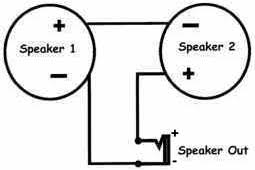
Seeing this, for an 8 ohm cabinet, the drivers are all 8 ohms and the wiring would have been parallel-series:
Each pair of black/white twisted wires feeds a pair of drivers like the image... orient the driver pairs with the terminals facing each other so you only have to untwist a few inches. The black wire is the series jumper.
Below is what each pair will look like:
Last edited:

Thanks, that makes senseDid you determine the impedance of the drivers? Are they all the same? This is an early cabinet.
Seeing this, for an 8 ohm cabinet, the drivers are all 8 ohms and the wiring would have been parallel-series:
Each pair of black/white twisted wires feeds a pair of drivers like the image... orient the driver pairs with the terminals facing each other so you only have to untwist a couple of inches. The black wire is the series jumper.
Below is what each pair will look like:
View attachment 7484207
The two pairs of twisted wires, one pair is marginally longer. So I can see now the there will be two pairs of speakers (top and bottom) wired as above your pic using the two twisted pairs from the Speaker Out. And then use the two Jumpers to connect each pair going from a + and - of each pair


Think I got it!
- Feb 12, 2006
- 60,978
- 5
- 220,735
- Disclosures
- Development Engineer-Mesa Boogie, Development Engineer-Genzler (pedals), Product Support-Genz Benz
CorrectThanks, that makes sense
The two pairs of twisted wires, one pair is marginally longer. So I can see now the there will be two pairs of speakers (top and bottom) wired as above your pic using the two twisted pairs from the Speaker Out. And then use the two Jumpers to connect each pair going from a + and - of each pair
Think I got it!


