• TalkBass has been independent since 1998. Add your voice.
    Create a free account to reply to discussions, view embedded media, and browse with fewer display ads.
    Join freeLog in
    Want zero display ads or expanded classifieds tools? Compare plans.

Cabinet Bracing Question

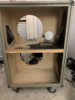
I have this old Marshall 215 that I got some new speakers for (Legend CB158) and since I have it taken apart, I’m taking the time to improve it where I can. Already threw some new casters on and now I’m brainstorming some bracing/lining. The middle shelf does add quite a bit of rigidity but I’m thinking of doing one or two dowels running top to bottom and at least two dowels connecting the baffle to the rear of the cab. Anybody with an eye for this see anything I’m missing?
 

Attachments

  • 0B26B528-AE26-41A7-8B24-3CD9A189FA7E.jpeg
    0B26B528-AE26-41A7-8B24-3CD9A189FA7E.jpeg
    852.4 KB · Views: 157
Isn't the point of using 3/4" ply that it is so thick it doesn't need bracing? With the substantial shelf, I wouldn't expect to gain much benefit from extra bracing.

Is there anything you can do with the ports? A better design rather than a hole in the baffle might get you a better sound. Lining the cab with acoustic wadding would probably be a good idea.
 
  • Like
Reactions: jnewmark
Isn't the point of using 3/4" ply that it is so thick it doesn't need bracing? With the substantial shelf, I wouldn't expect to gain much benefit from extra bracing.

Is there anything you can do with the ports? A better design rather than a hole in the baffle might get you a better sound. Lining the cab with acoustic wadding would probably be a good idea.

I hadn’t thought about doing anything with the ports but I’m definitely going to be lining it with poly batting if nothing else. There’s definitely a lot of middy boom with this cab that I’d like to address
 
If you're not going to put at least some effort into assuring the cab is tuned to the new drivers, any other efforts are likely to be more or less for naught.

Edit: If you don't know how to adjust the tuning, there are folks here who will probably help you out. Start by taking the internal dimensions and calculating the total internal volume. Also measure the diameter of the existing ports; it seems likely that you can do what needs to be done by adding a length of duct to the ports that are already there.
 
If you're not going to put at least some effort into assuring the cab is tuned to the new drivers, any other efforts are likely to be more or less for naught.
Exactly. Spending time and money on insignificant changes without at least investing the effort on determining the suitability of the cabinet and its tuning to the drivers chosen is a waste.
 
If you're not going to put at least some effort into assuring the cab is tuned to the new drivers, any other efforts are likely to be more or less for naught.

Edit: If you don't know how to adjust the tuning, there are folks here who will probably help you out. Start by taking the internal dimensions and calculating the total internal volume. Also measure the diameter of the existing ports; it seems likely that you can do what needs to be done by adding a length of duct to the ports that are already there.
Where do I go to find these people who will help me out? I have (I think) all the relevant the specs on the cab
 
I’d start by plugging the two cutouts on the shelf. Let each speaker operate independently. Then go from there.
Why? A shared airspace doesn’t matter as long as total number of drivers, total air space and total port area/depth (volume) are included in the calculations.
 
Where do I go to find these people who will help me out? I have (I think) all the relevant the specs on the cab
You could start a new thread with a title something like "Need help re-porting an old cab" and post the internal volume and port size in the first post. A link to the picture you've already posted would also be useful.

Just for grins -- what is the internal volume? The ports appear to be 4-inches in diameter -- how close am I with that estimate?
 
  • Like
Reactions: DJ Bebop
You could start a new thread with a title something like "Need help re-porting an old cab" and post the internal volume and port size in the first post. A link to the picture you've already posted would also be useful.

Just for grins -- what is the internal volume? The ports appear to be 4-inches in diameter -- how close am I with that estimate?
Total int. volume is 6.34 cubic feet and the ports are 5 inches in diameter
 
  • Like
Reactions: DJ Bebop
What is accomplished by doing that?

Why? A shared airspace doesn’t matter as long as total number of drivers, total air space and total port area/depth (volume) are included in the calculations.

A shared air space is good until one speaker stops working. I see it as a safety precaution.

Of course, if a speaker does better with a larger effective space then the shelf ports should be included. I’d want to model it both ways and see. As you mentioned, the modelling is more complicated with everything shared.
 
Just an aside- I don't see any hardware for the casters inside the cabinet and I can't tell how thick the bottom of it is. But you might want to consider bolting through the bottom rather than using lag screws. Those caster always seem to catch on cracks and holes and can rip out if they are not adequately secured.

As far as the rest of it goes; use the math that's available to predict the performance of those speakers in that cabinet. From there, know why you are making any modifications. Be able to complete statements like "I'm going to add poly batting because _______________________." If the answer is "because I saw it in a picture once.", it's probably time for more research. Know not only why you're adding it, but how much you need to add and what you expect the results to be.
 
Total int. volume is 6.34 cubic feet and the ports are 5 inches in diameter
I use a spreadsheet that a TB user, @fdeck, has graciously made available on his personal Web page: Francis J. Deck. Using the port calculator on the 'Tools' tab, I figure if you were to extend the two round ports to be 3-1/2 inches long, the cab tuning would be about 50 Hz, which lines up well with a design on Eminence's design page for this driver, here: https://www.parts-express.com/pedocs/more-info/290-497--eminence-legend-cb15-cabinet-design.pdf The design for "A Medium Vented Bass Cabinet" is about half-way down the page.

Also using fdeck's handy spreadsheet tool, I calculate the current tuning to be about 60 Hz -- not woeful, but the drivers will unload pretty quickly below that point.

Edit: I invite other, more knowledgeable participants to check my work -- I have been known to screw up a time or three. ;)
 
Last edited:
The modeling is no more complicated in a shared air space (when the drivers are identical)

I ran the numbers and the driver is an excellent match for the box as is.

F3: 59Hz
F6: 51Hz
F10: 42Hz
Mechanical power handling is 600 watts RMS all the way down to 42hz

This is just about as good as it gets, the maximum performance from those drivers.

Just make sure the box hardware is good and snug and give it a try before changing anything. I don't think you will benefit much if anything from additional bracing either.
 
I use a spreadsheet that a TB user, @fdeck, has graciously made available on his personal Web page: Francis J. Deck. Using the port calculator on the 'Tools' tab, I figure if you were to extend the two round ports to be 3-1/2 inches long, the cab tuning would be about 50 Hz, which lines up well with a design on Eminence's design page for this driver, here: https://www.parts-express.com/pedocs/more-info/290-497--eminence-legend-cb15-cabinet-design.pdf The design for "A Medium Vented Bass Cabinet" is about half-way down the page.

Also using fdeck's handy spreadsheet tool, I calculate the current tuning to be about 60 Hz -- not woeful, but the drivers will unload pretty quickly below that point.
Hey thanks homie, I appreciate it! Not sure if it makes any difference but it’s actually 6.74 cubic feet, I mistyped earlier. Time to check if I can get those port things locally or if I gotta order them.
 
  • Like
Reactions: DJ Bebop
Hey thanks homie, I appreciate it! Not sure if it makes any difference but it’s actually 6.74 cubic feet, I mistyped earlier. Time to check if I can get those port things locally or if I gotta order them.
That just improves my numbers slightly.

Don't change the porting, leave them exactly as they are.
 
Hey thanks homie, I appreciate it! Not sure if it makes any difference but it’s actually 6.74 cubic feet, I mistyped earlier. Time to check if I can get those port things locally or if I gotta order them.
Just about anything will work. PVC pipe and cardboard mailing tubes are popular choices. You could fabricate tubes exactly the right diameter out of cardboard -- maybe a couple of layers of single-weight cardboard rolled up and glued together. It doesn't need to be pretty, since it's inside the box.

The change in internal volume would mean the ducts could be a little shorter -- maybe 3 inches or so. But @agedhorse is right, you could probably just put them in and go and it will probably be fine. You could always go back and modify the ports at a later date if the drivers start to fart out on the lower notes.

And I vote for using some absorbent material. I'd start with padding on the back and two adjacent sides. It is possible to get carried away with the stuffing.
 

Latest posts