• TalkBass has been independent since 1998. Add your voice.
    Create a free account to reply to discussions, view embedded media, and browse with fewer display ads.
    Join freeLog in
    Want zero display ads or expanded classifieds tools? Compare plans.

cabinet frequency response

Oh man--I'd love to come! Unfortunately (well actually fortunately) I have to be out of town visiting my daughter in Baltimore.
Yeah--the stressed panel is really cool. A really elegant solution to address panel resonances--the bane of the upper bass region IMO. I learned a lot in making composite cabs (especially that it got me really sick!). That stuff is weird. It can be excited into vibration pretty easily but because of the foam core all of those resonances were damped. Weird. But AB'ing identical uber-braced wood cabs to the composite there was an audible greater clarity in the upper bass region with the composite..

I don't know how you're doing it but I had a hifi speaker made in the 80's by British designer Robin Marshall. He used threaded rods and little turnbuckles. Pretty neat.

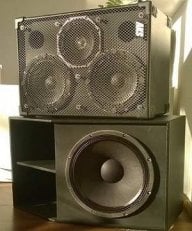
It's been really fun working with a new design. Except it's challenging when all of the rules you knew don't necessarily apply. One thing we can get is really low extension. But in one design we found that in changing a few parameters we sacrificed about 5 or 6hz on a pretty--low--already f3 and were all of a sudden getting kick-you-in-the-gonads impact. Upon reflection I decided to go with the gonad kick.
 
It can be excited into vibration pretty easily but because of the foam core all of those resonances were damped. Weird. But AB'ing identical uber-braced wood cabs to the composite there was an audible greater clarity in the upper bass region with the composite. .

If the foam core dampens these resonances it takes away(robs) "energy" that has been put into these panels.
A well braced cabinet is there to eliminate panel movement (actually move them to higher frequencies, so you only have to use lining to dampen the upper frequencies). These are two totally different approaches with different outcomes.
That it may have "sounded" clearer might be due to the fact that it robs away energy from some specific frequency range, making other frequencies sound louder.

I don't know how you're doing it but I had a hifi speaker made in the 80's by British designer Robin Marshall. He used threaded rods and little turnbuckles. Pretty neat.

yeah, threaded rods etc. are a way to fight panel movement (if that's what you mean)

One thing I like most is an "impuls-compensated" configuration.
It's just two woofers, one mounted at the front and one mounted at the backside of the cab. This configuration will not eliminated panel movement but it will make sure the cabinet itself won't move.You can put put your hand on top of the cab and you won't feel much vibration. This makes an enormous difference in clarity in the low end. I made several home cinema subs this way and the difference is huge compared to a regular configuration. It also seems to be more efficient cuz there's less energy lost in other things moving then the cones ;)
 
Interesting, as always. I've always toyed with this realm being in a band that has emphasis on bass and deep lows. I've gone back and forth, and for the sake of performances have found that I prefer not to extend too far down. Judging how 'deep' a cab is by looking at production cab specs is useless. So when someone has 'X cab' that they're using isn't going low enough at 40hz or whatever, I'm not sure they're aiming at the right target...their cab might be hitting a solid 80hz before roll off. I'd used an Acme 210 in the far distant past previously, but didn't really have a feel for it, given it was a 2x10 and not capable of producing volume levels that would make that experience relevant.

I use a bass with a 37" B string, so there's plenty of fundamental available. I still use a HPF to roll off steeply in the 30-35hz range. That way I can actually boost my lows and sculpt out the sub-lows to save speaker excursion and unnecessary power expenditure while keeping things sounding better in the room. When I started doing this my band didn't even notice. At all. My low B isn't any less present and doesn't sound any different to anyone.

I do find in small/medium sized rooms going too deep can do some strange things. I've had this experience over an over.

Waves MaxxBass works
It's being used in live sound everywhere.
Real bass takes a lot of power. A lot of cabinets. It is also incredibly hard to sound proof against. Outside the venue all you hear is bass. Some venues with nearby rooms you don't want bass leaking through.

Maxxbass arranges the harmonics, like pipe organs makers have done for centuries, to let you hear lower fundamentals at higher levels than they actually are.

Maxxbass is not for everyone, or all the time, but if you want low lows, it's something you should try.

I have a Maxxbass unit (probably one of the last of the hardware units) and I use it at home regularly. Its pretty awesome. It didn't make sense in the context of my rig because my speakers were already producing comfortably what the Maxxbass brings to the table for speakers that don't reach that low. Its too bad that most people never realized what a killer unit the 107 was, because every bass player who wants small light and low could have used one and smiled.

It all comes down to personal preference. When we were early beta testing the ML112's we initially had a 3012LF it tuned much lower as I wanted the low B to really sound deep. Every one of our beta testers came back at us with "I would gladly give up some of those really deep lows, for some more punch up higher". Most of the players simply preferred a leaner, tighter low end to one that extended very deep and low. We ended up with a different driver altogether and a higher tuning before our testers felt we hit a good balance of solid low end with plenty of definition. Almost identical experience with our initial testing of the ML115.

I'm not debating the need to reproduce the fundamentals for whatever tuning may be involved, but simply noting my experience with players not necessarily finding that ability for a cab to go super deep all that useful in a club setting.

^^High passing at 30-35 has addressed exactly this. And while it didn't change the perceived depth of my tone, everyone in the band DID notice that it changed how the 'room' sounds, cleaning it up for the better. Again, I tend to boost (wide shelving around 53hz is my bass control) the lows, then the HPF (24db per octave) lops off the stuff down really deep. It comes across as still huge because of how we hear the 35-200hz range.
 
I agree that the foam does "rob" a bit of the energy. In ab'ing identical cabs I didn't perceive a big difference in overall bass energy. I'm very willing to accept the fact that it might have "robbed" a bit or upper bass energy---fortunately the net effect was pleasing. I'm not doing composite cabs any more (which probably means that no one is--at least commercially) It was a fun exercise.

With the cabs I'm working on now there isn't any span greater than 5" that isn't broken up with part of the structure so cabinet resonances aren't a concern.
 
I'm a big proponent of the HPF's. You pick the cab you like. Likely it's a reflex cab. So---any bass you're asking for below the tuning frequency is not bass you want. It is just asking your low frequency driver to work in its non optimal range. So everything above suffers. Even a cab with a really low tuning (like maybe 37hz) will still benefit from subsonics below tuning frequency removed from the equation.
 
I'm a big proponent of the HPF's. You pick the cab you like. Likely it's a reflex cab. So---any bass you're asking for below the tuning frequency is not bass you want. It is just asking your low frequency driver to work in its non optimal range. So everything above suffers. Even a cab with a really low tuning (like maybe 37hz) will still benefit from subsonics below tuning frequency removed from the equation.

I chased the fact that stuff below E almost always sounded somewhat weak. I knew it wasn't my bass, and after getting a 15/6 and 15sub, I knew it wasn't my speakers (back in the early days of the fEARfuls). At first it was my amp (500w not being enough and whatever on board low end limiting clamping down in that range), but switching to a Multi-kilowatt amp took care of that. Then it became a matter of having that even tone and volume deep, but also having unwanted excursion, and that big wash in the room that didn't help the mix. The HPF takes care of that situation.
 
Which appears to illustrate how people tend to settle for certain compromises in bass reproduction - the ff approach getting low-ish, but still retaining relatively high sensitivity. Hoffman's Iron Law comes to mind....

Still, I'm curious to know if cleanly reproduced fundamentals below 50 Hz really contribute to muddying a mix. Or is that folklore?
As far as I'm concerned, that all depends on what else is going on in the instrumentation and what the goal is for the music.
 
I almost read all of this, and it was very interesting. I don't know anything really about the science of bass guitar reproduction, I just play see ;) and have my own experiences over the last 20 some odd years. However, I do know this, that when I attend any kind of concert, whether in a club or outdoor venue, if the bass guitar is too overpowering, too much "feeling it" I don't care for it. That is not to say that a good solid fundamental is the reason for this, I don't really know. But I can say that my preference, and I think much of the audience really, want the bass to sit in the mix in such a way as to hear everything equally yet be full. Of course, this is extremely genre specific. We played a club once years ago, and the sound man went on about how much low end his PA would produce... Sounded like trash for the music we played, and several told us.
 
Jimmy,
I didn't say that you were a relic of a bygone age...just that I understand (perhaps in error) that your usual audience is perhaps more likely to have grown up on musical styles that have less low end energy. On the few occasions that I've played for audiences with a few older folks here and there, things people have said have led me to believe that they prefer a less...vigorous, shall we say, low end, whereas the younger members of the audience were eating it up.
I don't know how old you are, but I've been playing for roughly forty years. I'm hoping that I'm not (yet) a relic of a bygone age.

Andy,
Given the amount of EQ that would be required, and the fact that an SVT cabinet rolls off at, what, 50-60Hz, and given that cone excursion increases by a factor of four for every octave dropped...I'm not so confident that an SVT will behave gracefully if pushed to deliver 27Hz. The drivers will quickly exceed Xmax, which in turn will lead to doubling, which will swallow the 27Hz whole--turning it into 54Hz. Will sound come out? Yes, of course. But will it be a true 27Hz? Ummm...I'm not convinced. There are better drivers for the job, although I agree that a sealed cabinet design will reduce headaches.

Once again, since there are those who see what they want to read, not what's really there...I have nothing against the SVT 810. I used to own one, but gave it up when the weight got to be too much. I also have no quarrel whatsoever with Jimmy or anyone else who has found their ideal tone. I would no more force my ideal gimme-the-fundamental tonal goal on anyone than I would want to see others force their first-harmonic-and-up tone on someone else.
Only...
That's what keeps happening. Certain people (no, Jimmy, not you--or at least I haven't yet seen you do so) bash those who want good response to at least E, and sometimes below.

Oh, and another, rather advanced technique: Feedback. Include the driver in the feedback loop. Deep response. Low distortion. Kick-ass speed. The trick is that the amp, driver, and cabinet must be designed as a system. I've done this sort of thing for stereo use, but have not tried it for bass.
Most (all, actually) of the EQ systems you see in bass amplifiers are just that, EQ. There are at least four ways to approach the problem.
1) Low pass. Set the EQ's corner frequency at (or below) the rolloff of the cabinet.
2) High pass. Set the EQ's corner frequency a bit below the cabinet's rolloff with the Q such that it compensates--for, say, 10-15Hz--for the cabinet's rolloff, after which the system as a whole falls off like a stone.
3) Dammit...got to go (I'm at work)...

Grey
 
Room and PA issues are immaterial IMHO, other than you have to deal with them. At the end of the day, it's all about the music and how it's supposed to be presented.

So the question was "can 50hz [coming out of a bass rig on stage] and below muddy up the mix" - the answer to that is "it's dependent upon the music only?"

Whether your sub-lows thumping bass rig muddies the mix absolutely depends on what's coming out of the PA and what your bass rig placement looks like.

You can get those sub lows without having a bass rig that makes them--or you can carry the house with your bass rig and not run through the PA.

What the other instruments in the band are doing matters too -- e.g. a kick drum or a synth can drop out a lot of sub lows -- of course.
 
Blast it, not likely to get back to this soon...
3) Shelf EQ (think Baxandall circuit, i.e. an "Ampeg-ish" tone control circuit)
4) Bandpass EQ
Hopefully that will give anyone who's interested in electronic EQ a starting point. Beware wattage requirements and cone excursion limitations. It's also easy to begin clipping the low level circuitry...something you wouldn't normally have to worry about. It's best to approach this as a system, not a mix-and-match kinda thing.
That said, the results can be impressive.
I'll get back when I can.

Grey
 
Jimmy,
I didn't say that you were a relic of a bygone age...just that I understand (perhaps in error) that your usual audience is perhaps more likely to have grown up on musical styles that have less low end energy.
Well sure. That's true, no doubt. I just meant that way of mixing bass isn't a relic. Our audiences are, though ;)

On the few occasions that I've played for audiences with a few older folks here and there, things people have said have led me to believe that they prefer a less...vigorous, shall we say, low end, whereas the younger members of the audience were eating it up.
I don't know how old you are, but I've been playing for roughly forty years. I'm hoping that I'm not (yet) a relic of a bygone age.
35 pro, another few to warm up before that. Not quite 40, though...holy cow, that's old! :D But we'll show these whippersnappers a thing or two about rockin' proper every time!

 
Thanks for chiming in, Rollins.

I agree that Jimmy seems to be a reasonable person of goodwill.

There's nothing wrong with not wanting to reproduce fundamentals, as a matter of personal taste, and he is certainly under no obligation to defend his personal taste any more than anybody else is.

It's for that very reason that all the silliness and mythology surrounding this subject is so non-productive. Hey, it's all good! If low bass doesn't float your boat that's OK! But if you try to justify your personal taste by saying things which aren't true, there are those among us who will point out the fallacies you present.

I'm certainly not singling out Jimmy. His posts are probably the most rational of the folks who share his tastes.

Thanks,
Andy

I'll make you a deal Andy. You make a 610 that is well designed and easily transportable (we're talking towel bar, casters) and I'll consider buying one. If you want to sell cabs, I'm right here -- just bought one - but you weren't even in the question because you don't offer a big transportable (think wedging in the backseat of a sedan) cab. My dad bought one of your 2 10's a while back (IM me and you'll probably remember his name) and loves it. His word means a lot to me, but you should really design these cabs after bass players like me, who needs massive volume in a portable package. We carry them around at 3am, and have to stuff them in our car after a long gig! You really could have won this purchase had you keep me, and many other gigging bassist in mind. Make a larger cab and incorporate basic features that allow working bassists to use them. We'll snatch them up in a heartbeat!

Thanks Andy!
 
I'll make you a deal Andy. You make a 610 that is well designed and easily transportable (we're talking towel bar, casters) and I'll consider buying one. If you want to sell cabs, I'm right here -- just bought one - but you weren't even in the question because you don't offer a big transportable (think wedging in the backseat of a sedan) cab. My dad bought one of your 2 10's a while back (IM me and you'll probably remember his name) and loves it. His word means a lot to me, but you should really design these cabs after bass players like me, who needs massive volume in a portable package. We carry them around at 3am, and have to stuff them in our car after a long gig! You really could have won this purchase had you keep me, and many other gigging bassist in mind. Make a larger cab and incorporate basic features that allow working bassists to use them. We'll snatch them up in a heartbeat!

Thanks Andy!

You are aware, I presume, that your post is in no way related to what the OP posted, and could be considered wildly off-topic. I hope and trust that nobody will scold you for leaving the rails, so to speak.

That said, I appreciate your input and your suggestions. I'll try to make some sense.

To me, and to most of the people I interact with, making a cab larger makes it less portable, not more portable. Most of the people who use my cabs in very loud situations like to use smaller cabs in multiples, just because of the advantage of greater portability. The other main advantage is that for quieter gigs, it's nice to be able to leave some of that stuff at home, and only take what you need. So, your opinion, while important, would seem to be in the minority. Still, I'm not averse to taking your advice. There are undoubtedly people who share your view.

Apart from the large size, the other reason I've never made a 6x10 is that of the screwy impedance you end up with. Cabs with an impedance of 2.7 ohms or 5.3 ohms are difficult to match up with amplifiers in an optimal way, and when you use multiple cabs together, it becomes even more unwieldy.

Say hello to your dad for me. Sounds like you've got a great thing going there!

Thanks,
Andy
 
Alright Andy! I am excited by that fire in your voice.

What I'm really expressing that what we need, at least a player that plays shows that needs one cab, is in need for more volume then your 410 can deliver. What myself, and many other bassists are really looking for is something that's easy to move around, has handles, a handle bar, and rollers. If you make a 610 that stomps what I already have, (that's really what I what I already expect out of your amazing cabs) I will buy one in a heartbeat. I'm just trying to clue you into the market. It really doesn't matter if they're are 150 pounds, but we have to move and slide these things in small spaces at very early hours in the morning. The more you can make that easy on us, the more apt we are to buy them. Don't make them too deep.

Sound, and portability is the name of the game.. You already have the former in a lock, it's the latter that will stray customers away.

And yes, for the working bassist, a 610 is the most portable we can get. 1 trip baby:)

I'm no slouch on gigs, so I hope you've played more than 1k :)

I have to say I love the fiery response, thanks Andy!
 
Alright Andy! I am excited by that fire in your voice.

What I'm really expressing that what we need, at least a player that plays shows that needs one cab, is in need for more volume then your 410 can deliver. What myself, and many other bassists are really looking for is something that's easy to move around, has handles, a handle bar, and rollers. If you make a 610 that stomps what I already have, (that's really what I what I already expect out of your amazing cabs) I will buy one in a heartbeat. I'm just trying to clue you into the market. It really doesn't matter if they're are 150 pounds, but we have to move and slide these things in small spaces at very early hours in the morning. The more you can make that easy on us, the more apt we are to buy them. Don't make them too deep.

Sound, and portability is the name of the game.. You already have the former in a lock, it's the latter that will stray customers away.

And yes, for the working bassist, a 610 is the most portable we can get. 1 trip baby:)

I have to say I love the fiery response, thanks Andy!


Sorry- we don't do custom work. Have you tried Dr. Bass?

A