Hi.
I already own a pair of these clamps, they seem like they'd work ok, right? Assuming I'd dust them off and use some scratch-resistant padding between them and the bass.
IMO/IME those clamps have their uses, instrument building or repairing just isn't one of them.
Plus if You only have a pair, buying the 6 or more additional
good quality ones you need will be more expensive and less suited for the task than:
DIY bass clamps:
Buy some threaded rod at a hardware store along with some wing nuts to fit. Cut the threaded rod into lengths a few inches longer than the thickness of the bass. Buy some large wooden spools of thread. Take all the thread off the spools and discard. Place one spool on each end of a piece of threaded rod followed by a wing nut and you're done!
Instead of thread spools, get a hole saw and some 3/4" plywood and cut a bunch of holes. Cover the sides of the holes that touch the body with scrap leather.
IMLE 3/4" by itself is too thin, they tend to rock, but if you glue two or three together, that tendency is greatly reduced.
One option is to buy round stock and to drill holes in them, yet another is to turn them on a lathe.
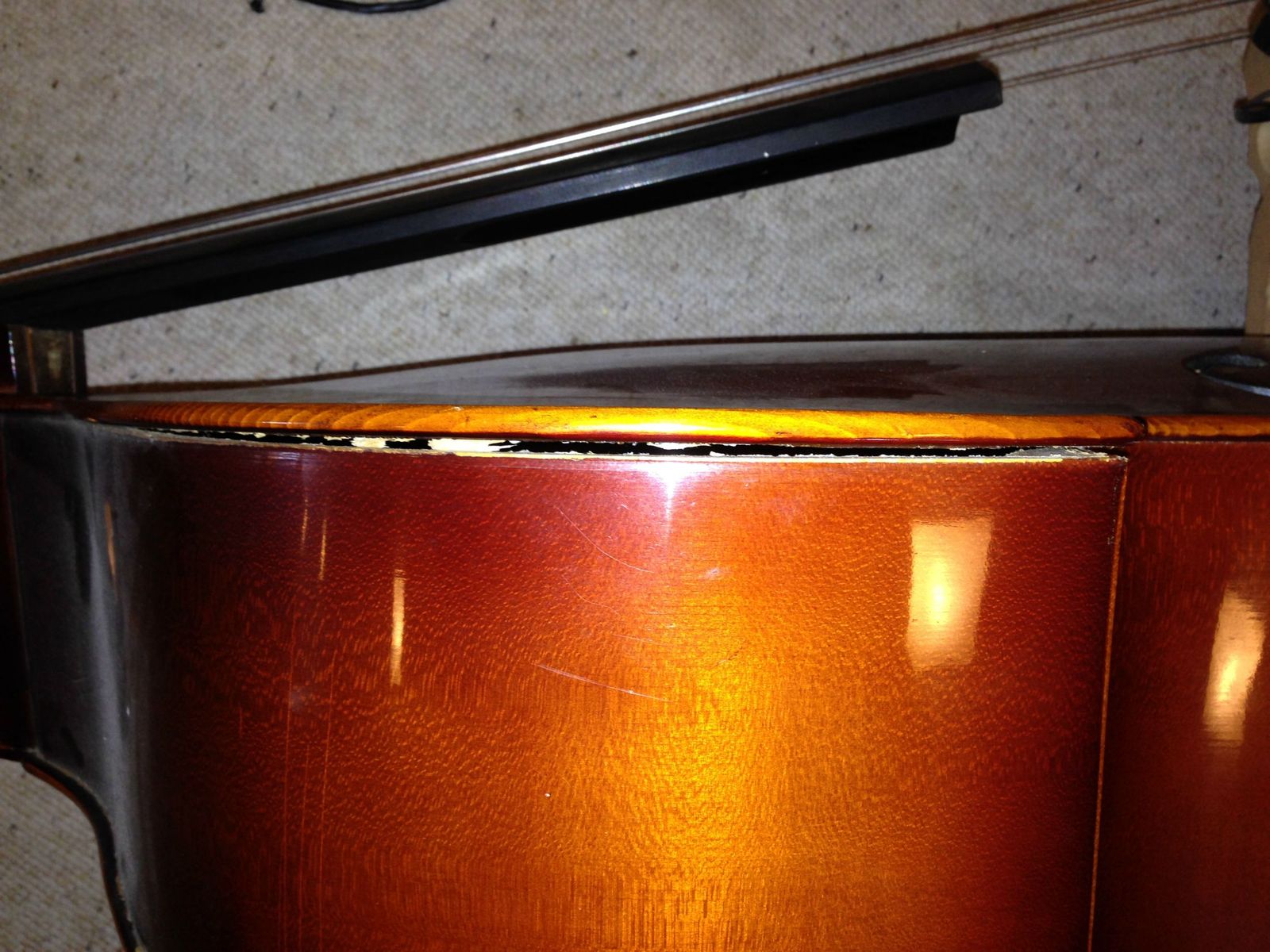
What glue do I need? Is bottled hyde glue really not ok? I guess I need some sort of powder and I heat it up somehow? Is there a trick to getting it into the crack or can I just spread it around with a toothpick or something?
Bottled hide glue is said to be a much better choice than PVA if You're in a hurry, but I wouldn't know because I have never bothered with it.
You'll need some kind of a glue pot, DIY'ing that is easy if you don't want to buy one, and some glue granules or powder.
You work it in with a spatula or a brush.
If You use a brush, the bristles obviously need to be able to take the heat

.
As someone who is not a talented DIY-er when it comes to jobs like these, I have a question. Given the size of the gap in the photo, it seems like the top would have to be forced (clamped) down considerably to make contact. Is it not the case that the top should "naturally" sit essentially flat on the ribs?
The string pressure/pull deforms the unsupported structures and the gap looks worse than it actually is.
Unstrung, the gap would be much less if anything at all.
Regards
Sam