
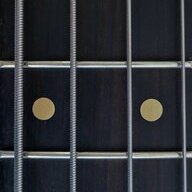
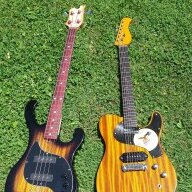
Can anyone tell me about this bass? You can see the body may have been reliced. I would love to get a body just like this, and maybe the whole bass!


Enjoy the benefits of a premium membership!
Upgrade Account
-
TalkBass has been independent since 1998. Add your voice.
Create a free account to reply to discussions, view embedded media, and browse with fewer display ads.
Join free Log in
Want zero display ads or expanded classifieds tools? Compare plans.
You are using an out of date browser. It may not display this or other websites correctly.
You should upgrade or use an alternative browser.
You should upgrade or use an alternative browser.
Can you ID Michael League's "new" bass?
- Thread starter Jigmay
- Start date
More options
Who Replied?



My trypophobia wouldn't let me get close, let alone the price tag.

Woodworm
Woodworms are the secret to the Amrita's airy sound - these insect larvae bore into the beautiful alder body, transforming the holes into tiny tonal chambers.
Finish
The Nitrocellulose finish on both the body and neck is like a second skin, allowing the wood to vibrate to its fullest potential. The result is a truly natural look that evokes a sense of timelessness.
Woodworms are the secret to the Amrita's airy sound - these insect larvae bore into the beautiful alder body, transforming the holes into tiny tonal chambers.
Finish
The Nitrocellulose finish on both the body and neck is like a second skin, allowing the wood to vibrate to its fullest potential. The result is a truly natural look that evokes a sense of timelessness.
Thoughts?

That's outrageous. Why so expensive? There is absolutely nothing special on this bass. Apart of course the body which was attacked by worms.

Woodworm
Woodworms are the secret to the Amrita's airy sound - these insect larvae bore into the beautiful alder body, transforming the holes into tiny tonal chambers.
Finish
The Nitrocellulose finish on both the body and neck is like a second skin, allowing the wood to vibrate to its fullest potential. The result is a truly natural look that evokes a sense of timelessness.
Thoughts?
It's pretty funny watching people creatively turn what was universally considered a defect laden material since the dawn of woodworking into a highly desirable ($$$$$) feature in a few short sentences.
I personally will not be buying into this "tone wood superiority by way of infestation" theory.

Woodworm
Woodworms are the secret to the Amrita's airy sound - these insect larvae bore into the beautiful alder body, transforming the holes into tiny tonal chambers.
Finish
The Nitrocellulose finish on both the body and neck is like a second skin, allowing the wood to vibrate to its fullest potential. The result is a truly natural look that evokes a sense of timelessness.
Thoughts?
... would probably earn me a slapped wrist!
It's pretty funny watching people creatively turn what was universally considered a defect laden material since the dawn of woodworking into a highly desirable ($$$$$) feature in a few short sentences.
I personally will not be buying into this "tone wood superiority by way of infestation" theory.
The only believable or real virtue I can indirectly glean from all that airy vibrating second skin marketing spiel is that the body might weigh a little bit less.
I don't dislike lacquer. The truth is more the opposite, I still prefer to work with it for myself to a very limited extent, but I don't ascribe to or sign onto all the typical nonsense virtuous claims about vibrations, tone, breathing, etc.
I think John Suhr's expert comment about this is worthy of preservation.
What Suhr said is true about urethane, especially if applied very thinly. It will sink into the wood grain, like lacquer. It may take longer, but if it's thin enough then not even all that long. I had an Alder Jazz body that Marty Bell finished for me in very thin urethane Fiesta Red. That finish sank into the wood grain--not in an unpleasant way--very quickly.
Last edited:
...Thoughts?
Actually I'll play. I imagine it sounds just like a 20-fret P-bass, thanks to the off-the shelf Aguilar pickup that any of us could mail-order for just over $100. Off-the-shelf Hipshot hardware that any of us could mail-order for $200 ($70 fo the bridge and $130 for the tuners) is hardly unique. As for "allowing the wood to vibrate to it's fullest potential" - IME vibration and resononance in solid-body instruments are the primary causes of dead-spots. No doubt the neck feels nice, but 8k for what is essentially a P-bass feels like a different universe to the one I live in.
Not only that, having to provide a whole bunch of personal data just to get a bit more information is a red line for me. I'm sure I'm not alone in this.
Last edited:
Gross. Not the wood but the ego to charge so much for a simple bass.

The bug holes are "tonal chambers" that give the bass an "airy sound"?
OK

It's pretty funny watching people creatively turn what was universally considered a defect laden material since the dawn of woodworking into a highly desirable ($$$$$) feature in a few short sentences.
I personally will not be buying into this "tone wood superiority by way of infestation" theory.
It was the next obvious step after the markup for burled wood. It's a feature, not a bug! Although, I guess in this case it was bugs....

Woodworm
Woodworms are the secret to the Amrita's airy sound - these insect larvae bore into the beautiful alder body, transforming the holes into tiny tonal chambers.
Finish
The Nitrocellulose finish on both the body and neck is like a second skin, allowing the wood to vibrate to its fullest potential. The result is a truly natural look that evokes a sense of timelessness.
Thoughts?


That's quite a niche market and some creative marketing to achieve the status of "sold out". I wonder how many were made...

31 minutes. One of the things I love most about TB. Ask a question, and it gets answered so quickly.
Can anyone tell me about this bass? You can see the body may have been reliced. I would love to get a body just like this, and maybe the whole bass!
View attachment 5200967 View attachment 5200968
They made a Fender Jazz bass body out of Alder with a bunch of wormholes. Instead of two single-coil Jazz pickups, they routed a cavity for one split-coil P pickup. Instead of simple routed 1/2" or 3/8" radius round-overs around the front and back perimeter they carved the top in a manner similar to what Mosrite did but not nearly as deep or dramatic.
31 minutes. One of the things I love most about TB. Ask a question, and it gets answered so quickly.
Have at it.


