• TalkBass has been independent since 1998. Add your voice.
    Create a free account to reply to discussions, view embedded media, and browse with fewer display ads.
    Join freeLog in
    Want zero display ads or expanded classifieds tools? Compare plans.

Can't deal with IEM's

I too really have a problem with IEMs. I feel like there is a disconnect from both my bandmates and the audience.

I did a quick read of the thread and one of the key things I learned to do is to not only mix in the other guys, but to MIC THE ROOM and mix that in too. We do a stage right and left mic pointed out towards the audience. This give us some real representation of the room and decreases the isolation of IEMs when we use them.

I know a lot of the guys are stressing the importance of really nice IEMs, but mic-ing the room has made that part less important.
 
Wow, thanks guys, I had no idea that the buds could make such a huge difference. I will look and see what is the best that I can afford.
I use the Sure dual drivers - SE435 I think?? Anyhow, I had a difficult time telling a difference between those and my drummer's Westone triple drivers. However there was a significant improvement over single drivers. I agree with what everyone has said, and also encourage you to spend a lot of time tweaking your mix. I have found a flat EQ to work very well, as long as the mix is good. One other thing I've found that sucks the tone of my bass out of my IEM is if the sound guy puts a compressor on it. This is using the Presonus Studiolive 24 channel mixer. They always argue with me, but I can hear it every time they turn it on mid song.

So that's my advice get at least 2 drivers, spend a lot of time on your in ear mix, and don't let the sound guy turn on a compressor if it affects your tone.

Good luck
 
Few months ago our church switched to IEM's, the kind with a belt pack and ear buds. Well, I can't deal with them and I seem to be the only one. For me there is only low boom and high twang. Also, I feel like I'm not in a band, like we're 5 members in separate rooms all playing to the same track with no cohesion. Basically my enjoyment has gone out the door and I don't look forward to playing there any more.

Does anyone have any advice on how I can drastically change things for the better?

BTW, I've tried 3 different ear bud types, all had the same issue.

You've had really good advice so far. I'd like to add a few things though.

I have played at churches that had top notch sound systems with well trained sound engineers and some with the most basic sound systems. I never got a sound that I liked through in ears until I started sending them an amp simulated (VT bass) signal and had it sent to me pre eq. They can do whatever they want to the eq for front of house, but I don't want to hear it. As a bonus, the sound engineers seem to like the VT bass as well.

I also have had good results with inexpensive ear buds....but make sure you look at the frequency specs before purchase--some have hardly any low end.

But I really don't like in ear monitor systems for 2 reasons. First, for the "feel and disconnect" reasons that you mentioned. But more importantly due to the sudden volume spike issue mentioned by one of the other posts. I've only had it happen once, but it was enough to make me never trust them again. A completely dead sound for half the service, then a sudden full volume spike. I suspect the sound guy had something muted, but their built in limiter obviously failed. My ears were ringing for days.

The best churches that I have played for have in ears for the band, but wedges for the singers. You can have one ear in and one out with just you in ear, but listen to the singers and rest of band with your open ear. Everything can be kept at a low enough volume that there is no hearing damage, but the feel and disconnect issue isn't as bad. Maybe your church would let you have a very small personal monitor?
 
I tried IEM's many years ago and had the same problems you encountered. But then I realized I just didn't have the right equipment. Fast forward 10 years and now I am in IEM heaven because I found the right gear. This is what I presently use (wired setup):

-Westone AMpro 20's - Love these headphones. They have good bottom end and fantastic clarity on top. They also have a natural ambient chamber that lets some of the stage volume bleed in so I don't feel so isolated.

Rolls pm351 headphone amp- Built really well and sounds great. It has 3 inputs for instrument, line level (monitor feed), mic input for your mic. Each input has its own volume control. It also has a D.I. Out (which I don't use), and two headphone outs (1/4", 1/8").

Mesa subway D.I. - I use the unbalanced preamp out of the D.I. to feed the instrument input to the Rolls. This really works fantastic because it provides me the ability to eq my bass for my IEM mix. This really makes playing very enjoyable for me.

I still use an amp (mesa subway 800) and cab (Audiokinesis TC112) on stage. This helps me feel my bass as I play. I don't make it loud, just loud enough so I can feel some air moving at my legs. Btw, my amp is fed via the thru out of my Mesa Subway D.I., this way any adjustments I make on my D.I. Pedal won't affect my amp or FOH. The D.I. On my amp feeds FOH.

This setup works fantastic for me, sounds great, and I do not feel isolated at all. I'm also lucky that I have the ability to mix my own monitor via iPad (my sound engineer uses the Behringer X32).

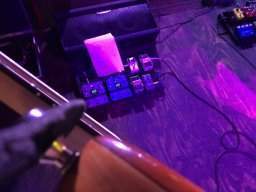
Here is my pedal board setup:

IMG_0076.JPG
 
  • Like
Reactions: bassmike2010
I have dealt with IEM systems for years. I'd say the most common problems are:
  • Incorrect wearing of the buds themselves. Which is an entire subject of its own.
  • Incorrect monitor mix technique.
  • Overall poor gain structure at the FOH mixer
  • Cheap gear
  • Signal chain issues
Lots more variables, but this hits the high points.

Going against the grain a little here, but I have achieved good results with cheaper (<$200) ear buds plenty of times.

I have had some folks who could just never connect with IEM systems, but most of those had problems with any monitor system.

Yep, this guy pretty much nailed it. I've had more problems with foh ruining a monitor mix by tweaking gain structure while playing a set. Some sound guys get it, but most don't imo.
 
I too really have a problem with IEMs. I feel like there is a disconnect from both my bandmates and the audience.

I did a quick read of the thread and one of the key things I learned to do is to not only mix in the other guys, but to MIC THE ROOM and mix that in too. We do a stage right and left mic pointed out towards the audience. This give us some real representation of the room and decreases the isolation of IEMs when we use them.

I know a lot of the guys are stressing the importance of really nice IEMs, but mic-ing the room has made that part less important.
Ambient mics work for some.. and not for others. We tried them.. junked them after a couple of gigs.. we found they muddied the IEM mix when playing.
The disconnect that you feel DOES take time to adjust to... I have found that much of that depends on how you practice..
Like @RoadRanger above, I've ALWAYS practiced at home using phones, and even used to jam with the guys (in my back room) using only headphones.. so moving to IEM's was for me.. a non-issue.
There are going to be folks who can't/won't adjust to IEM's - for various reasons.. I know quite a few. I have one in my current band... has a nice system (G3 wireless, UE7 buds) but doesn't like the mix.. can't get his "mix" the way he likes it (amp in the room sound - which will never happen) and yanks out one, then both buds after a couple of songs.. I don't think he practices with phones.

For anyone having these challenges, I suggest one practicing at home using phones, and piping your songs into that mix to get used to that "sound" before you move to IEM's on stage.
@oldcatfish mentioned getting his head blown off with a volume spike. THAT SHOULD NEVER HAPPEN with a correctly configured IEM system.
If you are wireless IEM, there WILL BE a compressor/limiter on your mix - usually built into the belt-pak receiver. Entry-level systems have fixed limiters, the upper-end models provide adjustable limiters on the receivers, along with EQ.
If you are wired you NEED to make sure there's a LIMITER of some kind in-line. Churches with older Aviom (A-16) systems seem to forget that, and the standalone stations do NOT have limiters built in, so spikes ARE possible. I'm not sure if the newer models have limiters or not, but the Behringer P16M's DO have them.

Going IEM will save your hearing. Once that hearing is gone.. or damaged.. its NOT coming back..
 
Last edited:
  • Like
Reactions: backtobass
Yep, this guy pretty much nailed it. I've had more problems with foh ruining a monitor mix by tweaking gain structure while playing a set. Some sound guys get it, but most don't imo.
in truth.. that applies to wedge mixes as well as IEM's.. mixing with trim controls (which many have incorrectly been taught to do) will affect any output buss mix - and kills a digital console mix. Set the trim, mix with faders.
Make sure you FOH guy is tapping your mix pre-fader - so changes they make to the FOH mix like compression, effects and so on.. do NOT affect your mix..
 
in truth.. that applies to wedge mixes as well as IEM's.. mixing with trim controls (which many have incorrectly been taught to do) will affect any output buss mix - and kills a digital console mix. Set the trim, mix with faders.
Make sure you FOH guy is tapping your mix pre-fader - so changes they make to the FOH mix like compression, effects and so on.. do NOT affect your mix..
Yep, unfortunately house sound guys often don't grasp this fairly simple concept, which typically leads to me yanking out an ear and using room sound to monitor mid set. Smh.
 
'5 people playing separately' is due to you not being accustomed to wearing earbuds. You're used to hearing the ambiance and reverberation of sound on the stage. In time you'll get used to it. Either that or you guys need to tighten up.

You need some type of EQ or preamp in order to get your desired bass tone in the earbuds. I use the $99 Shure buds that were included with the PSM-200. I hated them until I turned the IEM volume down and started doing my own mix. Beginners try to get the stage volume in their ears. This defeats the purpose of having IEMs. Turn it down and make sure you're using the correct fittings for your ears - read: isolation.
 
  • Like
Reactions: s0c9 and NicJimBass
I've been running IEM's for nearly 5 years in my current band, and, earlier this year, went exclusively IEM, ditching my amp completely.

I see a lot of people saying that the quality of the buds is key. I've personally found that a quality IEM system makes much more difference than the buds themselves. I bought a Sennheiser EW300 system, and it made the most difference of anything I had done up to that point. I now have the ability to EQ my ears after the mix from the board, and dropouts have never been an issue.

I tried a couple multi-driver buds, including the Shure 435 or 535, and Ultimate Ears UE900. I may be in the minority, but I prefer my Shure 215's over all of them. Been rocking the same pair for these 5 years. Only issue is I've had to change the cable once or twice.

A personal mix is definitely key. We have a Behringer X32 rack mixer, and those of us with IEM's can control our mix via a tablet or phone. It's been a lifesaver on more than on occasion.

For anyone wondering, my "amp" is now a Tech 21 VTBass Deluxe, and it makes my job and my sound guy's job so much easier. I can hear myself perfectly, and he doesn't have to deal with unwanted stage noise from my amp. Win-win.
 
  • Like
Reactions: denhou1974 and s0c9
I like the idea of IEMs but within limits. I think it's a bit precious to use IEMs in a small club or pub when you be keeping stage/FOH volume at a reasonable level anyways. But then there's the whole argument for not having to have wedges on stage. Which I get.

I totally agree with having quality buds. I used the single driver Shure buds and did not get anything good out of them at all. I stopped using IEMs altogether before having a chance to try 2 or 3 driver buds.

Another thing is the personal mixer paradigm. I spent countless hours (OK, maybe minutes) onstage trying to dial in an adequate mix for my needs. I spent a lot of playing time messing around with the Powerplay mixer for not great results. Never could get the bass up to a level of my liking without hitting distortion levels (maybe the fault of the drivers). And sometimes the guitar/drums would be mic'd and in the IEMs and sometimes not. Drove me batty so I went back to a wedge.

What I would think work best in an IEM situation is the type of personal mixer/app that gives you the overall mix plus a "more me" option. that assumes ALL instruments are mic'd! I know my Presonus 16.4.2 supports that option and if each band member uses the accompanying iOS app (QMix). Haven't tried it yet but may soon since all my band members own an iPhone. Even if we stick with wedges at least I won't be running back to the board to fix monitor mix issues all night!
 
I've been using iem's for a year and a half. Here's what I've learned: i use shure 215's (single driver, i think). They work very well. I've bought Shure SE215 Sound Isolating Earphones - Black
and replaced the tips with Shure EATFL1-6 - Triple Flange, 3 pair
for me, they knock down most of the external sound. It took me a month or two to get my mix just right in my ears. That will change from week to week depending on who's playing drums. In my experience, you don't need to spend a ton of money to get the mix in your ears right. We've had some practice sessions where we spend time just dialing in the mixes in the in-ears and in the regular floor monitors with the sound crew. hope this helps.

edit: and I've made sure my ears are very very clean.
 
Our church has been DI/IEM for a while now. We have a great FOH system and a board that allows us to have individual mixes and controlled via our iPhones. We are wired and use Rolls boxes for our IEM's. I have Westone UM-2's as does our drummer. We love them. I have a little ambient mic mixed in, and it helps a little, but I think you have to get used to them. It takes a while. You will always feel a little isolated I think. For us, it's worth it for the gains in other areas.

That said, even with our two pairs of 18" subs, we don't feel much bass on stage...mostly because if the system gets run at a level that we would like, the congregation complains. It' frustrating as the system is so nice that it doesn't sound loud if you know what I mean. You can hear the pastor speaking clearly everywhere in the space. It's a contemporary service, should' you expect it to "rock" a little bit? But what do you expect from a bunch of lutherans.

We've talked about putting a bass cab on stage for a little visceral feedback for us.
 
I play in a cover band that plays small bars and similar venues. My bandmates are all gear heads, so they own IEMs and try to use them whenever possible. (I am a gear head too, but my opinion on IEMs is mixed, as you'll see.). So we've played a number of gigs where all of us are on IEMs.

I definitely see the benefit for most of the band. Me personally, I much prefer traditional monitoring (floor wedges etc.). With IEMs I tend to hear vocals, guitars, and keys much better, which is nice. But I usually have a really hard time hearing myself. This is especially true because with IEMs, engineers usually ask me turn my amp down so low that I can't really hear it, so I depend on the monitor mix entirely to hear myself. We usually work with engineers who are only willing to give us a single monitor mix, which has VERY little bass in it. I've had situations where I've accidentally kept myself muted during a song and didn't notice until we got to the chorus, because the bass levels really didn't sound any different to me.

The most recent gig we played, I asked for a second monitor mix just for me. I asked the engineer for the same mix as everybody else, just with the bass cranked way louder. (The engineer is a bassist, so he understood.). It was great. I heard myself crystal clear, and had a blast.

So to me, the biggest risk and problem with IEMs is the monitor engineers. You're basically at their mercy. If you trust them to give you what they need to hear, you can have a great experience. If not, you may really struggle.
 
  • Like
Reactions: 1954bassman

Latest posts