• TalkBass has been independent since 1998. Add your voice.
    Create a free account to reply to discussions, view embedded media, and browse with fewer display ads.
    Join freeLog in
    Want zero display ads or expanded classifieds tools? Compare plans.

Capacitor help

dagrev

Supporting Member
Jun 21, 2006
25,322
148,195
63
Kentucky
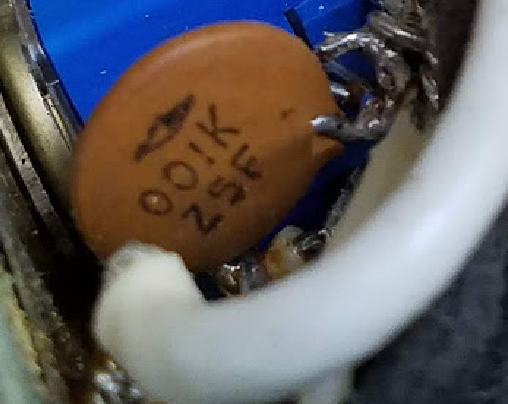
Hello- I'm not smart in this area at all and am wondering what this cap is doing tone wise (making things brighter or...?) in my '55 Pbass. I know a 0.1uF cap will cut more treble than a 0.047uF, but I'm not sure how to read the one in the pic. It's not the right cap for that time/bass but was this way when I bought it around 1982. Thanks for any help or suggestions.
upload_2018-11-16_10-46-20.png


upload_2018-11-16_10-43-13.png
 
Last edited:
  • Like
Reactions: Pbassmanca
Thanks for the replies. I'm not sure what the difference is with the treble bleed vs the normal approach. Sorry, I really am that unsmart!

This bass has some weird wiring--like having a Bill Lawrence Q filter wired in as well. Not sure what all that's doing to the tone.
 
Last edited:
It’s hard to tell from that pic, but I see a resistor, so I wonder if it’s all part of a treble bleed circuit? Are they wired to the volume knob?

If so, what this does is it preserves highs when you turn down the volume. Without it, turning down the volume control also darkens the tone...

This is what the whole thing looks like. The cap is near the pot on the left, but is hard to see. Nothing is under the tape.

upload_2018-6-16_11-50-56-jpeg-jpg.jpg
 

Attachments

  • upload_2018-11-16_11-24-47.jpeg
    upload_2018-11-16_11-24-47.jpeg
    323.5 KB · Views: 20
Last edited:
if I am jusxtoposing my opposition correctly the orientation of that plate leads me to think that's your tone pot there on the left, not vol. The treble bleed thing makes sense on the vol...

Honestly, unless the electronics are misbehaving, or something is tonally displeasing, i'd just put it back together and play it.

If you feel like experimenting, and (again) the setup you have there is working, leave all that intact and order a replacement plate and some pots and knobs and a little of that good cloth covered wire from mojotone or someone and rig you ups some stuff. Personally I like 500K for humbuckers, 250K for single coils. I like linear taper for volume and audio taper for tone. Usually I put a .047 orange drop cap on the tone. There are lots of sources on wiring out there, just google something like 2 pickup bass vol vol tone, and see what you get...
 
  • Like
Reactions: Pbassmanca
if I am jusxtoposing my opposition correctly the orientation of that plate leads me to think that's your tone pot there on the left, not vol. The treble bleed thing makes sense on the vol...

Honestly, unless the electronics are misbehaving, or something is tonally displeasing, i'd just put it back together and play it.

If you feel like experimenting, and (again) the setup you have there is working, leave all that intact and order a replacement plate and some pots and knobs and a little of that good cloth covered wire from mojotone or someone and rig you ups some stuff. Personally I like 500K for humbuckers, 250K for single coils. I like linear taper for volume and audio taper for tone. Usually I put a .047 orange drop cap on the tone. There are lots of sources on wiring out there, just google something like 2 pickup bass vol vol tone, and see what you get...

Thanks for the info.

There's really nothing wrong with it, I just wonder about making it more original. Then noticed the numbers on the cap--which made no sense to me and then wondered what that was doing to the tone. It's pretty smooth and clear sounding and lacks some mids. That's why I wondered if making it more typical for that time might make it a little more lively, for lack of a better term.
 
Sounds good. I have read posts that lead me to believe that Bill Lawrence is pretty approachable. You might contact him if you want to know more about what that q filter does. I've head tell that his pickups are pretty sweet. Am sure that gizmo is good for what it's good for.

Good Luck!!
 
Sounds good. I have read posts that lead me to believe that Bill Lawrence is pretty approachable. You might contact him if you want to know more about what that q filter does. I've head tell that his pickups are pretty sweet. Am sure that gizmo is good for what it's good for.

Good Luck!!

Thanks! I just finished sending Becky Larwence an email. Possibly they will respond with what effect it's having on the bass.
 
  • Like
Reactions: Wfrance3
Aren't volume knobs typically on the left? That would agree with the treble bleed hypothesis...

Q filter is, as far as I understand, sort of a mid filter control (cut only). I think it’s based around an inductor, but there may be other components... Unfortunately Bill passed away, but I’m sure Becky will help. Or, search Talkbass, it has been discussed in the past!

If the tone works for you, then all is good. If too smooth, make sure both controls are on max, as that will have the least effect on the tone of the pickup. If you want more mids passively, a small loading cap might help. Or, better yet, try a few different sets of strings - nickel rounds, pressure wounds, or even nickel flats can have nice mids.
 
  • Like
Reactions: saabfender
Aren't volume knobs typically on the left? That would agree with the treble bleed hypothesis...

Q filter is, as far as I understand, sort of a mid filter control (cut only). I think it’s based around an inductor, but there may be other components... Unfortunately Bill passed away, but I’m sure Becky will help. Or, search Talkbass, it has been discussed in the past!

If the tone works for you, then all is good. If too smooth, make sure both controls are on max, as that will have the least effect on the tone of the pickup. If you want more mids passively, a small loading cap might help. Or, better yet, try a few different sets of strings - nickel rounds, pressure wounds, or even nickel flats can have nice mids.

Thanks for the good information. It's much appreciated. Adding what you suggested might be above my pay grade. I've changed out PUPs and wiring harnesses but beyond that might be beyond me! Me and soldering don't get along for some reason.

Yes, I read one person say something to this effect as I recall, but I wasn't sure if that was accurate or just a perception. Bill's site simply says: "Q-Filter An LCR Network to reduce the impedance of pickups."

I does need more mids, so it the filter is drawing some out, it needs to go. I've tried many stings from TI flats (obviously lots of mids), and various others. Currently I have TI jazz rounds which help with not being super bright and add nice mids. Everything else I've tried with my current rig is either too bassy and indistinct or upper midy/treb in a way I'm not looking for with little in the middle.
 
You have a Wilde Q-filter installed. It’s a passive LCR network similar to the one Bill Lawrence designed for the Gibson Ripper bass.

It’s been called a passive midrange control. And I suppose it could be thought of that way. But to my ears it’s more of a texture knob. Dialed down it tightens and cleans up the overall sound. Cranked up and it gets you a looser and more open and midrangey quality. It's circuit that (along with its Bill Lawrence designed pickups and a clever pickup switching scheme) gave the Gibson Ripper it’s unique voice.

It’s a nice mod to have IMO. You can get a lot of good tone shaping out of a Q-filter. If you have cavity space it can be given its own knob - or put on a stacked pot and used in conjunction with a regular tone control/capacitor. Or it can be wired in place of the regular capacitor on an ordinary tone knob or even be made switch selectable. It’s pretty versatile in that regard. Lots of different ways to wire it in depending in what you want it to do.
 
You have a Wilde Q-filter installed. It’s a passive LCR network similar to the one Bill Lawrence designed for the Gibson Ripper bass.

It’s been called a passive midrange control. And I suppose it could be thought of that way. But to my ears it’s more of a texture knob. Dialed down it tightens and cleans up the overall sound. Cranked up and it gets you a looser and more open and midrangey quality. It's circuit that (along with its Bill Lawrence designed pickups and a clever pickup switching scheme) gave the Gibson Ripper it’s unique voice.

It’s a nice mod to have IMO. You can get a lot of good tone shaping out of a Q-filter. If you have cavity space it can be given its own knob - or put on a stacked pot and used in conjunction with a regular tone control/capacitor. Or it can be wired in place of the regular capacitor on an ordinary tone knob or even be made switch selectable. It’s pretty versatile in that regard. Lots of different ways to wire it in depending in what you want it to do.

Thanks for the information. I was told it was a Lawrence years ago when someone looked at it.

I don't mind keeping it--if it's helping to get a tone I like, but if it's minimizing mids (like some guys seems to like on guitars), I don't think it's helping me. It seems to be wired in as tone control in place of a cap, since the only cap there seems to be for a treble bleed. As a result I'm not sure how to control it any.

Thanks again!
 
This is what Becky directed me to. Like most everything I've read, it's guitar related and describes what it does largely in terms of electronics and less on what it does to the tone. But is still helpful.

Re: Q filter What does it do, exactly? #22 Invalid Link Removed [-]
Posts: 19433
Thu, Apr 11, 2002 07:12:48


The Big FIBer

...From the Man himself:

The Q-Filter is an LCR network - a 1 henry, low Q noisefree inductor in series with a .02 micro farad cap in parallel with an 8 kilo ohm resistor. Wired like a cap to a tone pot, you can gradually decrease the impedance of the circuit but maintaining a slightly higher impedance below 1100 Hertz. Also available without the cap and the resistor to gradually decrease the impedance of the pickup.

The EQ system is the most versatile system to alter the sound of a guitar and can be used for multiple functions. The basic components are a 900mh low Q inductor in series with a capacitor and a variable resistor (tone pot). We used to ship it as a complete pre-tuned unit to replace the cap at the tone pot, limited for one basic function. However, in conjunction with different pickups in different positions, it's much more versatile when the inductor is separated from the cap, like [shipped now]. In the past, this caused severe problems when players used the wrong caps and resistors, especially when the EQ was wired to a switch only. The system must be wired to a control or you totally limit its functions, as follows:

Function A - the L Filter - the inductor, wired like a cap to the tone pot.
When you turn the pot from 10 to 0, you slowly reduce the impedance of the pickup. This is equal to taking turns off the pickup or making a sweet clean pickup out of a high power, overdrive pickup. This works fine for the neck pickup. With the control set below 3, the impedance is much too low so we block the control with a fixed 10 kilo ohm resistor or don't turn the control below 3 or 4.

Function B - the EQ Filter
On the bridge pickup, we want to maintain more lows so we block the inductor with a resistor in parallel with a cap. Now, when you turn the control to zero and you use hi-fi speakers, you can duplicate the sound of an acoustic guitar. With the controls on 3, you can get out of the bridge pickup, the #4 position sound of a Strat.[/URL]
Invalid Link Removed
 
I have a Bill Lawrence QFilter for bass. It’s a black plastic enclosure about 1” square x 1/2” thick. A coil is inside. It works with a pot, a cap and resistor and shunts to ground at the tone pot. It essentially scoops out or unthickens the tone. You use a pot to make it work, you can swap your tone pot for a push/pull and use it that way. I have it on a couple of my basses.

The one in the pic doesn’t look like my QFilter, maybe it’s an older one in a different case. As mentioned earlier, it may be scuttled from a Ripper. Perhaps it is a custom case with the cap and resistor already inside. Or maybe it’s one for guitar. They are spec’d in H. (Henry’s) There are two models available currently. There are schematics on their website with suggested cap and resistor values. The values are dependent on the impedance of the pups, you have to experiment.
 
Last edited:
it may be scuttled from a Ripper. Perhaps it is a custom case

I think it’s the older version. The Wilde version sans resistor and cap is just a black plastic case with no markings.

It wasn’t from a Ripper however. The Lawrence circuitry in that was all discrete components.

Here’s the guts:

916628A4-16C6-4E54-82D7-7808B2EBF913.jpeg


That little tootsie roll thingy between the pots is the inductor. Fancy word for a coil of wire around a metal rod. Sorta like 1/2 of a small audio transformer - which is what homebrew builders use (with mixed results) when they don’t want to spring for one from Wilde. You can see the little blue tuning cap off to the right next to the big orange drop .047 tone cap. The Gibson circuit doesn't use any additional resistor. Probably because Bill calculated everything out to match those pickups which are a little different than anything else out there. The pots are also 300K rather than 250K. So that might also have something to do with it not needing one.
 
Last edited:
That's a ceramic capacitor in the picture. These are durable components. If you keep it at room temperature and never exceed its voltage rating, you can expect it to live forever. Chances are it works just fine. All those numbers and letters characterize the value and tolerances of the capacitor as follows:

"001" is the capacitance, most likely in microfarads (uF). I say "most likely" because this appears to be an old style of marking. These days, a different code is used.

"K" indicates that the actual capacitance value is within plus or minus 10% of the indicated value.

"Z5F" indicates the variability of the capacitance with temperature change. This particular code means that if you raise the temperature of the capacitor from 50 to 185 degrees Fahrenheit, the capacitance will increase, but by no more than 7.5%.

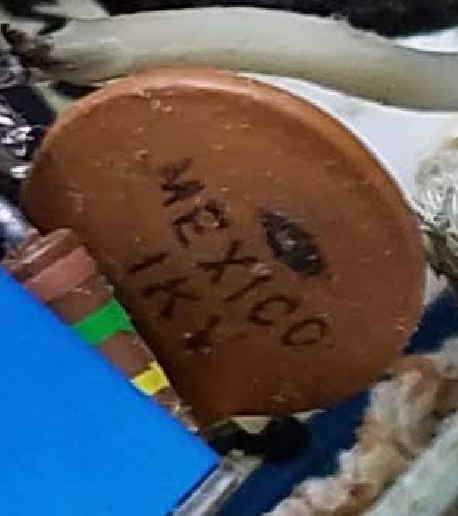
"1KV" means it's rated to withstand as much as 1000 Volts.

The little diamond above "MEXICO" is probably the manufacturer's trademark. Of course, "MEXICO" means it was manufactured in -- just guessing, folks -- in the country officially known as the United Mexican States.

As for the resistor, its color code of BROWN-GREEN-YELLOW means that its value is 150,000 Ohms (150K Ohms).
 
Last edited: