If there was a logical way to make a carbon fiber bridge work well on a double bass, I think Luis and Clark would do it. 
Invalid Link Removed
Invalid Link Removed

TalkBass has been independent since 1998. Add your voice.
Create a free account to reply to discussions, view embedded media, and browse with fewer display ads.
Join free Log in
Want zero display ads or expanded classifieds tools? Compare plans.

If there was a logical way to make a carbon fiber bridge work well on a double bass, I think Luis and Clark would do it.
Invalid Link Removed

If there was a logical way to make a carbon fiber bridge work well on a double bass, I think Luis and Clark would do it.
Invalid Link Removed
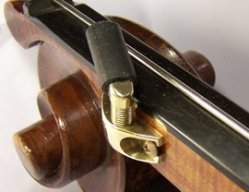
As for shaping the feet: what about a kind of plastic? Get it warm enough to be malleable. Press it against the top plate. Done. If there was no impact at all on tone (and I make no claim one way or t'other there), and assuming there's no philosophical/aesthetic/pseudo-religious objection, it's a straight-up economic decision.

Ah! Here let us indulge for a moment in a tangent which might be interesting. The luthier fits the bridge feet to an uncompressed top. No matter how well he carves the feet, the fit will change when string tension is applied. Of course corrections can be made if there are obvious discrepancies, bend can be anticipated, and also the maple feet are flexible and will adjust themselves, but if the foot to top fit is done with a thin layer of some very viscous epoxy paste, then it could be done on a sprung top, possibly better matching its surface.
 .
.
If there was a logical way to make a carbon fiber bridge work well on a double bass, I think Luis and Clark would do it.
Invalid Link Removed
Edit/add: Robo & T-Bird, with a "sprung top" and a "sprung bridge" I suppose you mean that the top is loaded (or stressed) with the downward force of the strings?
I feel that is difficult to do with a mold fit because of the following 3 reasons. Firstly I use a protective film over the top, cause the last thing you want is to glue a bridge to your top. But I fear the protective film will break because of the high point loads between the highest points of the feet and the table.
 .
.Secondly, even if the film does not break, you will deform the top (= the mold) at those highest points, so the shape you create will still not yield a constant surface pressure over the contact area. The low areas remain virtually un-loaded, because the viscous epoxy paste will continue to flow (viscously) away, just until all pressure is gone. So then it will not bear any load. It will do that even if it has a very high viscosity, only with a high viscosity it will take longer (that's the third reason). It is practically extremely difficult to time the setting (or gelling) point so that you end-up with an even pressure profile (unless that pressure is 0, so un-stressed). Maybe you could improve by doing it iteratively, starting off with an un-stressed fit and gradually increasing the load. Or re-work the un-stressed fit mechanically, if required.
) between the bridge feet and the top under load, I wasn't worried or concerned about the necessity to decouple the bridge from the top with a thickness of epoxy.Take a look... http://imgur.com/kGbOZTV
The material is far too stiff. The reason we thin bass bridges as far as is practicable is to make them flexible enough to sound good.
Nothing deader sounding than a big, fat bridge...
Sorry to be clear, this was a bridge I had installed recently. It had a plastic frame, graphite core filling and a cf shell.
.
Edit/add: Robo & T-Bird, with a "sprung top" and a "sprung bridge" I suppose you mean that the top is loaded (or stressed) with the downward force of the strings?


