
Id also add that people have a loss curve of high end as they age. Its called presbycusisNo. It's wishful thinking/confirmation bias. Audible memory is extremely short term and unreliable.

Enjoy the benefits of a premium membership!
Upgrade Account
-
TalkBass has been independent since 1998. Add your voice.
Create a free account to reply to discussions, view embedded media, and browse with fewer display ads.
Join free Log in
Want zero display ads or expanded classifieds tools? Compare plans.
You are using an out of date browser. It may not display this or other websites correctly.
You should upgrade or use an alternative browser.
You should upgrade or use an alternative browser.
Change in tone with ageing?
- Thread starter blr2
- Start date
More options
Who Replied?
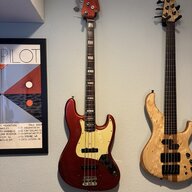
So the OP is correct, tone does age and become warmer with time, it's just our ears attenuating down the frequency of the LPF.Id also add that people have a loss curve of high end as they age. Its called presbycusis

Actually, if (and that's if) tone changes with ageing, this is most likely due to ageing pickups. Alnico permanent magnets have been shown to lose magnetic properties with ageing. The process is accelerated at higher temperature and upon mechanical impact. Magnet wire also ages. It may corrode and the insulation may break down. This changes the DC resistance and the capacitance of the coil. Finally, in very old pickups the bobbins may shrink or warp that changes the whole geometry of the assembly.
All these leads to changes in inductance, that changes the resonant peak of the pickups, that's, in turn, perceived as treble response. Which way it's gonna go is tough to say, factors work in opposite way.
Pots and caps can also change values over long periods of time that impacts the tone of the instrument.
Now, I'M NOT SAYING that this is happening on a 14 years old set of J-pickups, not at all. Just saying that ageing pickups and other electronics can (and in many cases is) changing their tone. In extreme cases, pickups just die and have to be rewound, pots replaced...
All these leads to changes in inductance, that changes the resonant peak of the pickups, that's, in turn, perceived as treble response. Which way it's gonna go is tough to say, factors work in opposite way.
Pots and caps can also change values over long periods of time that impacts the tone of the instrument.
Now, I'M NOT SAYING that this is happening on a 14 years old set of J-pickups, not at all. Just saying that ageing pickups and other electronics can (and in many cases is) changing their tone. In extreme cases, pickups just die and have to be rewound, pots replaced...
Last edited:

Some instruments get better with age others do not, especially acoustic guitars, violins and other stringed wooden instruments. IME it comes down to many contributing processes starting with the quality of materials and craftsmanship. I am also of the opinion that as one of those instruments are played the vibrations will begin to unify the tonal qualities that are perceived as pleasing. This is not something that always happens and takes a lot of time often centuries, trying to prove this with a modern instrument is a challenge and why there is a pervasive opinion that such things do not matter with solid body instruments, but I do believe that in some cases there can be a magical improvement over a few years of play or simply the perfect combination. With electric guitars and basses it is more often that provenance is more a determining factor.



In short, we may be able to recreate the same signal chain and track part of the bass line of one of the songs. Then we can compare on high quality monitors/headphones and do some FFT analysis.
I think this is great possibility for a test, and I would be very interested to hear the results. I know sometimes such tests are made with a degree of objectivity on violin family instruments; the results I remember reading are 'there are differences, but not such that it would overweight the initial build quality'.
My experience leads me to believe that after years, the instruments become less 'universal' and more 'personal', they become more sensitive to finger work. Can't say whether it's anything objective though.
Asking around, musicians who play old instruments usually believe in ageing, while musicians who prefer new instruments don't. That's where the majority of 'no' conclusions come from, IMO.
It is interesting to hear other instrument players, like trumpets, trombones or pianos, talk about this issue.

Human memory is highly unreliable.
I think I read that somewhere before, but I can't recall where.
I don't know about your bass, but I'm aging and my tone has changed a LOT.
For the better or for worse?
My tone has changed for the better, mostly because now I can afford better quality amplification and effects, and learned to use them wisely. Also, I can afford to change strings much more often now, than back in the late 80's and early 90's.

Actually, if (and that's if) tone changes with ageing, this is most likely due to ageing pickups. Alnico permanent magnets have been shown to lose magnetic properties with ageing. The process is accelerated at higher temperature and upon mechanical impact. Magnet wire also ages. It may corrode and the insulation may break down. This changes the DC resistance and the capacitance of the coil. Finally, in very old pickups the bobbins may shrink or warp that changes the whole geometry of the assembly.
All these leads to changes in inductance, that changes the resonant peak of the pickups, that's, in turn, perceived as treble response. Which way it's gonna go is tough to say, factors work in opposite way.
Pots and caps can also change values over long periods of time that impacts the tone of the instrument.
Now, I'M NOT SAYING that this is happening on a 14 years old set of J-pickups, not at all. Just saying that ageing pickups and other electronics can (and in many cases is) changing their tone. In extreme cases, pickups just die and have to be rewound, pots replaced...
OK, I gotta chime in - as someone who has designed products including all the things you're talking about, and understands the Physics of such things.
Alnico is VERY stable stuff - yes, it ages, but over HUNDREDS of years. You may find old alnico pickups that are weaker than newer ones, but they haven't really "aged" - there hasn't been enough time for that - the processes for making alnico gets better over time, so the new ones may be hotter, but the old ones haven't really aged. I worked regularly on a microphone that has been in production for over 50 years - we had precise enough testing to see the changes that have occurred over time in the various grades of alnico. Yes, alnico can be damaged by heat. The Curie temperature at which this occurs is 840 degrees - the wood in your bass will burst into flames (and the plastic around them will melt) long before you harm the Alnico in the magnets.
Magnetic pickups can be harmed - you can break (or corrode through) the wire. That's the one thing you kinda need to worry about, and that's a very sudden process - the pickup will work like the day it was made, and then it'll be very different all of a sudden. It's a rare failure in normal use, but it can happen.
Potentiometers - yes, they change value - the carbon tracks wear with use and time, the value goes up some. Nothing too drastic happens from this, unless the carbon breaks then, it's another sudden thing. Capacitors? Some (not all) of them change value. If they are ceramic capacitors, depending on the dielectric, they can lose value over time. If they are plastic film caps, they don't do this. The rate at which they lose value is logarithmic - the amount they lose slows down drastically over time - they lose a little the first month, a similar amount the first year, a similar amount the next decade, and a similar amount the next century, and so on. Your Fender amp made in the 60's has some parts that are out of spec - all on the low side.
Wood? yes, it does change - if you ever work on old houses, you quickly realize that old studs get harder over time (insert joke here), and they lose damping - wood gets stiffer, lighter and more resonant over time - that is absolutely true, and something you can measure (there are journals with scientific papers on this that, well, you can't understand - highly technical stuff) - you can't really debate that. You are free to argue its significance and whether or not you can hear its effects, but the fact that it changes is well established. If you happen to have a bass neck with a pronounced dead spot, you might get lucky as it ages - the resonance frequency will change somewhat. If you happen to have a bass neck without noticeable dead spots, you might..get unlucky. The one thing you can predict is which way it will go - the neck's resonance frequency will go up. If you want to get some idea of whether or not you're in for bad news, you can take a tuner off the headstock (not the G string tuner - you need that for the string where the dead spot is) - that will shift the resonance up a bit, giving you some idea of whether or not the neck's change will be favorable.
Agree with most you said, including that you can completely demagnetize an Alnico magnet heating it to the Curie temperature. However, you can greatly accelerate demagnetization at way lower temperatures. In any case, this is irrelevant to our discussion.
What I know from experience is that some guitar players I know and/or played with that use their volume pots a lot (for volume swells), change them quite often, like every 4-5 years. I've been told that they're not doing it because they get scratchy and cut, but because they change their guitar tone. I don't know how much of that is true.
What I know from experience is that some guitar players I know and/or played with that use their volume pots a lot (for volume swells), change them quite often, like every 4-5 years. I've been told that they're not doing it because they get scratchy and cut, but because they change their guitar tone. I don't know how much of that is true.
Agree with most you said, including that you can completely demagnetize an Alnico magnet heating it to the Curie temperature. However, you can greatly accelerate demagnetization at way lower temperatures.
You need to do more research. The changes you speak of with alnico are reversible - it loses some of its strength with increasing temperature, but when the magnet cools down, it goes back to normal.
You're effectively experiencing the instrument for the first time again since your memory of the sound after 7 years away from it is almost certainly more of a vague notion of how it sounded rather than anything you could rely on. So I'd imagine it's that.
I remember a/b-ing my basses via a di box and being struck by how distinct they sounded in the moment, only to listen back to the recordings a few days later and find that they were all much more similar than I'd thought.
Whether the sound actually changed and, if so, what caused it is an unanswerable question with no baseline to compare against. But as long as you're into the sound it's a win.
I remember a/b-ing my basses via a di box and being struck by how distinct they sounded in the moment, only to listen back to the recordings a few days later and find that they were all much more similar than I'd thought.
Whether the sound actually changed and, if so, what caused it is an unanswerable question with no baseline to compare against. But as long as you're into the sound it's a win.
You need to do more research. The changes you speak of with alnico are reversible - it loses some of its strength with increasing temperature, but when the magnet cools down, it goes back to normal.
It's hysteretic. Never goes back to the same value. Anyway, it's not relevant.

I'm 51, and I've definitely changed tone with aging.
Every time I move, I moan.
My joints are all zingy like fresh rounds. You can gear the grind!


I definitely feel that the tone changes and I think it stems mostly from the neck. I can compare tones over a period of 29 years with recordings using the same bass as my mainstay. From a study, titled "Effects of aging on the vibrational properties of wood," from University of Tsukuba, "Vibrational properties of aged wood were compared with those of recently cut “new” wood. The aged wood showed higher sound velocity (VL) and lower mechanical loss tangent (tanδL) than the new wood." The wood doesn't have a direct effect on the pickup, but it does have a direct effect on string vibration, and the pickup is reading the strings vibrations. There's no way that a guitar's tone doesn't change over time. Maybe more so in the amount of hours played rather than the years since construction.
It's hysteretic. Never goes back to the same value. Anyway, it's not relevant.
Alnico is not like other materials, which exhibit the behavior you’re referring to.

If you think the tone has changed and improved over time, hold that thought and be happy that you've got a better sounding bass, which is going to make you feel better when you play it, which will make you play better as a result, which is our aim when we choose a particular musical instrument in the first place.


