• TalkBass has been independent since 1998. Add your voice.
    Create a free account to reply to discussions, view embedded media, and browse with fewer display ads.
    Join freeLog in
    Want zero display ads or expanded classifieds tools? Compare plans.

Change in tone with ageing?

My two Alembics were an '86 production, the other a '07. While the fresh build of the '07 did entail the initial stabilizing of new(er) woods ( and of course they use nothing that's not carefully aged), the '86 was as if it was granite. It routinely held its setup within 1/32" all 10 years I owned. WTH, I rarely had to tune it, it was just an exceptional lucky combination of time and the right woods.

I once asked Mica Wickersham about this and got two priceless answers:

Regarding the '07 squirming with it's new wood adjusting to Nashville instead of NorCal, she said ,' . . . Sooner or later the wood will realize it's not a tree anymore. . . '

And regarding the granite-like surety of the '86, she explained that in her experience, it took their axes from 2-3 years for them to reach an equilibrium as all the sap dried to a small percentage and all the finish and adhesives gassed off completely, and essentially the bass was now set for life, barring moving to Miami or Saudi, where big differences might provoke them for a little while.
 
  • Like
Reactions: Derek Kay
Hello,

As described in THIS THREAD , I reacquired a Jazz Bass I used to own since new, after 7 years. Obviously, I cannot make a direct comparison, but from memory, I am convinced that now, after 7 years, the tone of the bass is considerably deeper and warmer. Could it be that the this is due to wood ageing, knowing that it has a thin nitro finish?

What's your experience people?

Might be a sign you need a visit with an audiologist.
 
Hello,

As described in THIS THREAD , I reacquired a Jazz Bass I used to own since new, after 7 years. Obviously, I cannot make a direct comparison, but from memory, I am convinced that now, after 7 years, the tone of the bass is considerably deeper and warmer. Could it be that the this is due to wood ageing, knowing that it has a thin nitro finish?

What's your experience people?

You aged too though, yeah?


I estimate the impact from something about you that's changed with time or age at around approximately here.


I estimate how much difference the nitro makes sits right about way down here.
 
Last edited:
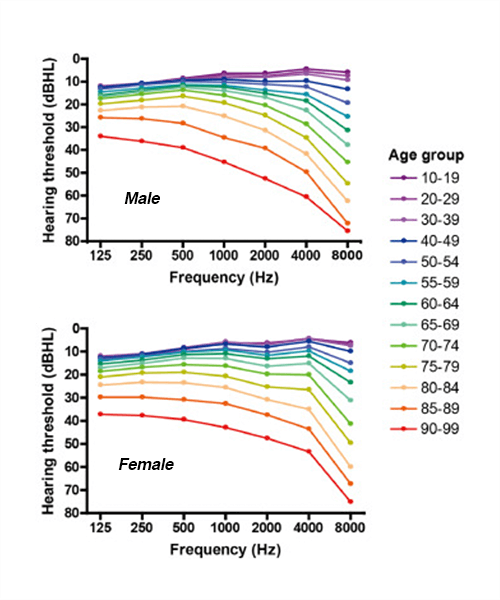
More likely you've lost top end in your hearing, so you're only hearing the warmer mids and down.
This is a great answer. Seven years may not seem like a long time, but once you’ve crossed into the back half of life, the drop in the top end of hearing range comes fast.

avghearing.png
 
  • Like
Reactions: Grinderman
OK, I gotta chime in - as someone who has designed products including all the things you're talking about, and understands the Physics of such things.

Alnico is VERY stable stuff - yes, it ages, but over HUNDREDS of years. You may find old alnico pickups that are weaker than newer ones, but they haven't really "aged" - there hasn't been enough time for that - the processes for making alnico gets better over time, so the new ones may be hotter, but the old ones haven't really aged. I worked regularly on a microphone that has been in production for over 50 years - we had precise enough testing to see the changes that have occurred over time in the various grades of alnico. Yes, alnico can be damaged by heat. The Curie temperature at which this occurs is 840 degrees - the wood in your bass will burst into flames (and the plastic around them will melt) long before you harm the Alnico in the magnets.

Magnetic pickups can be harmed - you can break (or corrode through) the wire. That's the one thing you kinda need to worry about, and that's a very sudden process - the pickup will work like the day it was made, and then it'll be very different all of a sudden. It's a rare failure in normal use, but it can happen.

Potentiometers - yes, they change value - the carbon tracks wear with use and time, the value goes up some. Nothing too drastic happens from this, unless the carbon breaks then, it's another sudden thing. Capacitors? Some (not all) of them change value. If they are ceramic capacitors, depending on the dielectric, they can lose value over time. If they are plastic film caps, they don't do this. The rate at which they lose value is logarithmic - the amount they lose slows down drastically over time - they lose a little the first month, a similar amount the first year, a similar amount the next decade, and a similar amount the next century, and so on. Your Fender amp made in the 60's has some parts that are out of spec - all on the low side.

Wood? yes, it does change - if you ever work on old houses, you quickly realize that old studs get harder over time (insert joke here), and they lose damping - wood gets stiffer, lighter and more resonant over time - that is absolutely true, and something you can measure (there are journals with scientific papers on this that, well, you can't understand - highly technical stuff) - you can't really debate that. You are free to argue its significance and whether or not you can hear its effects, but the fact that it changes is well established. If you happen to have a bass neck with a pronounced dead spot, you might get lucky as it ages - the resonance frequency will change somewhat. If you happen to have a bass neck without noticeable dead spots, you might..get unlucky. The one thing you can predict is which way it will go - the neck's resonance frequency will go up. If you want to get some idea of whether or not you're in for bad news, you can take a tuner off the headstock (not the G string tuner - you need that for the string where the dead spot is) - that will shift the resonance up a bit, giving you some idea of whether or not the neck's change will be favorable.

Nice post Micguy!

Yep, the studs and rafters in my 80 year old house are like concrete. Wood does age, not just through drying out but through change in its structure. I suppose it's really decay.

Whether that affects an instrument, who knows. Personally I like to believe instruments sound better as they're played in over the years, but that may just be a romantic sentiment. If it makes me love my instrument more then all good :)
 
  • Like
Reactions: Derek Kay


Don't know if it had been posted but they did the whole job right.

My feeling is that it don't change that much. My longest bass owning is 10 years and it feels like the first day.

The brain is a powerful tool and can adapt and change so being biased is easy.


Interesting video (once you skip past all the pointless blabbering...).

The difference is VERY noticeable IMO, but there's one HUGE variable they should have taken more seriously: The playing. Most of the day366 clips are played noticeably smoother, which mean they have less fret buzz/clank and a fuller tone. Some of the day1 clips are rather sloppy, and less dynamically controlled. Sloppy playing will often come across as brighter/thinner sounding. Maybe they simply got better at playing bass during that year?

It's a shame. After going to such lengths they still end up with a severely flawed comparison. They should have used a more experienced bass player, who should have been able to play FAR more consistently.

Still, the results are more or less what I've always suspected based on experiences with my own basses. I often find brand new basses slightly bright/thin sounding and dynamically "stiff", but over time (actually far less than a year) they seem to develop a slightly warmer/fuller tone and livelier dynamics.

But I'm not 100% convinced I'm not imagining things, and this video proves absolutely nothing.
 
Last edited:
Interesting video (once you skip past all the pointless blabbering...).

The difference is VERY noticeable IMO, but there's one HUGE variable they should have taken more seriously: The playing. Most of the day366 clips are played noticeably smoother, which mean they have less fret buzz/clank and a fuller tone. Some of the day1 clips are rather sloppy, and less dynamically controlled. Sloppy playing will often come across as brighter/thinner sounding. Maybe they simply got better at playing bass during that year?

It's a shame. After going to such lengths they still end up with a severely flawed comparison. They should have used a more experienced bass player, who should have been able to play FAR more consistently.

Still, the results are more or less what I've always suspected based on experiences with my own basses. I often find brand new basses slightly bright/thin sounding and dynamically "stiff", but over time (actually far less than a year) they seem to develop a slightly warmer/fuller tone and livelier dynamics.

But I'm not 100% convinced I'm not imagining things, and this video proves absolutely nothing.

Well i understand your point but it's as close as we can get when dealing with humans. I don't feel it's this far from consistency.
At least they tried! And i agree it proves that it's hard to compare.

What can be made is a mechnical measurement of the resonant frequency of the whole bass like what i do at my job.
A vibration test with many sensors capturing the freq response of the material on a new bass.
Then do an aging process by playing it a whole year.
Then Redo the vibration test and compare.

But many things can go wrong: Untighten parts, strings failure, electronic failure...
 
Some instruments get better with age others do not, especially acoustic guitars, violins and other stringed wooden instruments. IME it comes down to many contributing processes starting with the quality of materials and craftsmanship. I am also of the opinion that as one of those instruments are played the vibrations will begin to unify the tonal qualities that are perceived as pleasing. This is not something that always happens and takes a lot of time often centuries, trying to prove this with a modern instrument is a challenge and why there is a pervasive opinion that such things do not matter with solid body instruments, but I do believe that in some cases there can be a magical improvement over a few years of play or simply the perfect combination. With electric guitars and basses it is more often that provenance is more a determining factor.

Even the common belief that violins improve with age has been demonstrated to be questionable, given the results of recent painstakingly designed double-blind studies. (Professional concert violinists were unable to guess consistently which of the violins they were playing or listening to were centuries-old Italian violins worth millions and which had been built within the previous few years.)
 
  • Like
Reactions: Snert
Hello,

As described in THIS THREAD , I reacquired a Jazz Bass I used to own since new, after 7 years. Obviously, I cannot make a direct comparison, but from memory, I am convinced that now, after 7 years, the tone of the bass is considerably deeper and warmer. Could it be that the this is due to wood ageing, knowing that it has a thin nitro finish?

What's your experience people?
There is a tonal aging due to play. There is a vibrator called tonerite that sends a frequency through the wood. It supposedly improves the tone. Sounds interesting to me.
 
While I’m not sure about changing sound quality of solid body instruments over time, I do know my tastes and perceptions certainly have. For example, I have a 95 EB MMSR 4H 3-band I bought new back in the 1990’s. For years I had a love/hate relationship with it, to twangy and harsh highs and upper mids, etc. After several years of preferring my P’s or J’s, I really love that bass now and it doesn’t soundtrack quite as “off” as I remember.
 
Nice post Micguy!

Yep, the studs and rafters in my 80 year old house are like concrete. Wood does age, not just through drying out but through change in its structure. I suppose it's really decay.

Whether that affects an instrument, who knows. Personally I like to believe instruments sound better as they're played in over the years, but that may just be a romantic sentiment. If it makes me love my instrument more then all good :)

My place is over 100 years old now. When mounted LED overhead strip lights on the joists in my garage I had to drill pilot holes for the screws because the wood is extremely hard and while doing that I had a drill bit snap off.